Listen to the articleTap any word to play from there. The words follow the recording.
America's Tariff War: The Bill Doesn't Stop at the Border
Reporting updated October 18, 2026. Illustrated October 19, 2026.
A metal casting begins its journey in Mexico. It crosses into the United States for processing, travels north to Canada for more work, and returns to the United States for final assembly.
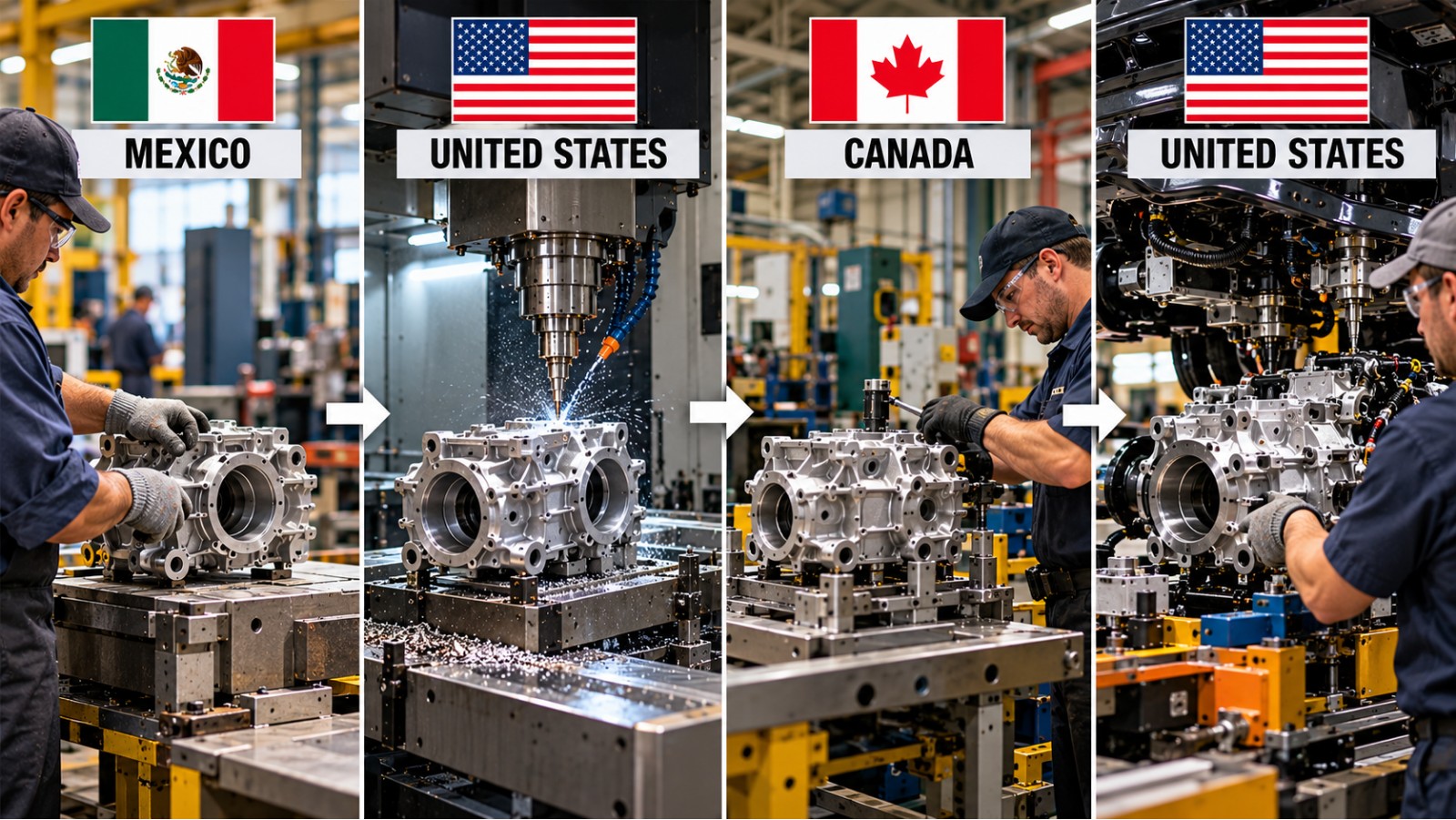 The casting crosses a border
Illustration of the cross-border route Jarrell described, not a photograph of Linamar’s actual part.
Jim Jarrell told NPR about that route in September. He is chief executive of auto-parts maker Linamar: “That is actually how the industry works.” Source 9
Now imagine a new tax at one of those crossings. The importer may have to pay before the shipment is released. The part still has to reach the assembly line. Someone has to find the money.
Maybe the supplier cuts its price. Maybe the importer accepts a smaller profit. Maybe the factory passes the increase along, and the next car costs more even though it was assembled in the United States.
That is the argument over tariffs, stripped of the speeches. Who gets the invoice, who ends up carrying it, and what changes because of it?
The evidence does not support selling broad tariffs as a bill paid mainly by other countries. A tariff can help a protected producer, raise government revenue, or put pressure on a trading partner. But the American businesses and households paying higher costs belong in the account, too.
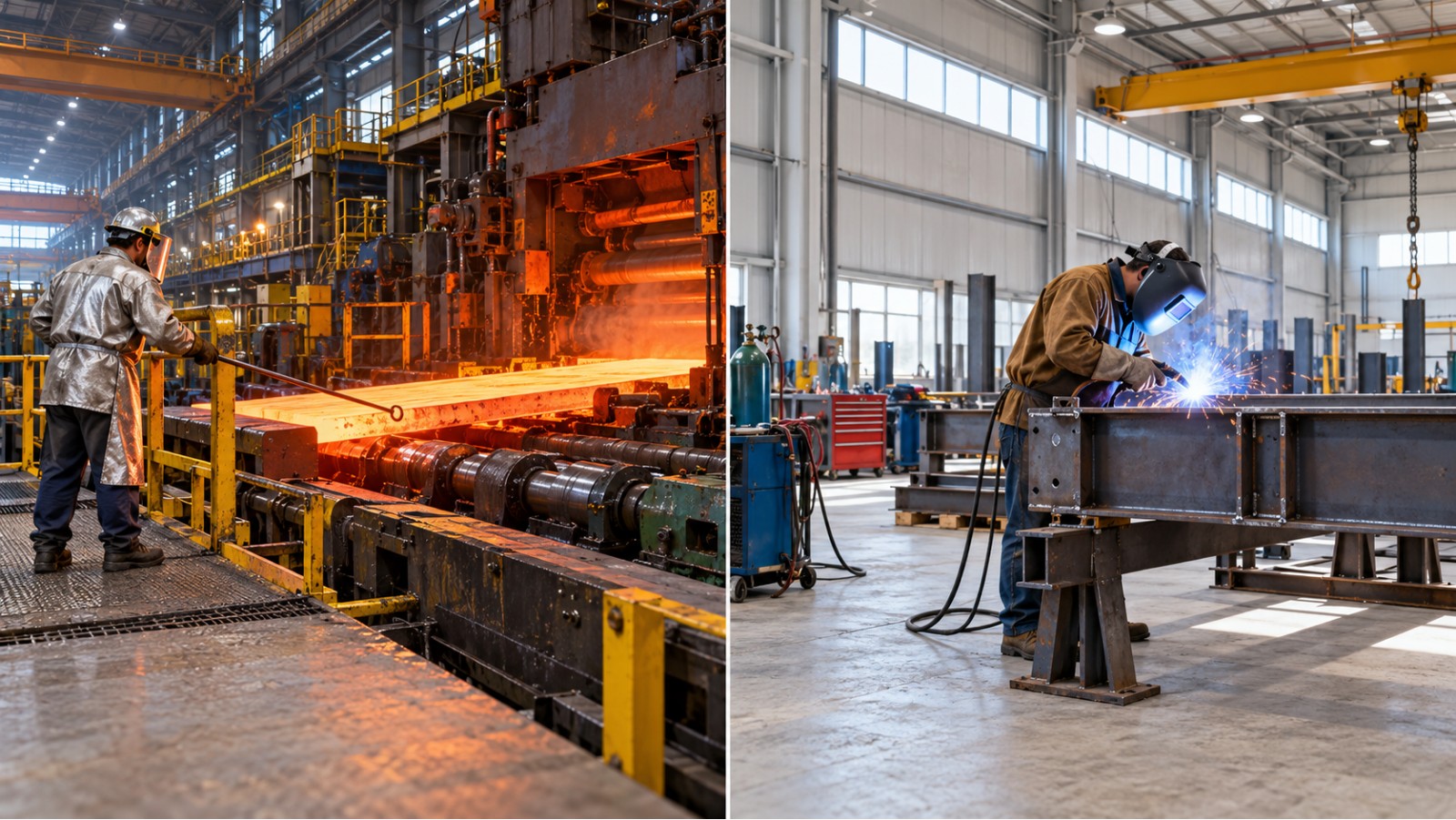 A gain and a bill
Illustrative steel producer and steel buyer: protection can benefit one while raising the other’s costs.
Follow the first payment
A tariff is a tax on goods brought into a country. In the United States, the importer of record—the party legally responsible for the import—is generally responsible for paying the duty to Customs and Border Protection. The Chinese, Canadian, or Mexican government does not mail Customs a check. Source 1
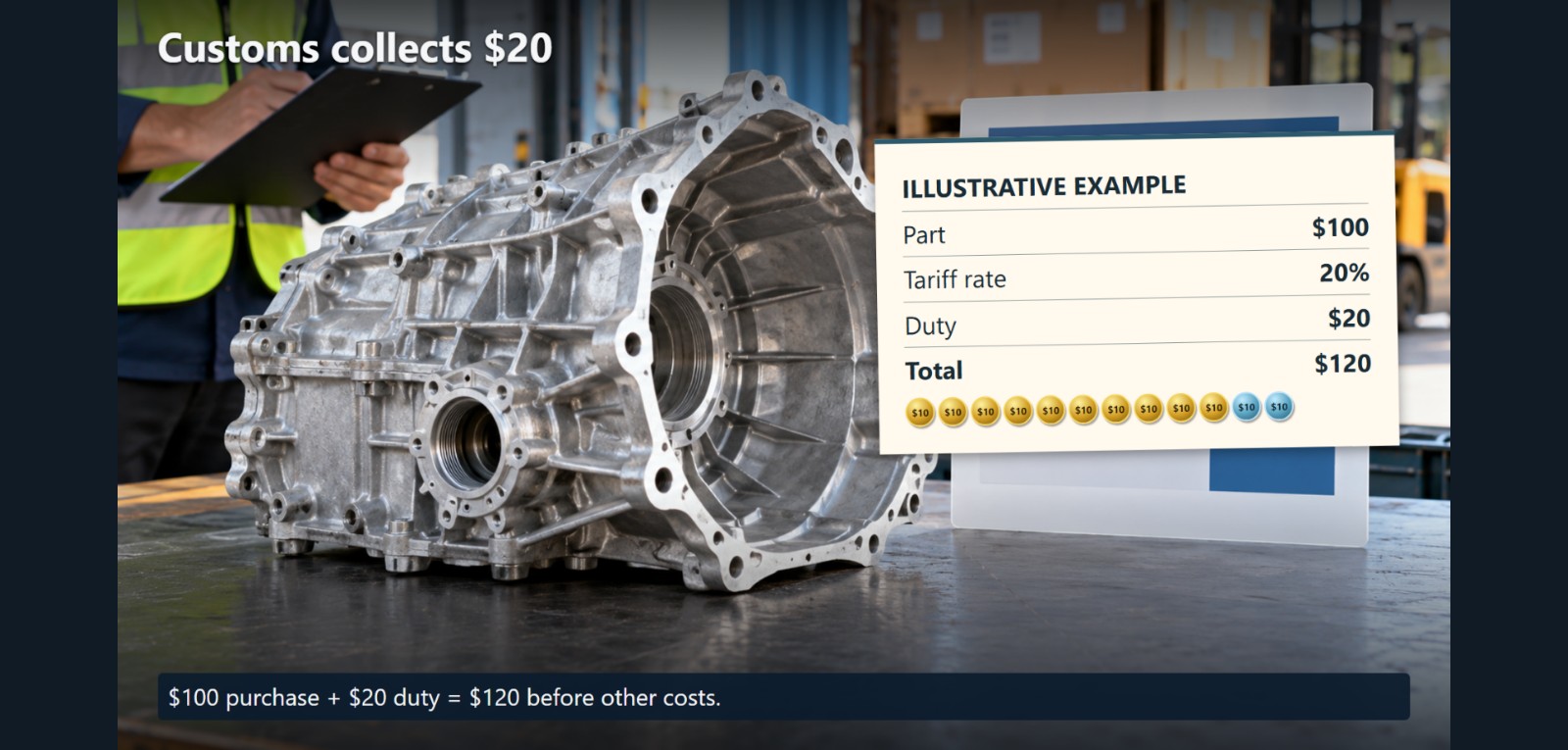 The $100 part
Illustrative arithmetic: $100 plus a $20 duty makes $120 before other costs.
Suppose you run a U.S. company. You buy a $100 imported part, and it carries a 20% tariff. On that simplified bill, Customs collects $20 from you.
What happens next determines who really pays. Can you charge your customer more? Will your supplier lower its price to keep your business? Can you afford to earn less on the sale?
Two confident statements can both mislead. “Foreign countries pay our tariffs” confuses the customs invoice with the ultimate cost. “Every tariff dollar is paid by shoppers” leaves out lower supplier prices and smaller business margins.
The New York Fed examined the 2025 tariffs and estimated that nearly 90 percent of the measured burden fell on U.S. firms and consumers. Source 2
And the price tag can lag behind the payment. Federal Reserve research found that retail prices adjusted gradually: a shop can be selling inventory bought months before a newly taxed shipment arrives. The tariff has been collected even if the shopper hasn't felt it yet. Source 3
That explains the imported part. What about the product marked “Made in America”?
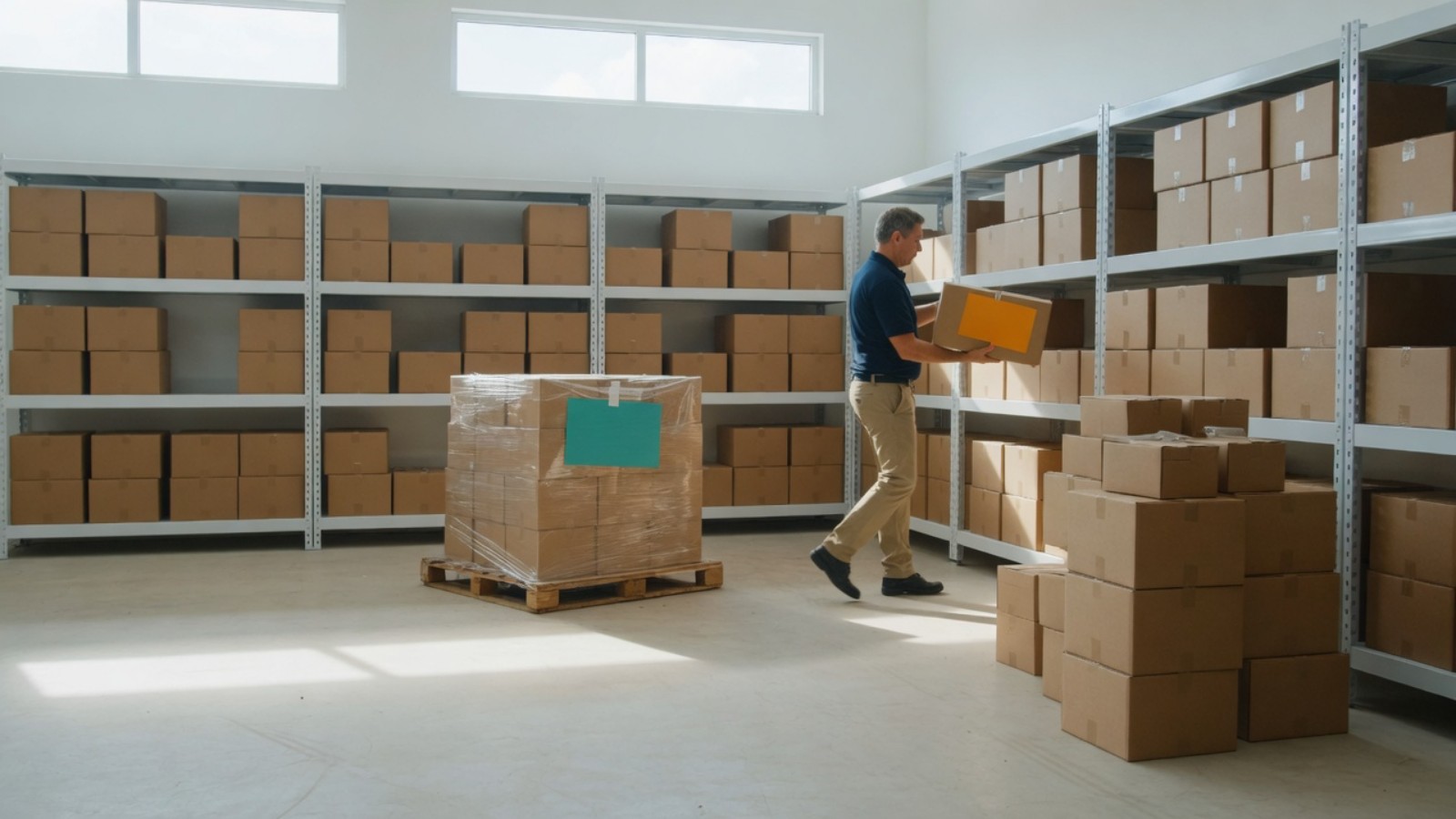 Old stock, new cost
Older stock can delay when a higher import cost reaches the shelf. Representative store image.
Two American factories can want opposite things
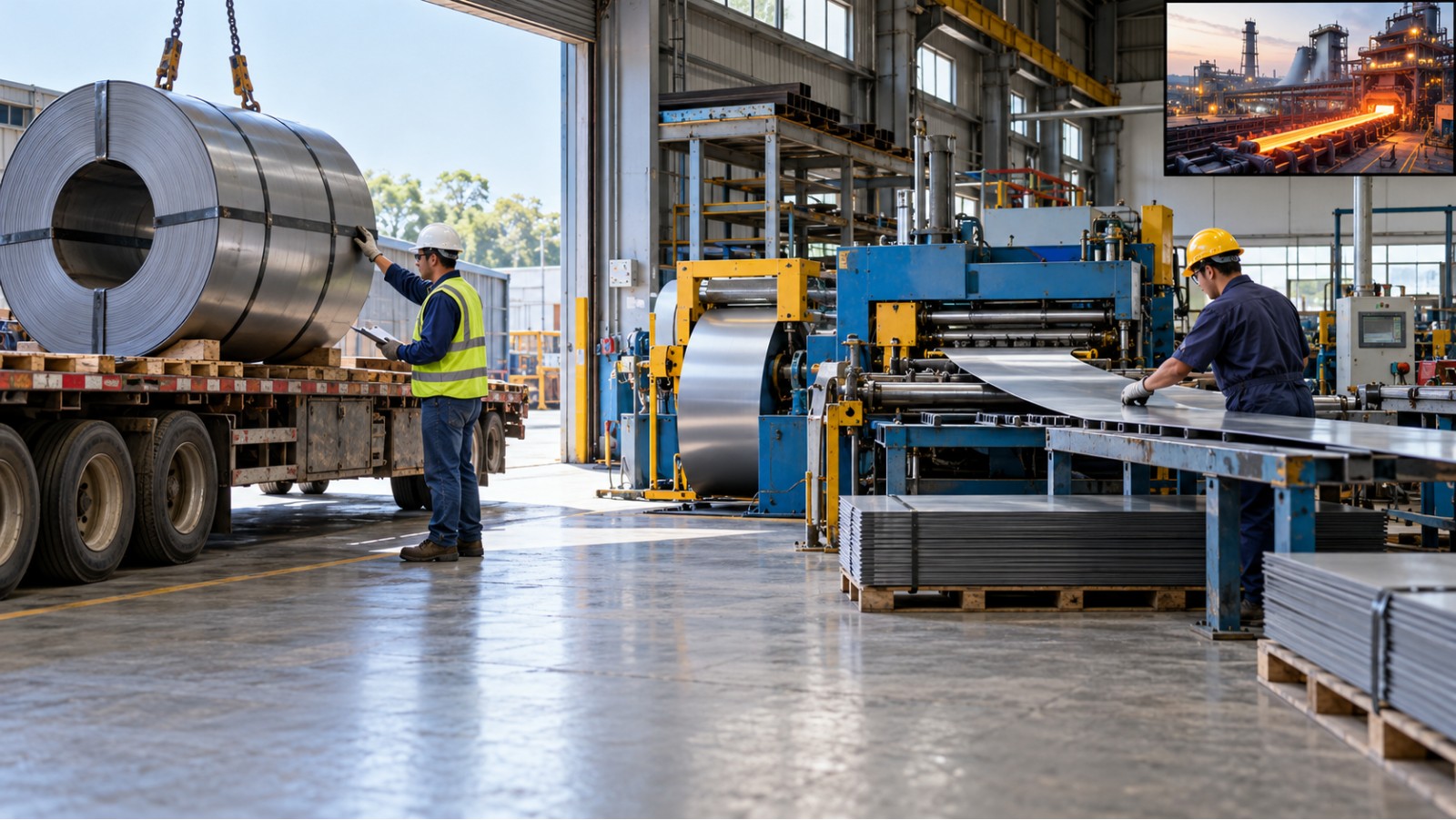
An American steelmaker may welcome protection from imported steel. An American factory that buys steel may face a higher bill. Both employ American workers. Helping one does not automatically help the other.
 Steelmaker and steel buyer
Two positions in the production chain: selling steel and buying steel. Representative factories.
Imported parts and materials create another route into an American-made product's price. A domestic manufacturer can owe more for its inputs even when the finished product never arrives on an import ship. Domestic alternatives can become more expensive, too: changing import prices changes the competition they face. Source 4
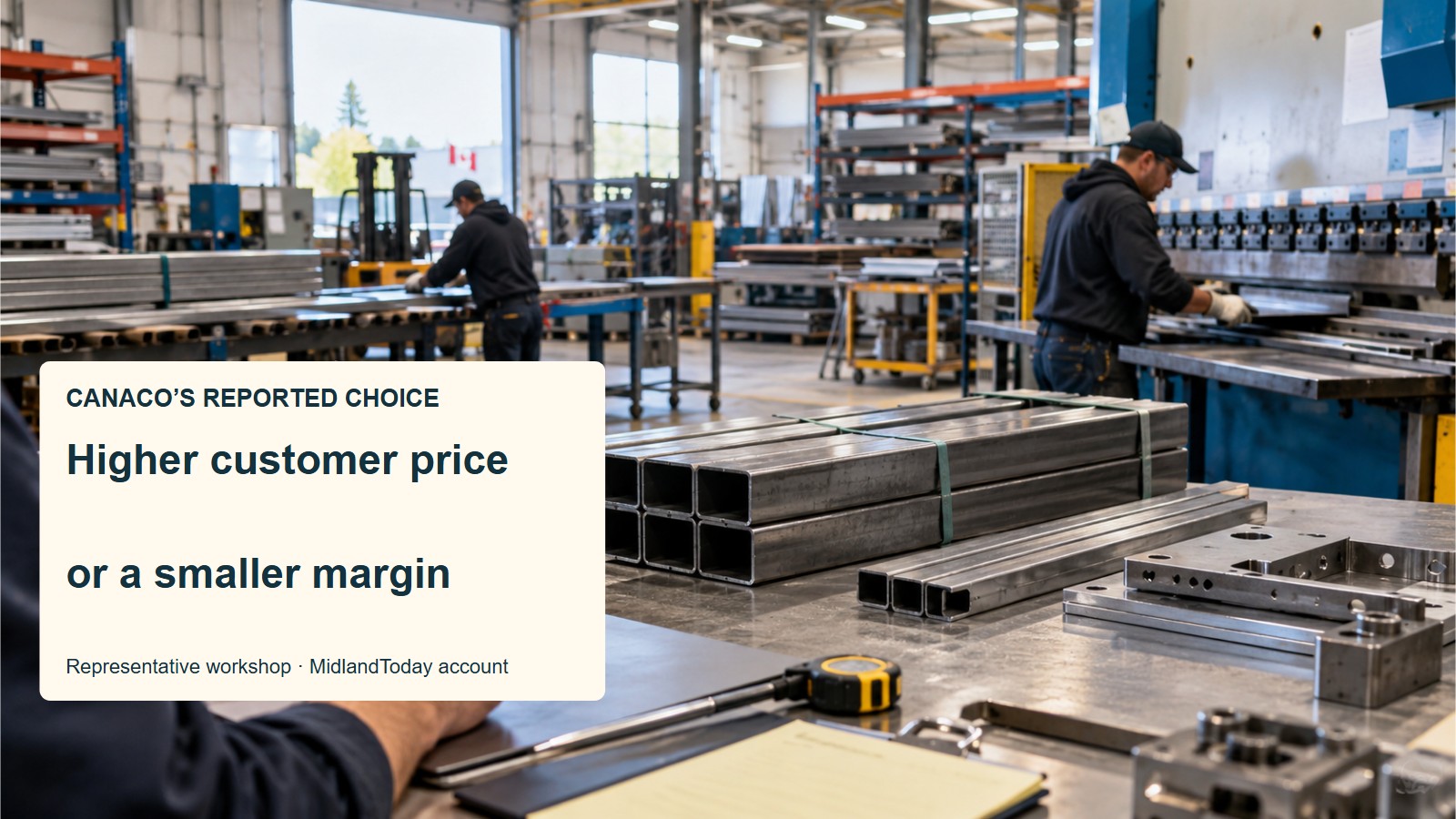
The same input-cost problem reaches manufacturers on the Canadian side of the border. MidlandToday’s account of an October roundtable in Aurora, Ontario, puts Kurt Wenzel of Canaco Industries in a difficult position: he said aluminum, steel, and other inputs had become more expensive. With input costs rising and the trade war unresolved, the business could charge more or earn less on the work.
Hugh Caines said tariffs had halted plans to expand and hire. He is chief executive of CleanRiver Recycling Solutions. “You can’t pivot overnight. It takes a while,” he said. Source 12
A higher customer price. A smaller margin. An expansion put off. The American steel buyer faces the same basic question about protection: does it help the business you work for, or raise the cost of what that business needs?
 Canaco’s choice
Representative workshop with editorial labels explaining Canaco’s reported price-or-margin choice.
A lost customer doesn't wait for the argument to end
The other side of the border has customers to lose, too. When another country retaliates, an American exporter can become the expensive supplier.
 The buyer finds someone else
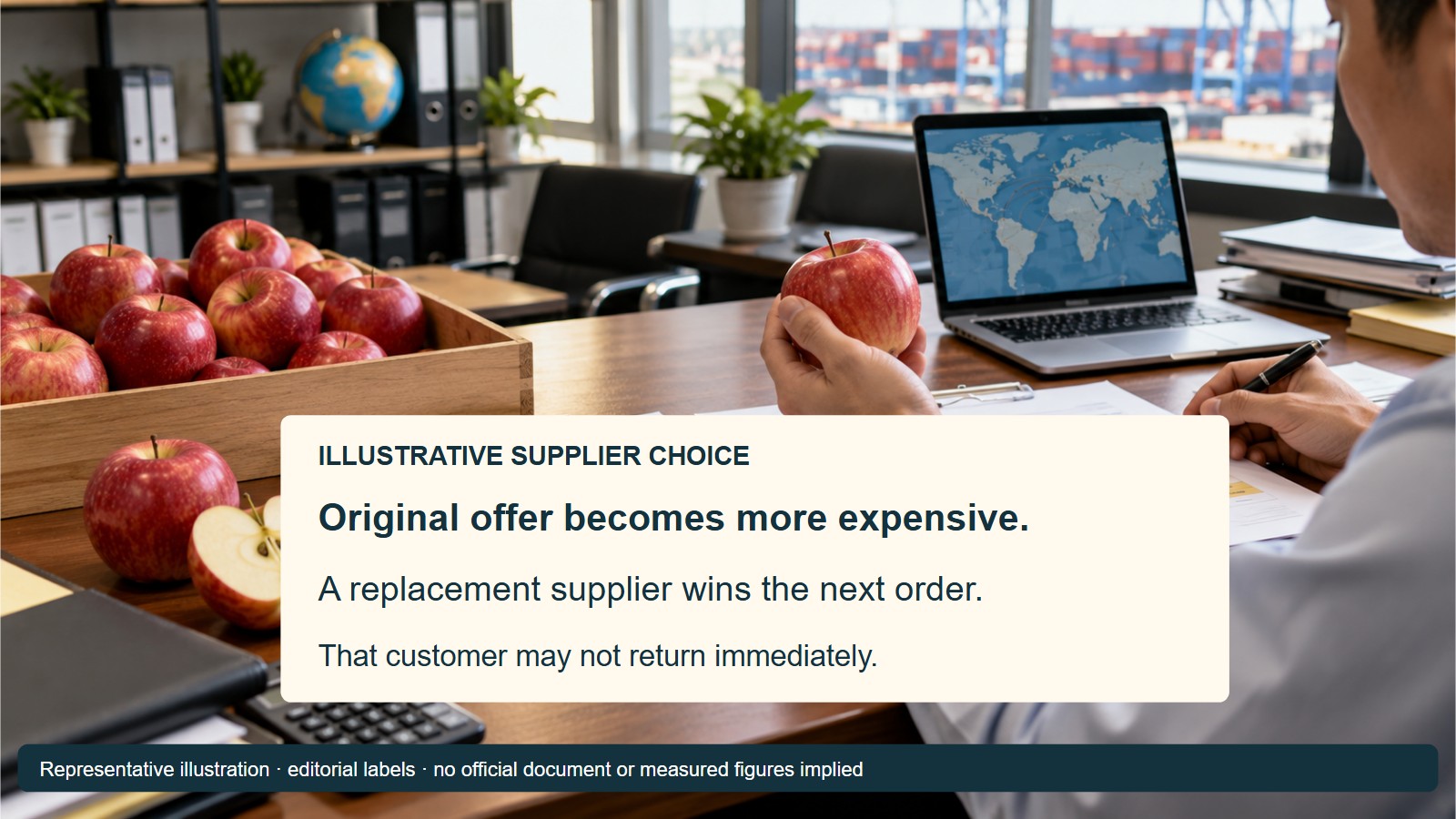
Illustrative supplier choice: a lost customer may keep buying elsewhere after a tariff ends.
For a farmer selling abroad or a manufacturer supplying a foreign factory, that can mean cutting prices, finding another buyer, or shrinking production. Even if the tariff later disappears, a customer who has qualified a replacement supplier may not return immediately.
Canadian steelmakers have been looking for those replacement customers. Reuters reported October 16 that shipments to the United States had fallen sharply after higher U.S. duties. Some workers lost jobs. Companies began shifting sales toward Canadian mining, energy, and infrastructure projects.
David Fritz told Reuters he felt optimistic about Canada’s fabricated-steel market. He works at Alberta-based Supreme Steel and was looking at the projects still to be built at home: “there are enough projects in pipeline to support this industry.” More Canadian companies were competing for domestic business, he said, leaving less room for steelmakers from outside.
Other producers were making the turn as well: Tenaris Canada was investing in capacity for Canadian customers, while Algoma’s chief executive said its shift toward Canadian steel-plate buyers was working despite the hardship. Government loans and purchasing policies helped shape the outcome. Source 10
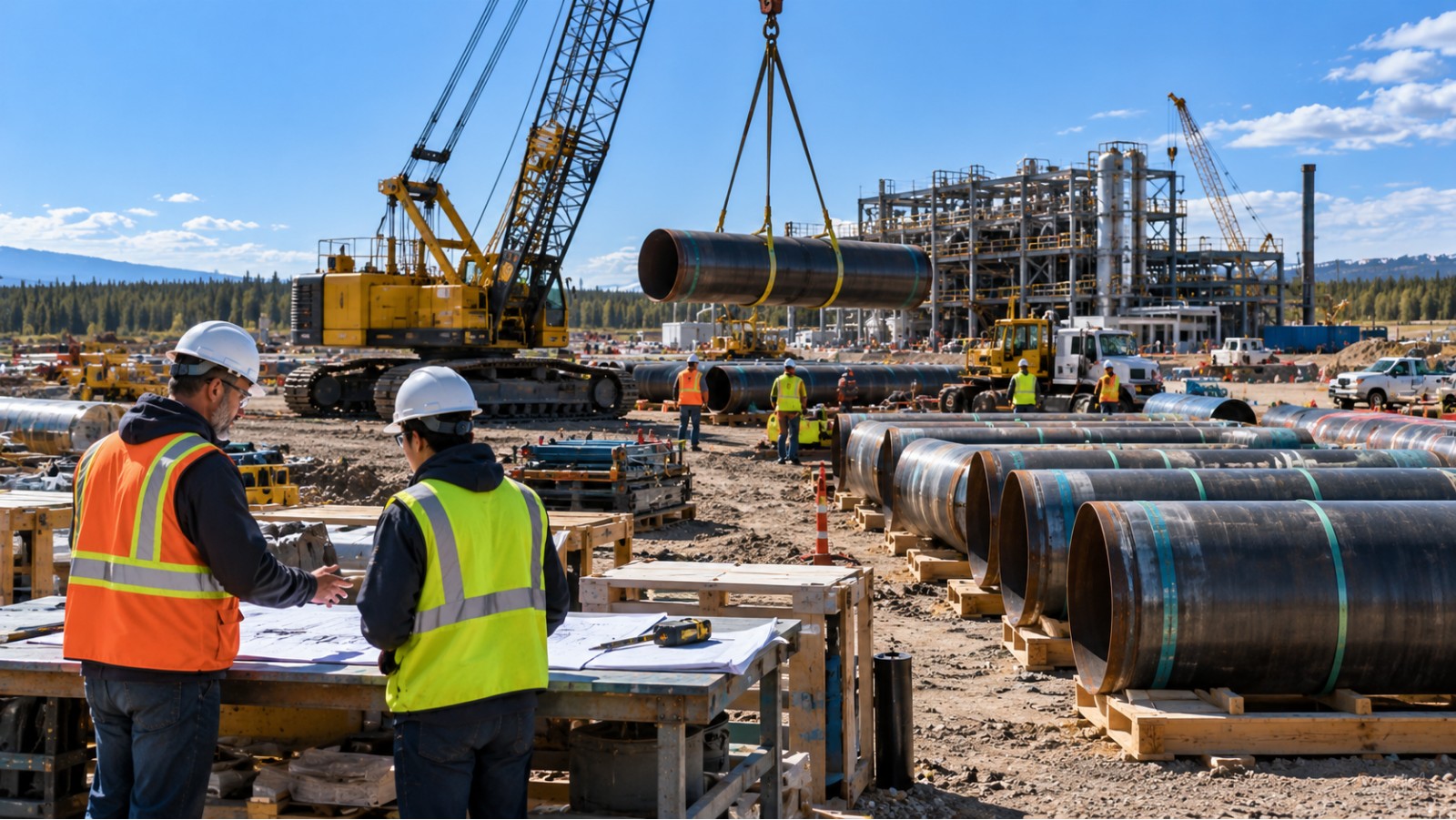
Fritz could see work ahead. Whether new sales restore the lost jobs and contracts is a separate measure of recovery.
That search for customers at home matters to American buyers, too. A supplier rebuilding its business around customers at home may offer different prices, products, or availability across the border. Trade relationships can change while politicians are still arguing over who won.
 Sales are not the whole recovery
Representative production image. New sales and restored jobs must be checked separately.
Moving a factory takes longer than announcing a tariff
Return to Jarrell's casting: Mexico, the United States, Canada, and back to the United States. Each stop does a different job. Taking a border out of that journey means finding another way to do the work.
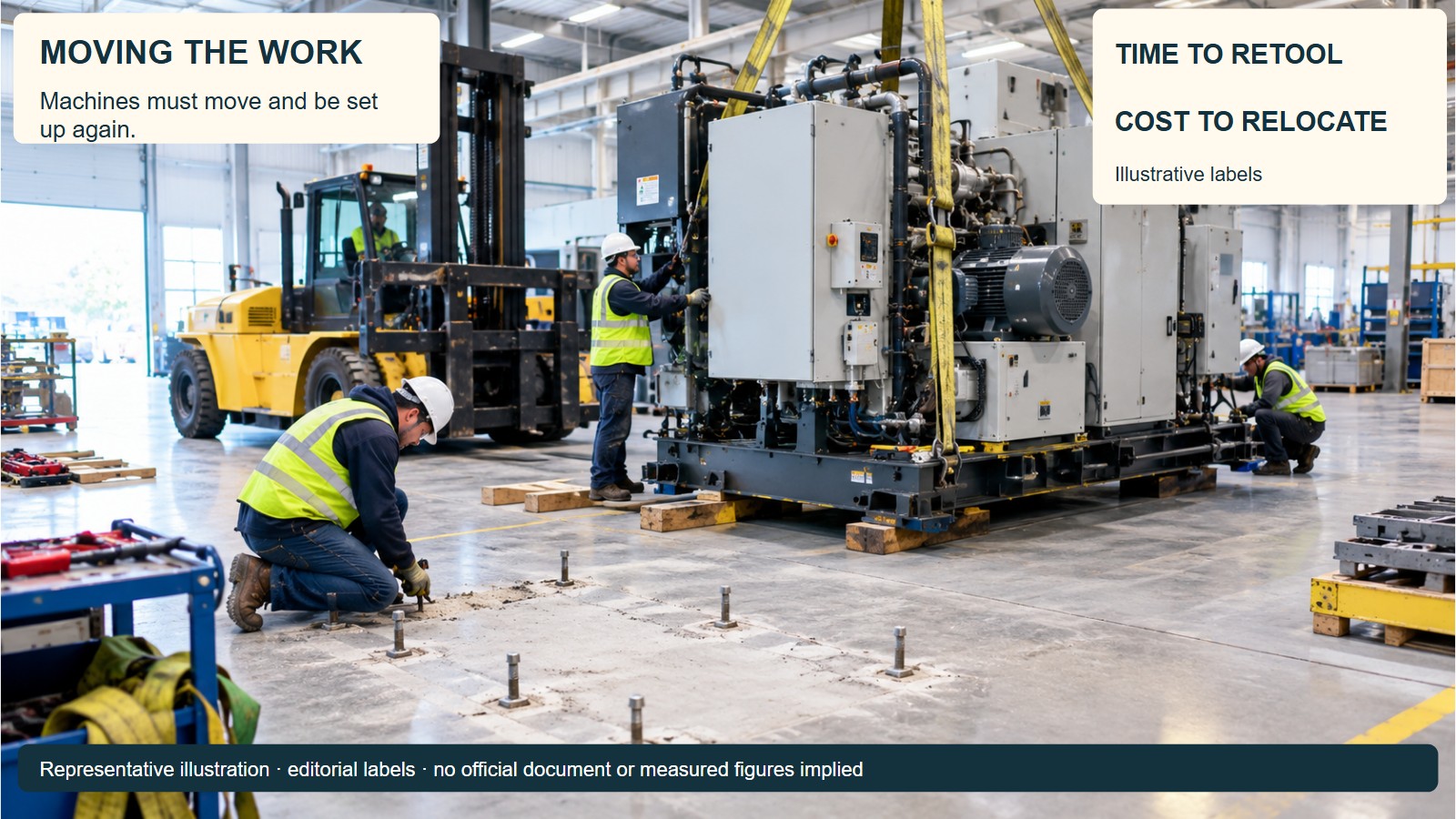 Plants do different work
Illustrative workstations and labels: moving production requires equipment, time, and setup.
Jarrell told NPR that Linamar’s plants in the three countries make different things. Moving the work means rethinking the network, not simply sending the truck to another address. He expected the change to take years and a great deal of money.
Chuck Sanders said the company has long treated the region as one production area. He is an executive in Aisin's North American division. Sudden tariff changes, he said, “kind of creates chaos on the business.” Moving production can mean moving jobs—the outcome Sanders said the company wanted to avoid for its workers. Source 9
Businesses can react to a threatened tariff before it collects a dollar. An importer may rush a shipment ahead of the deadline. A manufacturer may investigate another supplier, an assembly location, or an exemption. Stocking up can fill warehouses and make ports busier. None of that requires the new factory promised in a speech to be ready.
A supply chain isn't a line on a map. It's contracts, machines, skilled people, ports, roads, and customers. Caines's warning—“You can’t pivot overnight”—gets at the gap between changing the rule and changing the business.
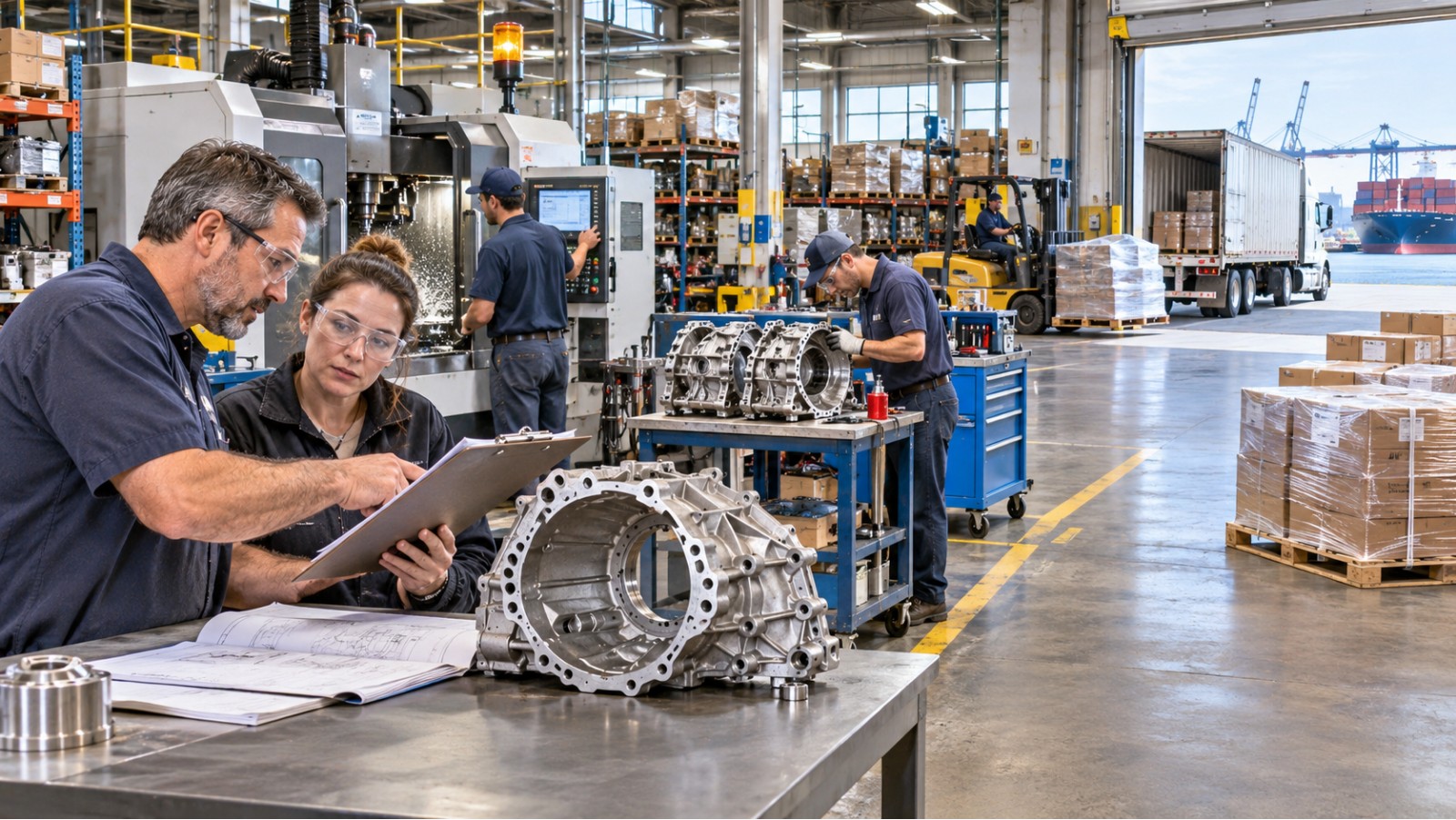 Rebuilding takes work
Representative factory work. A new rule does not instantly replace equipment and skills.
Sometimes the missing American substitute is coffee
The tariff argument can come down to an ingredient as ordinary as instant coffee. Before a business can switch to an American supplier, it has to find one that can supply what it needs.
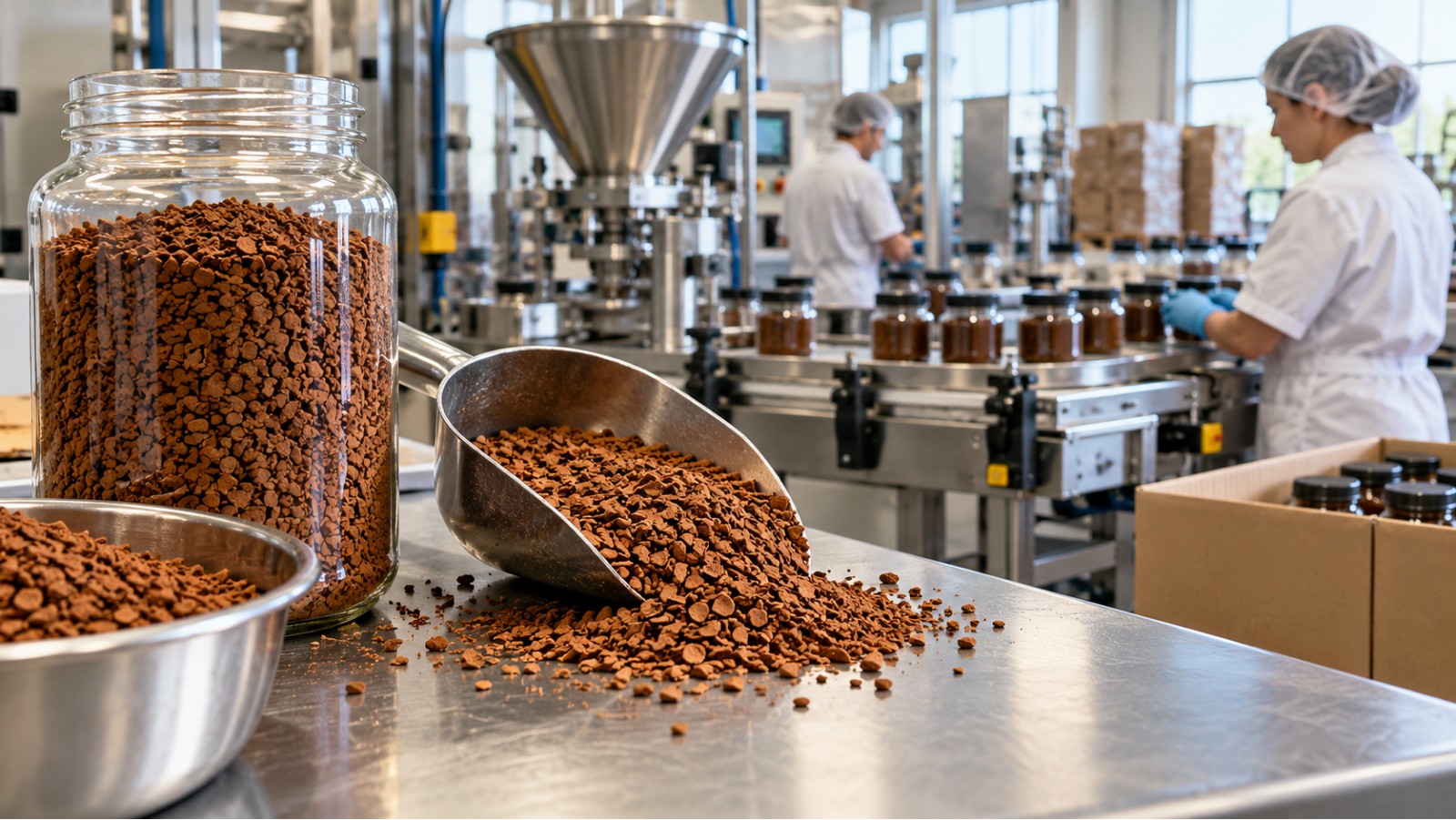 Coffee is an input
Coffee as a business input: the ingredient is needed before the finished product can be sold.
A July government notice recorded businesses’ warnings that some instant coffee, fertilizer, and pesticide inputs lacked adequate untariffed substitutes. That Federal Register notice exempted unflavored instant coffee and certain fertilizer and pesticide inputs from those new duties. Source 11
That exception changes the buyer's bill. It also changes the protection a competing producer receives. Building new capacity might eventually offer another choice; it doesn't supply today's missing ingredient. That is the detail a headline tariff rate leaves out.
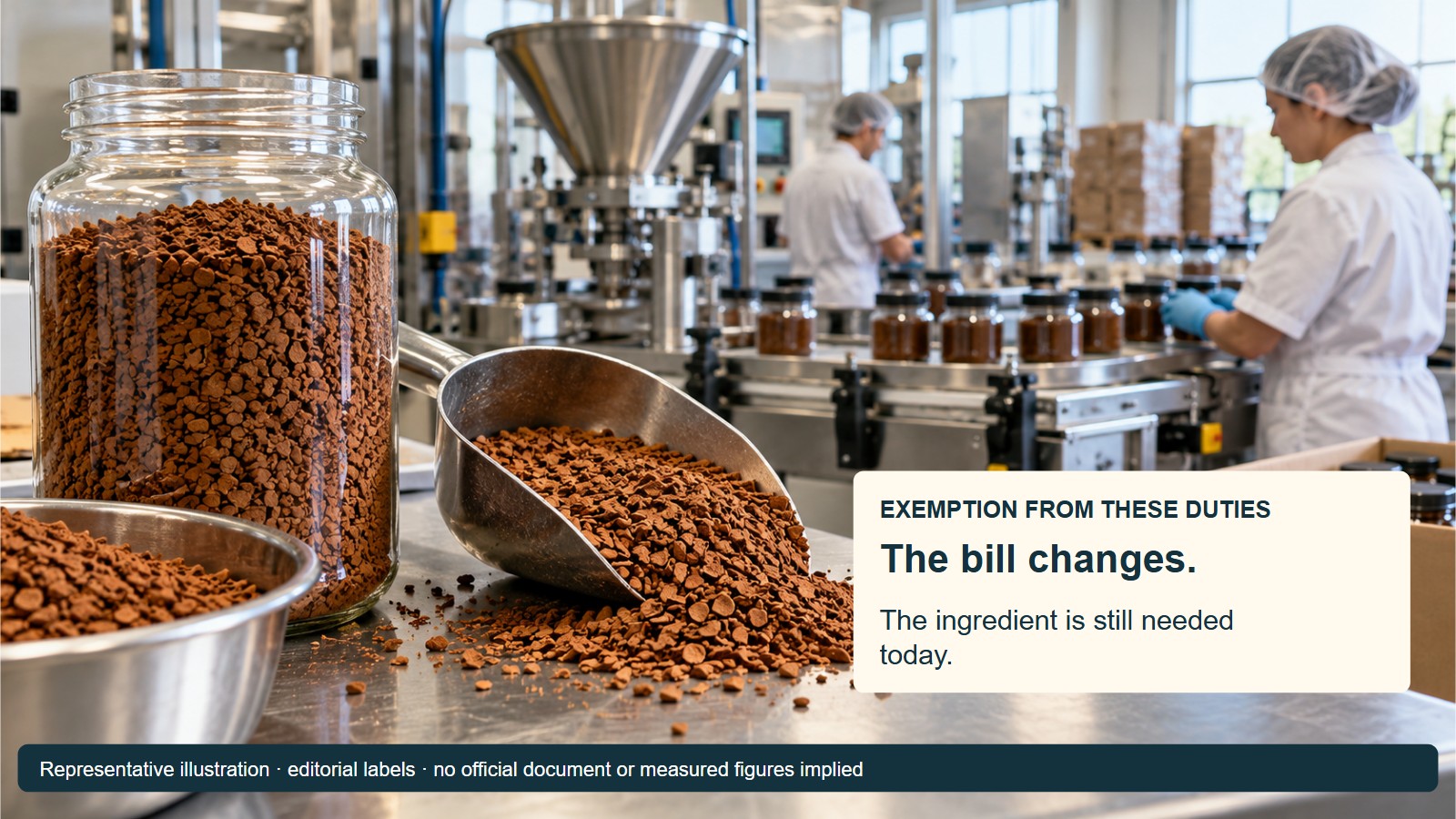 An exemption changes the bill
Illustrative exemption explanation, not a universal statement about all coffee duties.
The money is real. Is the promised gain?
Customs collects the checks. Collecting revenue does not, by itself, authorize a school, a bridge, or a tax cut. Spending needs authority from Congress through laws called appropriations; that authority may already exist. Tax cuts need authority under tax law. A politician claiming tariff receipts paid for a particular program still needs an accounting trail.
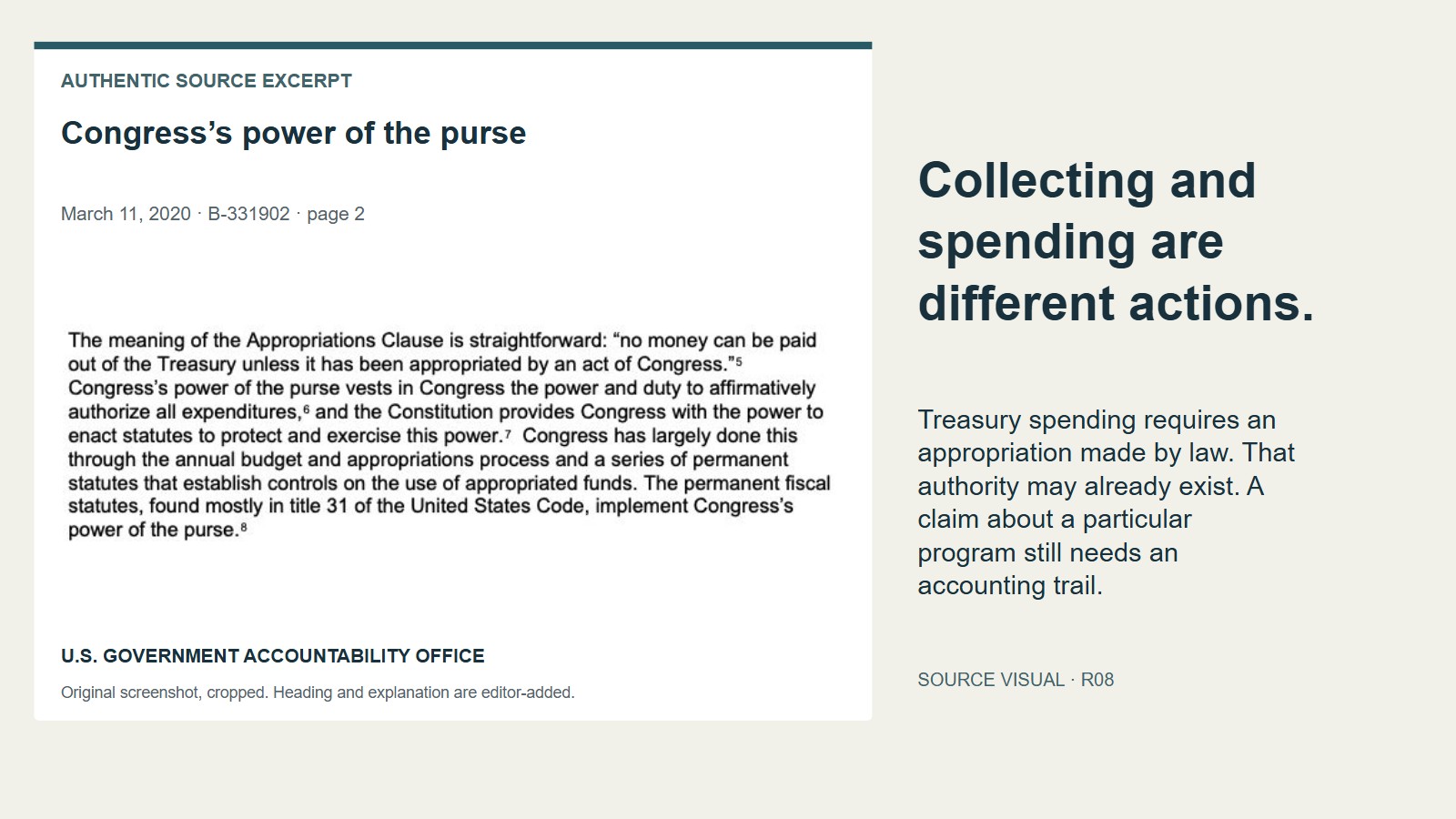 Collecting and spending differ
Authentic GAO excerpt, B-331902, March11,2020, page2. Heading and explanation added separately.
Even checks already collected can be disputed. In February 2026, the Supreme Court ruled that IEEPA—the International Emergency Economic Powers Act—did not authorize the challenged tariffs. That left a fight over the duties already collected and whether they would have to be returned. The administration used other laws, including Section 301 of the Trade Act of 1974, which targets specified foreign trade practices. By July it had announced action covering trading partners representing most U.S. imports, with product exemptions. Source 5 Source 6 Source 7
Winning the legal argument still wouldn't prove the economic promise. A tariff sold as protection should show what happened to production. One sold as negotiating pressure should show the concession it won. Revenue needs to be measured after refunds. Each result has to be weighed against the American costs already following that casting through the factories.
The trade deficit cannot settle that argument by itself. Imports may rise because Americans buy more, factories need parts, or companies stock up before a deadline. Exports also respond to currency moves, harvests, and demand abroad. A narrower deficit doesn't automatically mean a richer country, any more than a wider one automatically means a poorer country.
The protected producer's gains count alongside its customers' bills, lost export sales, and the cost of rearranging production. Jobs and prices also respond to forces besides tariffs. Claiming credit for every gain—or blaming the tariff for every loss—makes the result look simpler than it is.
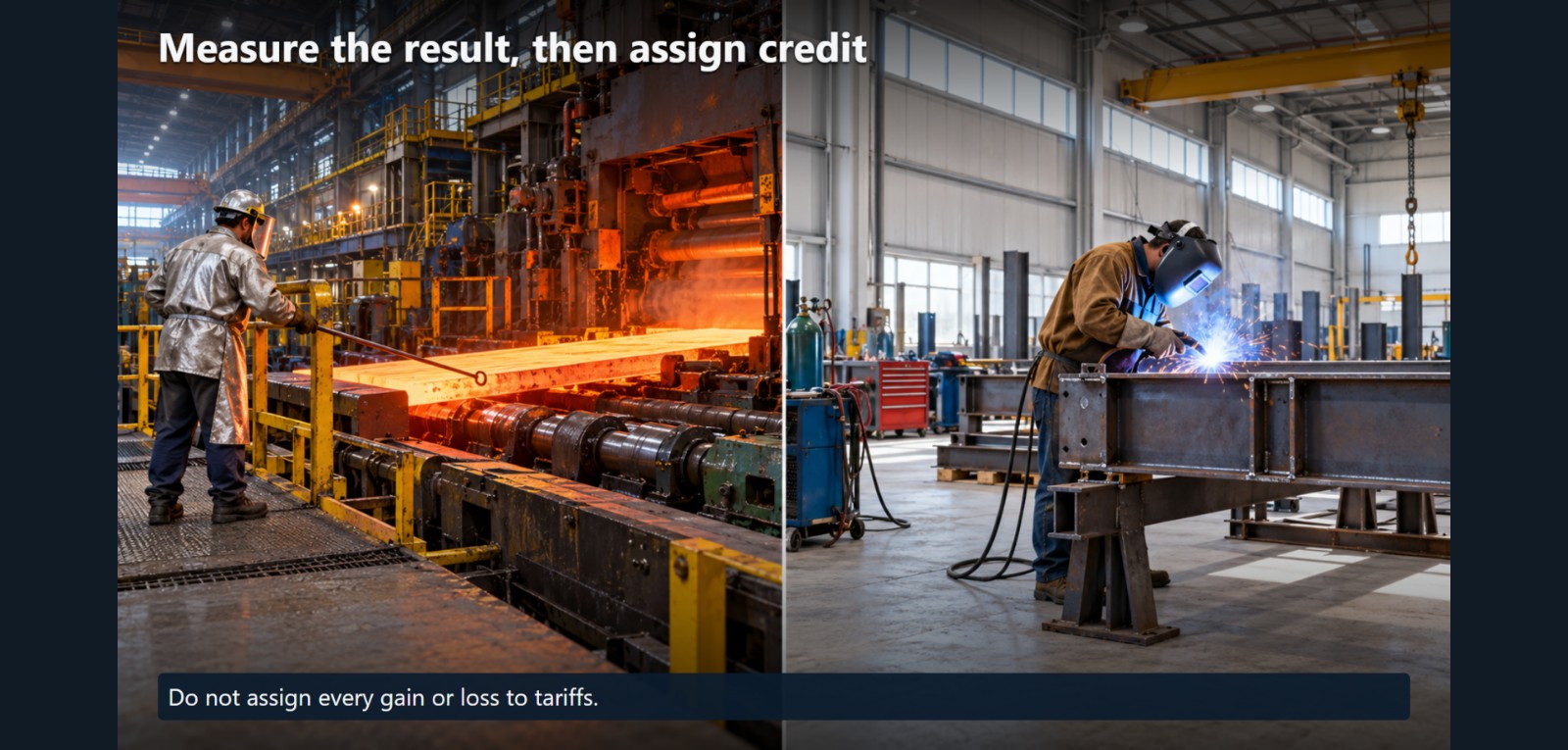 Count gains and costs
Final film diagram: measure the result before assigning every gain or loss to tariffs.
Back to the casting
Customs can tell you who wrote the first check. Following the part tells you why the cost doesn't necessarily stay there.
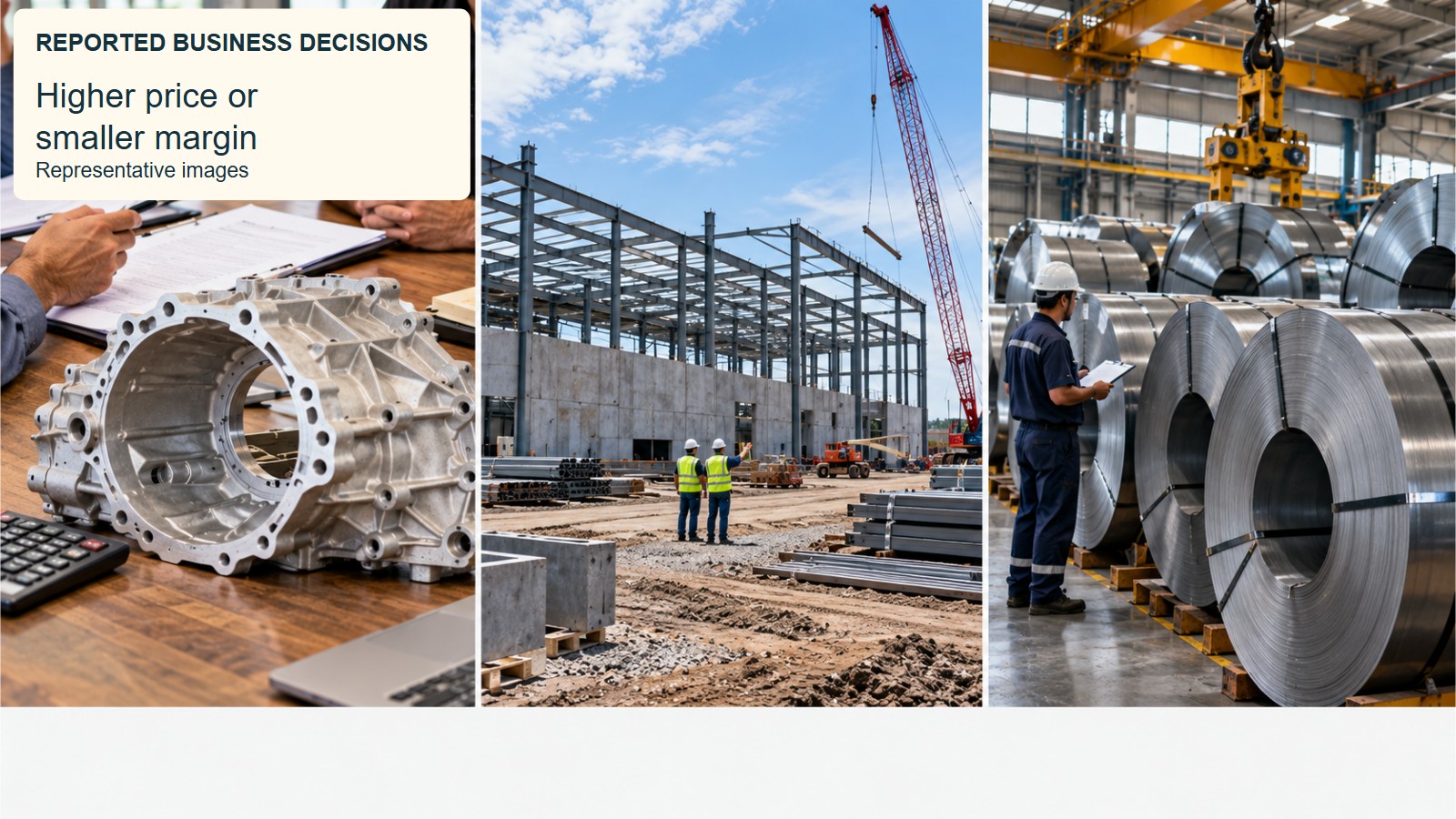 Three business decisions
Representative images of the reported decisions; generated people do not identify the named sources.
A factory may need that casting to keep its assembly line moving. The supplier wants to keep the order. The buyer has a price it can afford. Across the production network are people deciding whether to raise a price, earn less, find another customer, or postpone hiring.
In Wenzel’s account, Canaco faced a higher price or a smaller margin. At CleanRiver, expansion stopped. The steelmakers had to find other customers. None of those decisions fits inside “foreign countries pay” or “every tariff destroys jobs.”
Tariffs can protect particular businesses. They can bring in revenue and create pressure. The evidence still does not support treating them as a bill paid mainly by somebody abroad. The American costs have to be counted, along with the gains.
Jarrell's casting still has work to do at each stop before it becomes part of a finished product. A new charge at the border doesn't do that work. It gives the businesses depending on the part another bill to divide.
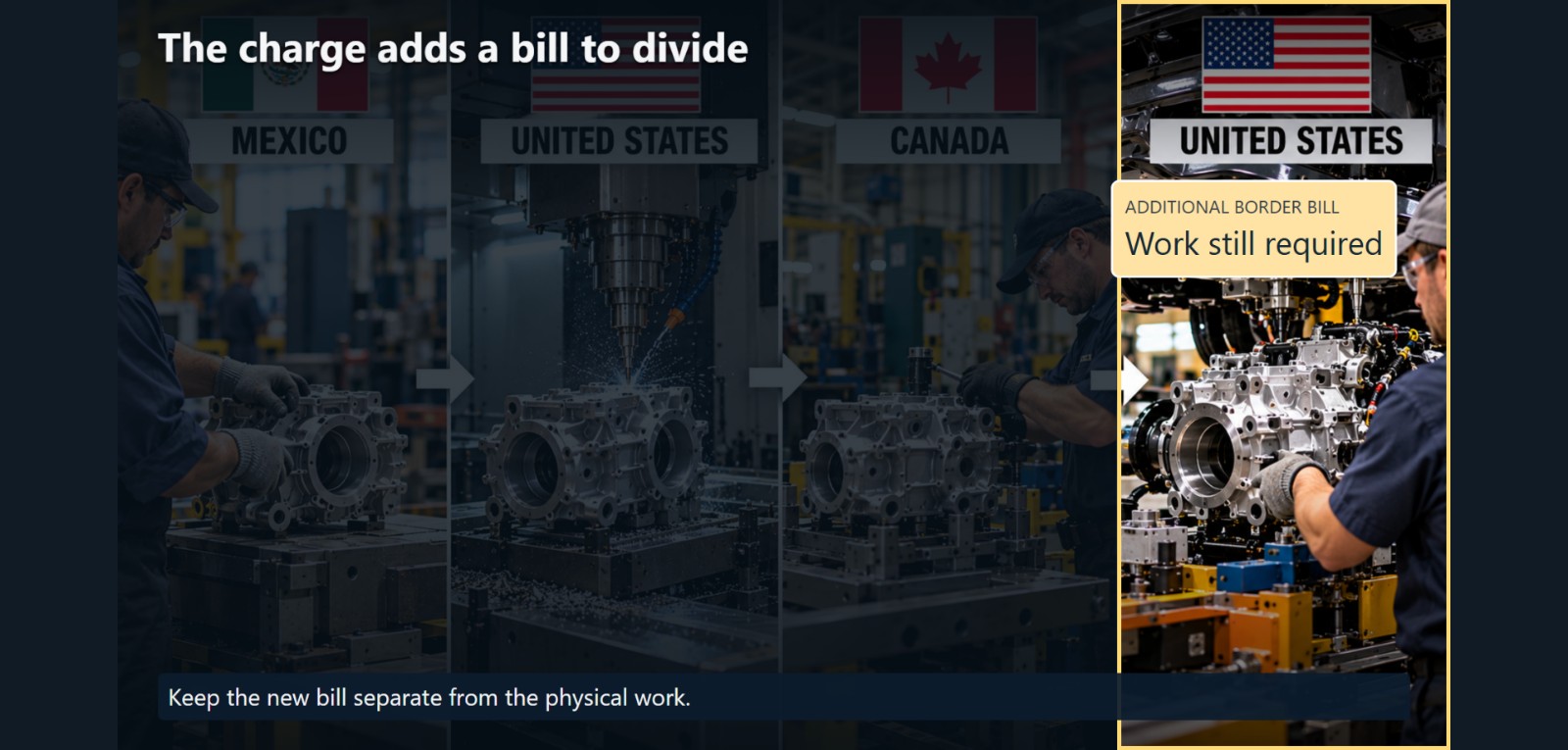 The part still needs its work
Final film diagram: changing who pays the bill does not perform the work on the part.
Listen to the teaching sideTap any word to play from there. The words follow the recording.
Teach me from scratch: America's Tariff War
A step-by-step lesson with illustrations. October 19, 2026.
Some facts appear on both sides. This side uses new explanations, worked examples, and the film’s pictures to teach how the parts fit together. The examples use simple numbers to show how a decision works; they are not measurements of a real business.
America's Tariff War: The Bill Doesn't Stop at the Border
The casting crosses a border
Illustration of the cross-border route Jarrell described, not a photograph of Linamar’s actual part.
A tariff is a tax on goods entering a country. Goods are things businesses sell, such as toys, coffee, steel, or cars. Buying goods from another country is called importing.
A car has many parts. Different factories can do different jobs on the same part before anyone puts it in a car.
Jim Jarrell leads Linamar, a company that makes car parts. He told NPR about a metal part that begins in Mexico. People work on it in the United States, then in Canada, then in the United States again. The part is still being made during that trip. Source 9
A new border tax can add a bill along the way. The business still needs the part. It must decide how to handle that extra cost.
That is why a tariff can help one business and hurt another. A company competing with imports might welcome it. A factory buying the taxed part might struggle with it. We need to follow both effects.
Read the picture: Trace the four country labels in the picture from left to right. The repeated United States label means the part comes back for more work. It does not mean the same job happens twice. The picture illustrates Jarrell's route; it is not a photograph of his actual part. The second picture contrasts a gain with a bill, showing why the same policy can affect businesses differently.
The key thing to remember: Paying the tax at the border begins the story; it does not tell us where all the cost ends up.
A gain and a bill
Illustrative steel producer and steel buyer: protection can benefit one while raising the other’s costs.
Follow the first payment
The $100 part
Illustrative arithmetic: $100 plus a $20 duty makes $120 before other costs.
The United States has an agency called Customs and Border Protection. Among its jobs is collecting taxes on imports.
The importer of record is the person or business legally responsible for an import. That importer generally owes the tariff. A foreign country's government does not automatically pay it. Source 1
Follow the money after that:
- The importer pays Customs.
- The importer tries to recover the money through its business.
- A higher selling price can move some cost to customers.
- A discount from the foreign supplier can move some cost back to that supplier.
- Whatever the importer cannot recover reduces what it earns.
The New York Fed, part of America's central banking system, studied the 2025 tariffs. It estimated that U.S. businesses and shoppers carried nearly 90 percent of the cost it measured. That is a finding about those tariffs during that period. Source 2
Shop prices may change later than the tax payment. A shop may still have older goods bought before the tariff. Once it replaces them with more expensive goods, customers may notice the increase. Federal Reserve research found that retail prices rose gradually in this way. Source 3
Read the picture: The diagram uses a $100 part and a 20 percent tariff. That adds a $20 duty, making $120 before other costs. These are illustrative numbers, not the rate on every car part. The part and its border bill belong to different steps. First ask what the importer must hand over. Then ask whether the seller, business, or shopper accepts less money afterward. A shelf of older stock explains why the shop's price may change later.
The key thing to remember: The importer owes the first payment, but prices and business profits determine how the cost spreads.
Old stock, new cost
Older stock can delay when a higher import cost reaches the shelf. Representative store image.
Two American factories can want opposite things
Steelmaker and steel buyer
Two positions in the production chain: selling steel and buying steel. Representative factories.
A factory's inputs are the things it needs to make its product. Steel can be an input for a machine. A part shipped from Canada can be an input for an American car.
A label saying a finished product was made in America does not mean every input came from America. A tariff on an imported input can raise the cost of making that product here.
Even competing goods made at home can become more expensive. Think back to the board maker in the example above. When imported boards cost more, a local seller may be able to charge more and still win the sale. There is less pressure to keep the price down. The New York Fed has examined how changing import prices reaches American-made goods. Source 4
Canadian manufacturers face input problems, too. At a meeting in Aurora, Ontario, Kurt Wenzel of Canaco Industries talked about rising metal and other costs. His business could charge customers more or accept a smaller margin. A margin is the money left from a sale after the costs of doing the work. He discussed uncertainty and rising prices for raw materials such as metal. That does not mean he blamed tariffs for every increase.
Hugh Caines leads CleanRiver Recycling Solutions. He told MidlandToday that tariffs had stopped plans to grow and hire. He said changing direction takes time. These accounts came from Canada, not from American factories. Source 12
The American steel buyer faces a related problem: protection for the steel producer can add to the buyer's costs. Where you work in the chain matters.
Read the picture: Compare the steel producer with the factory using steel. The producer sells a material; the other business must buy it before it can make anything. The picture is an illustration of those roles, not a photograph identifying Wenzel or Caines. The Canaco picture shows the next choice: charge the customer more or keep less from the sale.
The key thing to remember: A policy helping the maker of a material can make life harder for a business that needs to buy it.
Canaco’s choice
Representative workshop with editorial labels explaining Canaco’s reported price-or-margin choice.
A lost customer doesn't wait for the argument to end
The buyer finds someone else
Illustrative supplier choice: a lost customer may keep buying elsewhere after a tariff ends.
An export is something sold to a buyer in another country. One country's import is another country's export.
Retaliation means responding to another country's trade action with an action of your own. If another government taxes American goods, American exporters can lose sales.
Canadian steel companies have faced the problem from the other direction. Reuters reported on October 16 that their U.S. shipments had dropped sharply after higher American duties. Some workers lost jobs. Companies sought Canadian customers in mining, energy, and building projects. Source 10
David Fritz works at Supreme Steel in Alberta. He told Reuters he was hopeful about Canadian construction work. More Canadian firms were seeking orders at home, leaving less space for suppliers from elsewhere.
Tenaris Canada was investing to serve Canadian buyers. Algoma was shifting toward steel plate for customers closer to home. Government loans and buying policies also affected the outcome. The tariff was not the only force at work.
A business can find a new market without restoring every old job or contract. We have to check those outcomes separately. American buyers also need to consider what happens when their Canadian suppliers build stronger ties to customers at home.
Read the picture: A customer choosing another supplier can change more than one delivery. Once the customer has tried and accepted the new supplier, winning that customer back takes work. A picture of busy production cannot tell us whether the old workers got their jobs back.
The key thing to remember: Losing a customer can change a business long after the tax that started the problem.
Sales are not the whole recovery
Representative production image. New sales and restored jobs must be checked separately.
Moving a factory takes longer than announcing a tariff
Plants do different work
Illustrative workstations and labels: moving production requires equipment, time, and setup.
A supply chain is the connected work needed to make and deliver something. It includes materials, parts, factories, transport, and buyers.
The same metal part can visit several factories because each factory does a different job. Jarrell told NPR that Linamar's North American plants make different things. Changing that system could take years and a lot of money. He was talking about that production network, not giving a deadline for every factory. Source 9
Chuck Sanders works in Aisin's North American business. He said Aisin has treated the region as one area for production. Sudden tariff changes upset its plans. Shifting work can also shift jobs, which he said the company wanted to avoid.
A business expecting a new tax has choices before it builds anything:
- It might order extra goods before the tax begins.
- It might look for another supplier.
- It might investigate a different place to do some work.
- It might seek an exemption, permission for a particular product to avoid that tariff.
These are possible responses, not a list of changes every company has made. New orders can arrive sooner than a new factory can open.
Read the picture: Look at the different workstations. A machine doing one task cannot automatically do the next task. Before work moves, the business must arrange the equipment, skills, deliveries, and checks that make the whole sequence work.
The key thing to remember: Announcing a rule takes much less work than rebuilding the businesses affected by it.
Rebuilding takes work
Representative factory work. A new rule does not instantly replace equipment and skills.
Sometimes the missing American substitute is coffee
Coffee is an input
Coffee as a business input: the ingredient is needed before the finished product can be sold.
A substitute is something that can do the job of something else. A factory needs a substitute that actually works in its product and can be supplied when needed.
A July government notice recorded businesses’ warnings about inadequate substitutes not subject to the tariff for some instant coffee and ingredients used in fertilizer and pesticides. Fertilizer helps crops grow. Pesticides control pests that damage crops. The businesses were describing a supply concern, not proving that a shortage had already happened.
The Federal Register, where the government publishes official notices, recorded exemptions for unflavored instant coffee and certain farm-related inputs under that July notice. Source 11
An exemption can reduce a buyer's bill. It can also reduce the protection a competing producer receives. That is why a headline about a tariff rate does not explain every product's cost.
Read the picture: The coffee picture shows a business needing an ingredient before it can sell its own product. The exemption changes the tax on that ingredient. It does not change where coffee can be grown or guarantee that every coffee product gets the same treatment.
The key thing to remember: Taxing an ingredient does not make a replacement available, and an exemption changes who pays.
An exemption changes the bill
Illustrative exemption explanation, not a universal statement about all coffee duties.
The money is real. Is the promised gain?
Collecting and spending differ
Authentic GAO excerpt, B-331902, March11,2020, page2. Heading and explanation added separately.
Revenue is money the government receives. Appropriations are laws giving it authority to spend public money. Congress, the national lawmaking body, ordinarily has that spending role. Permission may come from a law already in force; collecting a tariff does not itself supply that permission. A tax cut also needs a law changing taxes.
If someone says tariffs paid for a school or a tax cut, a record of money arriving at Customs is not enough. We need the law and accounts linking that money to the claimed use.
Courts can also decide whether the government had legal authority for a tariff. In February 2026, the Supreme Court said the challenged tariffs were not authorized by IEEPA, a law about international emergency powers. That left questions about duties collected and possible refunds, money paid back. Source 5 Source 6
Other laws still offered tariff powers. The administration used Section 301, part of a trade law dealing with specified foreign trade practices. By July it had announced action involving trading partners responsible for most U.S. imports, with some products excluded. Source 7
Legal authority does not prove economic success. A tariff meant to help factories should be judged by what happened to production and costs. One meant to win a deal needs a real concession—something the other side agrees to give. Revenue needs to be considered after refunds.
A trade deficit means a country buys more from abroad than it sells abroad in the trade being measured. It is not a simple score of how rich a country is. Imports can rise because people buy more or factories need more parts. Exports can change with harvests, overseas demand, and currency values.
Prices and jobs also change for reasons besides tariffs. To judge the policy, we need to compare its gains and costs with what likely would have happened without it.
Read the picture: The document excerpt comes from the U.S. Government Accountability Office, which checks how public money is used. It explains why money arriving and permission to spend are different. The next picture says to measure the result before assigning credit, and warns against blaming every gain or loss on tariffs. Before assigning credit, check production, any agreement won, and revenue left after refunds, then count the costs too.
The key thing to remember: A collected tax, a legal victory, and a useful result are different things; one does not prove the others.
Count gains and costs
Final film diagram: measure the result before assigning every gain or loss to tariffs.
Back to the casting
Three business decisions
Representative images of the reported decisions; generated people do not identify the named sources.
Think back to the part crossing North America. Customs can identify the business owing a duty. It cannot show every later price change or hiring decision just from that payment.
Follow the decisions instead. Wenzel's business faced a choice between price and margin. Caines reported that growth plans had stopped. Canadian steelmakers were seeking new buyers.
Those examples do not prove every tariff has the same outcome. They explain why we need more than a slogan. A protected company may gain while another business buying its materials pays more.
The 2025 study found that Americans carried most of the measured cost. It does not support the idea that broad tariffs are paid mainly by foreign countries. Any claim of success still needs to include American costs alongside the benefits.
Jarrell's part needs processing and assembly before it can be used. A border tax adds a payment to that journey. It does not perform any of the work.
Read the picture: Follow the part again, then follow each business decision. Charging more moves some cost to a customer. Earning less leaves some cost with the business. Delaying expansion changes future work. The pictures illustrate choices; they do not measure how often each happens.
The key thing to remember: To judge a tariff, follow what changed for the people making, buying, and selling the goods—not just the first tax payment.
The part still needs its work
Final film diagram: changing who pays the bill does not perform the work on the part.