Choose how to read this

Watch the explainer

Prefer to watch? This narrated film walks through the whole story in about 12 minutes.

🎧 Listen to this article — --:--
0:00 / --:--

Play the audio and the sentence being read lights up. Tap any sentence to jump there.

Words you may not know, explained
OASI
Old-Age and Survivors Insurance. The retirement half of Social Security. Its fund pays retirees, their husbands, wives and children, and the families of workers who died.
DI
Disability Insurance. The smaller half of Social Security. Its fund pays workers who become too sick or hurt to work before retirement age.
OASDI
The two funds together, OASI plus DI. It is the official name for what most people just call Social Security. It shows up on pay stubs.
FICA
The Federal Insurance Contributions Act, the law behind the payroll tax. On a pay stub, the FICA line covers Social Security and Medicare.
payroll tax
A tax taken out of every paycheck, with a matching amount paid by the employer. Social Security’s share is 6.2% from the worker and 6.2% from the employer.
trust fund
A savings account made of government bonds. It holds what was left over in the years when Social Security took in more than it paid out.
actuary
A person whose job is to use math to estimate future money: how many workers, how many retirees, how long people live, and what that costs.
solvency
Having enough money to pay what you owe when the bill comes due.
present value
What a future amount of money is worth in today’s dollars. It lets you add up money spread over 75 years using one yardstick.
CRFB
CRFB stands for the Committee for a Responsible Federal Budget, a nonprofit group that studies and comments on federal budget choices.
OMB
OMB stands for the Office of Management and Budget, the White House office that prepares the president’s budget and prices proposals.
COLA
COLA stands for cost-of-living adjustment, the yearly raise added to Social Security checks to follow prices. Where this article says “yearly raises,” that is the COLA.
full retirement age
The age when you can claim your whole earned check. Claim earlier and every check is smaller for life. Claim later and it is bigger.
wage cap
The yearly income ceiling above which no Social Security payroll tax is taken. In 2026 it is $184,500. Its official name is the taxable maximum.
Part 1 of 13

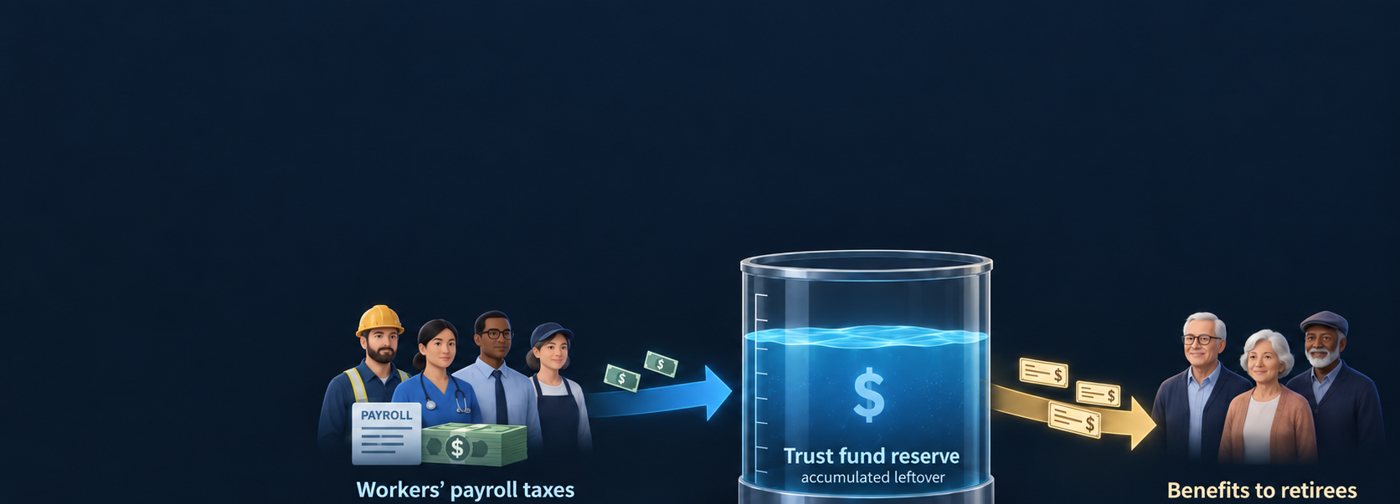
Most people have heard some version of the same headline: Social Security is running out of money. The implication, whether stated or just implied, is that the program is going to disappear, and anyone who hasn't retired yet will be left with nothing.
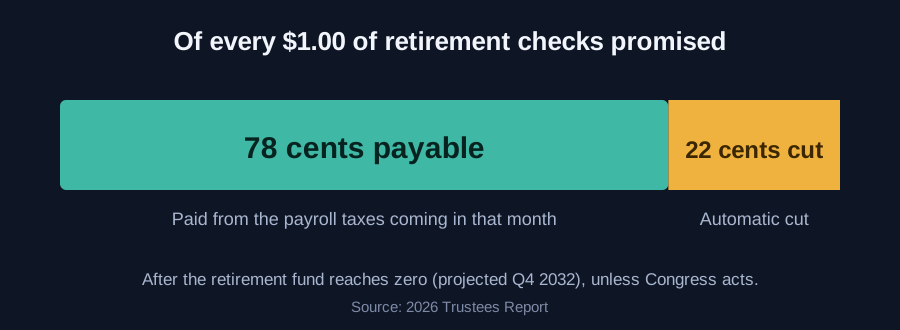
A bar of one dollar split into 78 cents payable and 22 cents cut
What to see: the green part is what the coming-in payroll taxes can still pay after the retirement fund hits zero. The amber part is the automatic cut.Chart drawn from the article’s numbers. Source: 2026 Trustees Report.

That's not what's happening. The trust fundA savings account made of government bonds. It holds what was left over in the years when Social Security took in more than it paid out. is the savings account the program built up over decades of collecting more than it paid out, and the retirement half of it is projected to hit zero in the fourth quarter of 2032. When it does, the program doesn't stop. It keeps paying benefits, but only with the money coming in from current workers' payroll taxes. The Trustees' math says that will cover about 78% of what's been promised. That means an automatic cut of roughly 22% to every retirement check — unless Congress acts before then.

The question isn't whether Social Security survives. It's what kind of cut or tax increase we end up with, and when.


Part 1 of 13, continued

What's in the rest of this article

  • Where Social Security came from — the Depression conditions behind the 1935 law, who actually paid for it at the start, and the changes that made it the program people know now.
  • How the money actually moves — why your payroll taxA tax taken out of every paycheck, with a matching amount paid by the employer. Social Security’s share is 6.2% from the worker and 6.2% from the employer. is not sitting in an account with your name on it, and what the two trust funds really are.
  • What the 2026 Trustees Report says — the date that moved, the three reasons it moved, and the numbers that are confirmed against the report itself.
  • What is actually draining it — every force pulling money out or keeping it from ever coming in.
  • So did the government raid it? — the straight answer, in three parts.
  • Would raising the capThe yearly income ceiling above which no Social Security payroll tax is taken. In 2026 it is $184,500. Its official name is the taxable maximum. fix it? — what the government's own scorekeeper says each version is worth.
  • What about just putting it in the stock market? — why the returns argument is half right, and what Chile's forty-year experiment actually produced.
  • What a switch would actually take — the transition bill, and the two things the pitch leaves out.
  • How Congress fixed it last time — the 1983 deal that is everybody's template, and what each side had to give up.
  • What is on the table now — what the advisers and a sitting senator expect, and the bills already written.
  • What it means for your own plan — whether to claim early to beat the cut, and what a planner says to stress-test instead.
  • What is still unsettled — the figures nobody has confirmed yet.

Part 2 of 13

Where Social Security came from

Before 1935 there was no national retirement check. If you got too old to work you lived on savings, family, charity, or a state pension. The Social Security Administration's own history says only about 5% of elderly Americans received a retirement pension in 1932, and that by 1934 more than half of the elderly did not have enough income to support themselves. Thirty states had an old-age pension law by 1935, but only about 3% of the elderly collected.
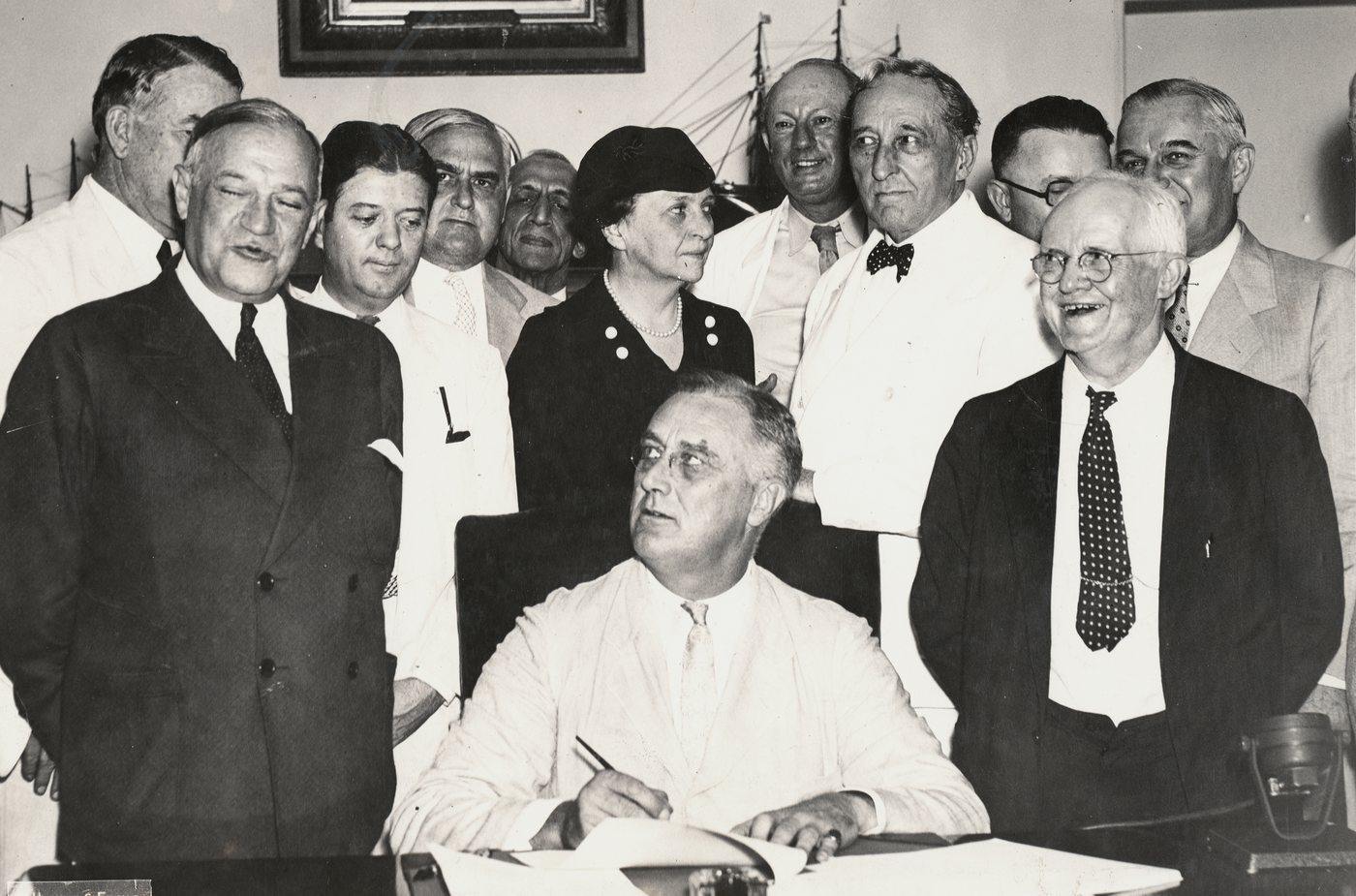
President Roosevelt seated at a desk signing the Social Security Act, officials standing behind him
What to see: the signing of the Social Security Act on August 14, 1935.Photo: FDR Presidential Library, via Wikimedia Commons.

President Roosevelt signed the Social Security Act on August 14, 1935. Title Two created the federal retirement benefit. Title One sent federal money to the states to pay cash to people already old and poor. Title Nine taxed employers to fund state unemployment insurance.

Who paid depends on which part you mean. The retirement program ran on two matching taxes, starting on wages paid after the last day of 1936: 1% out of the worker's pay, and a matching 1% from the employer. No government money at all. SSA historian Larry DeWitt calls it a payroll tax "imposed equally on employers and employees (with no government contribution)." The unemployment tax was the one paid by employers alone, and only by those with eight or more workers, and it never touched retirement checks. The money for the old and poor came out of general federal revenue. So one part of the Act was funded entirely by businesses, and the retirement program was split down the middle between workers and their bosses. Coverage was narrow: a little over half the workforce. Farm workers, domestic workers and the self-employed were left out, and only the first $3,000 of a year's wages was taxed at all.

The 1935 law did not schedule monthly checks until 1942. The amendments signed on August 10, 1939 moved that up to 1940 and added benefits for a retired worker's spouse and children, plus survivors' benefits for the family of a worker who died. Ida May Fuller, a retired legal secretary from Ludlow, Vermont, received the first Social Security check ever issued, on January 31, 1940, for $22.54. She had paid $24.75 in Social Security taxes over three years of work. She lived to 100 and collected $22,888.92.

On August 1, 1956 Congress added cash benefits for disabled workers aged 50 to 64, which is where the disability fund started. In 1972 it made benefit increases automatic from 1975, tied to consumer prices. Before that every raise took its own act of Congress: Fuller's check sat at $22.54 until the 1950 amendments took it to $41.30.

Social Security has paid for benefits the same way since the checks started. Fuller's came out of taxes collected from people working at the time, not out of the $24.75 she paid in. DeWitt writes that the trust funds "have never been either fully funded or on a strict pay-as-you-go basis" and have always held a partial reserve. That reserve is the trust fund.


Part 3 of 13

How the money actually moves

Social Security is a pay-as-you-go system. The payroll taxes you and your employer each pay — 6.2% apiece, listed on your pay stub as FICAThe Federal Insurance Contributions Act, the law behind the payroll tax. On a pay stub, the FICA line covers Social Security and Medicare. or OASDIThe two funds together, OASI plus DI. It is the official name for what most people just call Social Security. It shows up on pay stubs. — don't sit in an account with your name on it. They flow directly to the people collecting benefits right now. When the program takes in more than it pays out, the surplus goes into what are called trust funds, which are reserves held in U.S. Treasury securities that earn interest. When it pays out more than it takes in, it draws from those reserves.
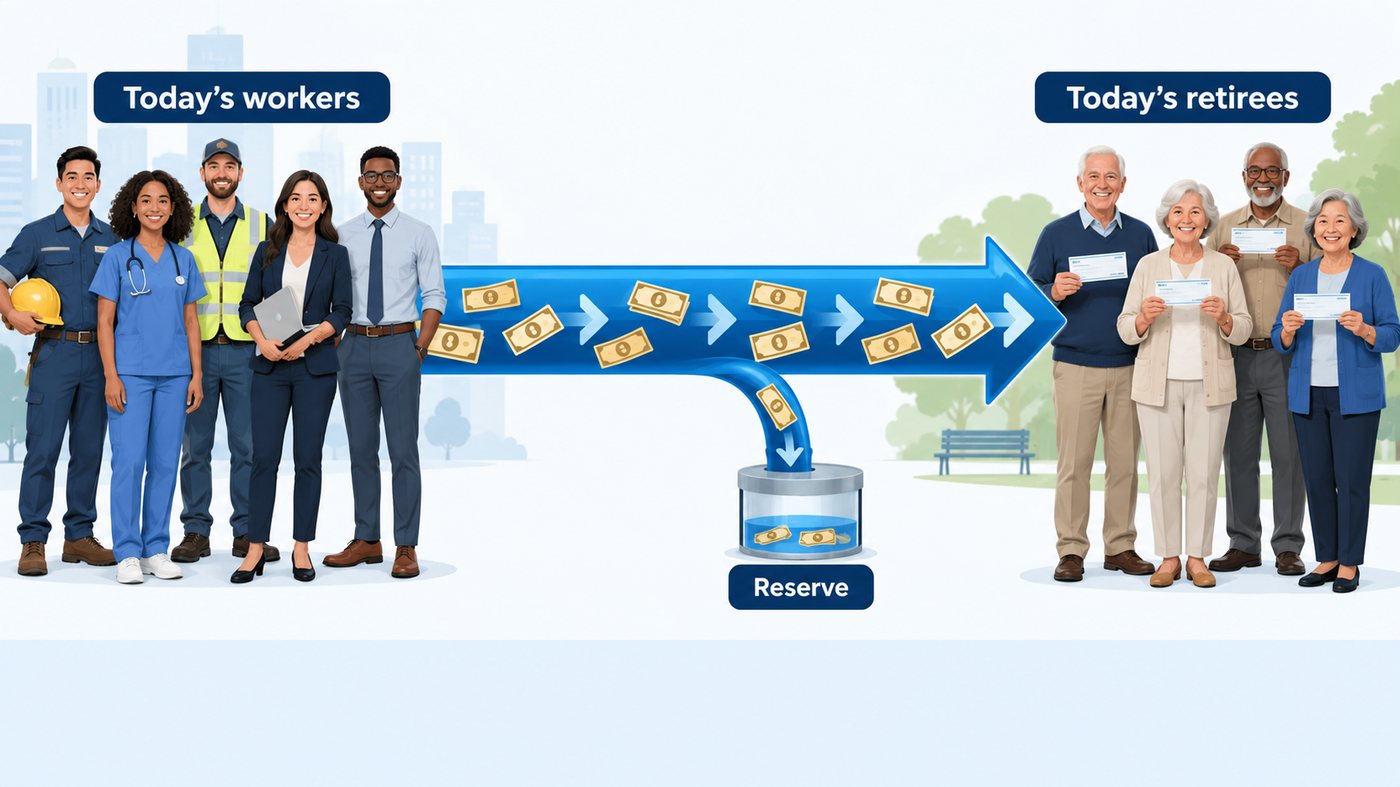
Working people on the left and retired people on the right with an arrow of money between them and a small tank underneath
What to see: today’s workers pay, and the same month today’s retirees get paid. The small tank underneath is the leftover reserve.Illustration.

There are two trust funds, and they're in very different shape.

The big one — the one the headlines are about — is the Old Age and Survivors Insurance (OASIOld-Age and Survivors Insurance. The retirement half of Social Security. Its fund pays retirees, their husbands, wives and children, and the families of workers who died.) fund. It pays retirement checks, spousal benefits, and survivor benefits to widows, widowers, and their children.

The other is the Disability Insurance (DIDisability Insurance. The smaller half of Social Security. Its fund pays workers who become too sick or hurt to work before retirement age.) fund, which pays workers who become disabled before retirement age. This one is in genuinely good shape: the Trustees project it can pay full scheduled benefits for the whole 75-year projection window.

Together the two funds held $2.56 trillion at the end of 2025, down $160 billion over the year — that combined figure is straight out of the 2026 Trustees Report. The split between them is where you have to be careful. Erik Goodge and the retirement planners working from the report's tables put the retirement fund at about $2.34 trillion and the disability fund at about $223 billion, with the retirement side running roughly $200 billion short in 2025 while the disability side ran a surplus. Those splits are consistent with the combined number the Trustees publish, but they are the advisers' reading, not the Trustees'. Treat the $2.56 trillion as settled and the split as very likely.

The two funds are legally separate, but Congress has combined them before. If it does so again, the disability fund's savings get spent on retirement checks too, which pushes the date out to 2034 — the Trustees say so directly — at which point a bigger share of benefits would be payable. Some financial advisers suggest planning to that combined date, since moving money between the funds is relatively easy for Congress to do.
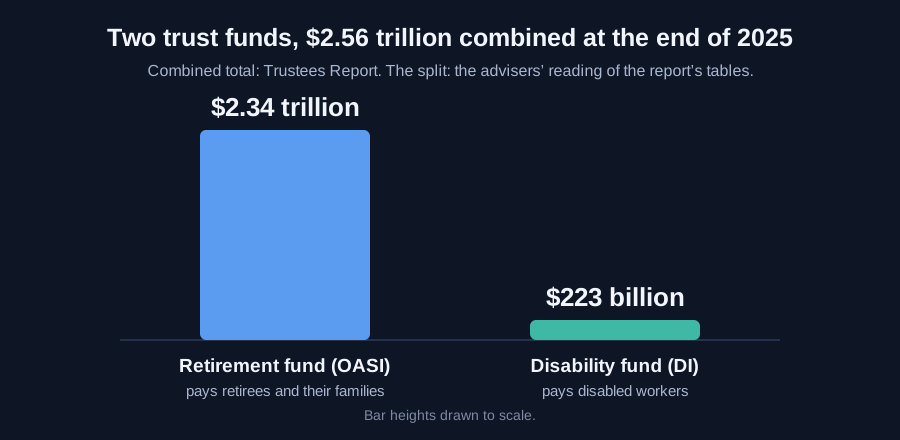
Bar chart of the retirement fund at 2.34 trillion dollars and the disability fund at 223 billion dollars
What to see: two funds, and the retirement one is about ten times bigger. The $2.56 trillion total is the Trustees’. The split is the advisers’ reading.Chart drawn from the article’s numbers.

Part 4 of 13

What the 2026 Trustees Report says

Every year, the Social Security Trustees release a financial audit of the program. The 2026 report moved the projected depletion of the retirement fund forward by one quarter, into the fourth quarter of 2032. One quarter sounds small, and the date is the part that gets reported. The number underneath it moved much more: the 75-year gap went from 3.82% of the nation's wages in last year's report to 4.42% in this one. A date that slips three months and a hole that grows by that much in a single year are the same news told two ways, and the second way is the bigger story. The report points to three reasons.
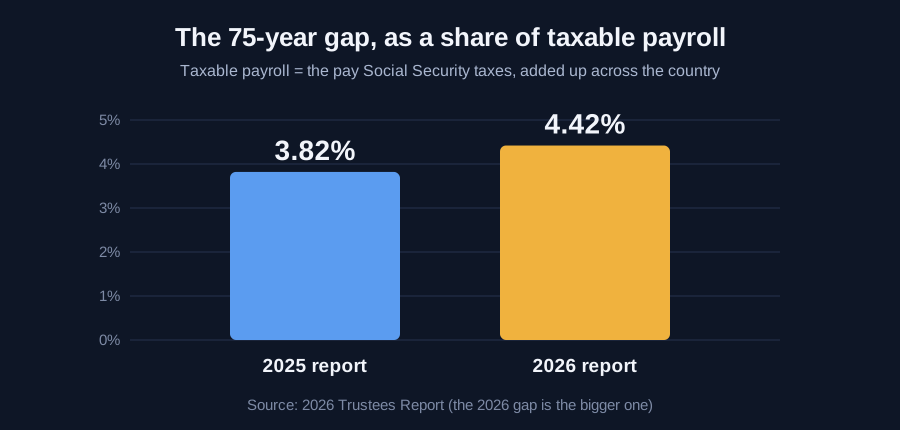
Bar chart of the 75-year gap growing from 3.82 percent to 4.42 percent of taxable payroll
What to see: the hole grew between the 2025 and 2026 reports, from 3.82% to 4.42% of taxable payroll.Chart drawn from the article’s numbers. Source: Trustees Reports.

The first two are demographic. The assumed long-term fertility rate was lowered from 1.9 children per woman to 1.75. And both historical and projected levels of net immigration were revised downward. Fewer births and less immigration mean fewer future workers, which means less payroll tax revenue flowing into the system.

The third is the One Big Beautiful Bill, which made the lower income tax rates from the 2017 Tax Cuts and Jobs Act permanent. It also expanded the standard deduction and added a temporary additional deduction for taxpayers over 65. The effect, as financial adviser Scott Caufield explains, is that the bill reduced the taxes collected on existing Social Security benefits — and those taxes flow back into the trust fund. Less coming back in means the fund empties sooner.

Once the reserves are gone, the program can only pay benefits out of incoming payroll taxes. The Trustees put that at 78% of scheduled benefits — the 22% cut. Senator Bill Cassidy, interviewed by Erin Moriarity, cited a figure of "as much as 28.5%." He did not say where it came from, and it does not match the 22% the Trustees give for the automatic cut. It is in the report, though — as the answer to a different question. A 28.5% cut is what it would take to close the whole 75-year gap if Congress waits until 2034 to act. That is not the automatic cut at depletion; it is the size of the deliberate fix after eight more years of delay. So the number is real and the senator is quoting his own government. He just did not tell the interviewer which of the two he meant, and the difference decides whether you are hearing about something that happens to you or something somebody chooses.

The Medicare Part A hospital trust fund is on a similar timeline. Medicare comes in parts, and the difference matters here. Part A is the hospital part, and your payroll tax already paid for it — there is no monthly bill. Part B is the doctor-and-outpatient part, and you pay a monthly premium for it out of your Social Security check. Part D is the prescription drug part, and you pay a premium for that too. Only Part A has a trust fund that can run dry.

The 2026 Trustees Report puts Part A's depletion in the second quarter of 2033, with 89% of scheduled benefits payable at that point. Scott Caufield says the same thing, and argues that when Congress addresses that shortfall, changes to Part A are very likely to be paired with changes to Parts B and D — the parts retirees do pay for — meaning higher premiums or thinner coverage for outpatient care and prescriptions.


Part 5 of 13

What is actually draining it

The three reasons above are the ones that moved the date this year. They are not the whole story. Here is everything that is pulling money out of the system, or keeping money from ever arriving.
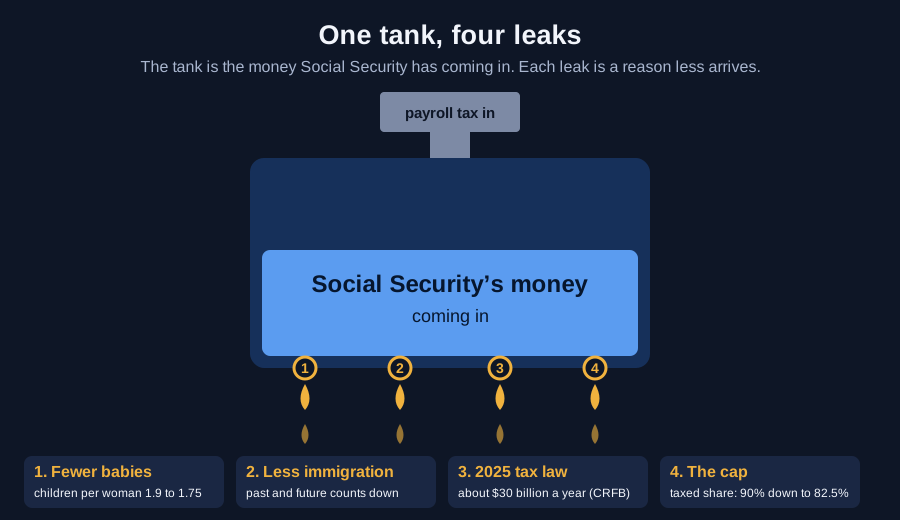
A tank of money with four leaks labelled fewer babies, less immigration, the 2025 tax law and the cap
What to see: four separate leaks, each one a reason less money reaches Social Security. The cap is the biggest.Drawn from the article’s figures; the tax-law figure is CRFB’s.

The 2025 tax law — money that stopped coming back in. This one needs a step most people skip. Since 1984, if your income is above certain levels you pay income tax on part of your own Social Security check, and some of that tax money goes straight back into the trust fund. It is one of the fund's three sources of income. Be careful with the split, because it is where most write-ups get it wrong: the tax on the first half of a benefit goes to Social Security, and the tax on anything above that half goes to Medicare's hospital fund instead. The One Big Beautiful Bill, signed in July 2025, cut income taxes for people over 65 by adding an extra deduction for them, on top of making the 2017 tax rates permanent. Seniors owe less tax. That also means less of that tax flows back into the fund. The Committee for a Responsible Federal BudgetCRFB stands for the Committee for a Responsible Federal Budget, a nonprofit group that studies and comments on federal budget choices. puts the loss at roughly $30 billion a year, about $168.6 billion through 2034, and the Trustees name the law as one of the three reasons the depletion date moved. Nothing was taken out of the fund. Money that was scheduled to come in stopped coming in.

Fewer babies. The Trustees lowered their long-term assumption from 1.9 children per woman to 1.75. Every child not born is a worker not paying payroll tax in twenty years.

Less immigration. The Trustees revised both past and future net immigration down. Same effect, sooner: immigrants who work on the books pay payroll tax, and fewer of them means less money in.

The cap has been leaking since 1983, and nobody voted for it. This is the biggest one, and almost nobody talks about it. The cap is the income ceiling above which you stop paying into Social Security — $184,500 in 2026. If you earn a dollar above that, no payroll tax comes out of it, and it is not counted when your benefit is worked out either. When Congress set the modern version in 1983, it picked a level meant to cover 90% of every wage dollar in the country, and then let it rise automatically with average wages. That formula assumed pay would grow at roughly the same rate up and down the ladder. It didn't. Pay above the cap grew faster than pay below it, so year after year a bigger slice of the nation's wages sat above the ceiling, untaxed. The share covered fell from 90% to about 82.5% by 2000 and has stayed near there since. Stephen Goss, Social Security's Chief ActuaryA person whose job is to use math to estimate future money: how many workers, how many retirees, how long people live, and what that costs., told the Senate Budget Committee that this means payroll tax has come in more than 8% lower than the 1983 plan expected — and that this shrinking taxed share "explains most of" the program's higher costs and earlier depletion compared to what was projected in 1983.

That last one deserves a second look, because it answers the question most people are really asking.
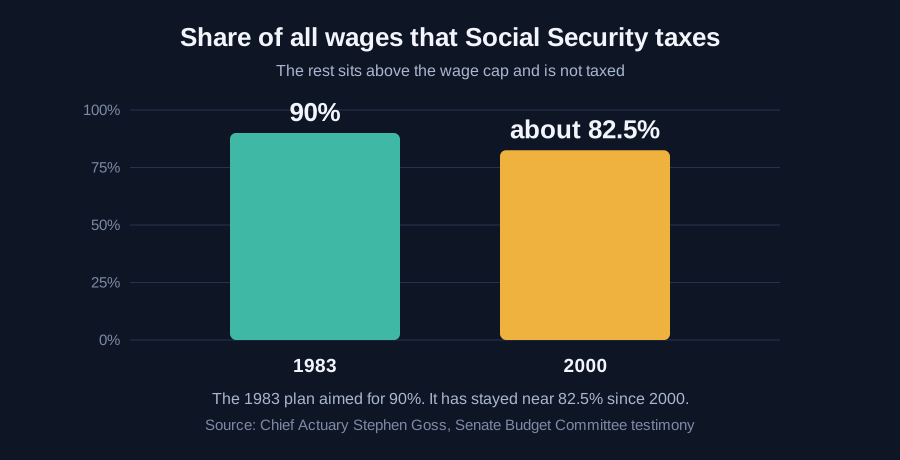
Bar chart of the taxed share of wages falling from 90 percent in 1983 to about 82.5 percent in 2000
What to see: the 1983 plan aimed for 90% of wages taxed. By 2000 it was about 82.5%, and it stayed near there.Chart drawn from the article’s numbers. Source: Chief Actuary Stephen Goss.

Part 6 of 13

So did the government raid it?

There are three parts to the answer.

A closed steel vault door stamped TRUST FUND
What to see: nobody broke into this. The vault is closed and intact.Illustration.

Nobody took the cash out and spent it on something else. The Social Security Administration's own history office addresses this directly: the trust fund has never been moved into the government's general fund, and the way the program is financed has never changed. The raid story is false.

But the fund never held cash in the first place. It can't. Every surplus dollar is lent to the U.S. Treasury by law, and the fund gets back a special government bond that earns interest. The Treasury spends that cash on whatever else the government is doing that year. So the government does owe the fund money, and that debt is real and has been paid every time. If you call lending money to the Treasury a raid, then yes. If you mean someone drained an account, no.

What actually hurt was not a raid. It was money that never arrived. That is the cap leak above, and it is the real answer to the suspicion that the system was never built right for the way the country changed. The 1983 fix was built for a country where pay grew evenly and people had more children. We got neither. Nobody stole anything. The design just quietly stopped collecting what it was written to collect.

Two things the government did do that people file under "raid": it started taxing benefits in 1984, and raised that tax in 1993. The 1984 tax sends money into Social Security's own fund — in, not out. The 1993 increase was written to go to Medicare's hospital fund, so it never helped Social Security at all. And the 2025 tax cut shrinks the 1984 money going in.
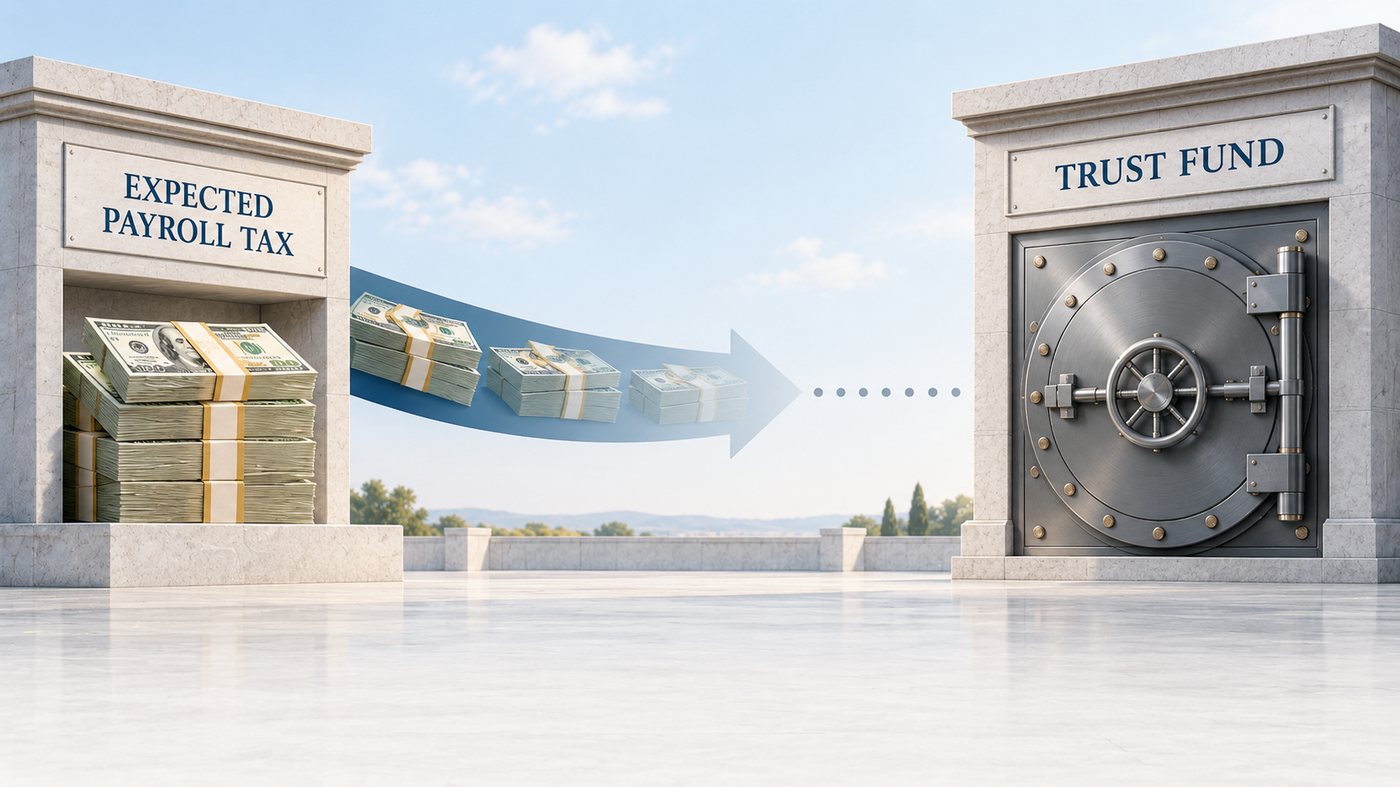
A stack of expected payroll tax cash on the left, an arrow of dots that stops short of the trust fund vault on the right
What to see: the arrow of money thins out and stops before it reaches the vault. That gap is money that never arrived, which is the real story.Illustration.

Part 7 of 13

Would raising the cap fix it?

You hear a version of this everywhere: lift the cap to $400,000, or scrap it entirely, and the problem is solved. It is the most popular answer there is, and it is not what the government's own scorekeeper says.
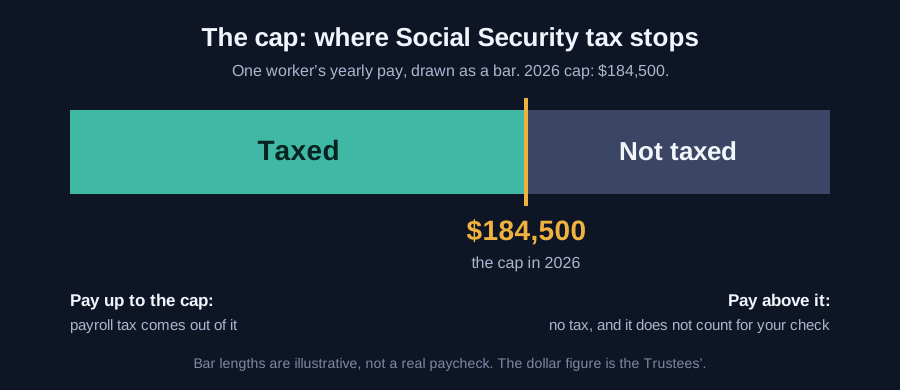
A pay bar split at the 184,500 dollar cap: pay below is taxed, pay above is not
What to see: tax stops at the cap line. Pay above it is not taxed and does not count toward your check.Illustration of the rule. The dollar figure is the 2026 cap.

First, what "the gap" actually is, because every number below is a share of it.

Add up everything Social Security is scheduled to pay out over the next 75 years. Add up everything it is scheduled to collect. It comes up short. That shortfall is the gap.
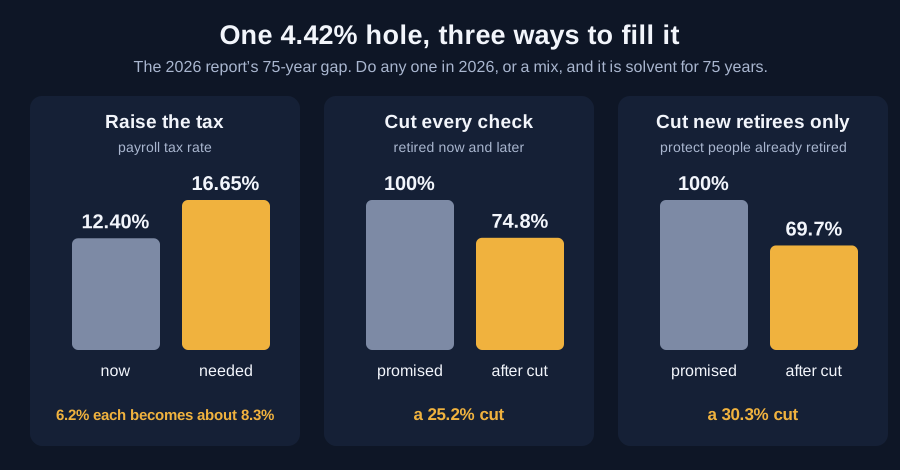
Three panels: raise the tax rate from 12.40 to 16.65 percent, cut every check 25.2 percent, or cut new retirees 30.3 percent
What to see: one hole, three ways to fill it. Each panel alone would close the whole 75-year gap.Chart drawn from the article’s numbers. Source: Trustees Report.

The Trustees size it three ways. It is one hole measured three times, not three problems. $29.3 trillion in today's dollars. Or 4.42 cents out of every wage dollar the country will earn between now and 2100. Or about 1.5% of everything the country produces.

That is the hole. Now the useful part, which the Trustees also print and almost nobody quotes: exactly how much medicine it takes to close it. Do any one of these in 2026 and the program is solventHaving enough money to pay what you owe when the bill comes due. for the full 75 years.

  • Raise the payroll tax from 12.40% to 16.65%. That is the 6.2% out of your pay and the 6.2% from your employer becoming about 8.3% each.
  • Or cut every benefit, for people already retired and people not yet retired, by 25.2%.
  • Or protect everyone already retired and cut only people retiring from here on, by 30.3%.
  • Or any mix of the three.

Waiting makes the dose bigger, and the Trustees price that too. If nobody acts until 2034, the same list becomes a payroll tax of 17.30%, or a 28.5% cut for everybody. Four and a quarter cents on the wage dollar now. About five cents in eight years.

Everything below is a piece of that dose. When a proposal "closes 67% of the gap," it covers two-thirds, and something else still has to cover the rest.

Social Security's Office of the Chief Actuary prices these proposals one by one and publishes what share of that gap each one closes. Measured against the 2025 report, where the gap stood at 3.82% of all taxable wages:

  • Tax earnings above $400,000, and pay bigger checks on the extra. This is the shape of a bill called Social Security 2100, written by Congressman John Larson: closes 58% of the gap.
  • Tax earnings above $250,000, and pay bigger checks on the extra: 62%.
  • Tax earnings above $250,000 and pay nothing extra in benefits: 65%.
  • Scrap the cap completely and pay nothing extra in benefits: 67%. That is the best any cap change does.
  • Scrap the cap completely but credit those earnings toward bigger checks: 48%.

So the answer is no. Not one version of it gets there. The most aggressive one on the list — tax every dollar anyone earns and give the high earners nothing back for it — closes about two-thirds of the gap.

Two things make that picture worse rather than better. Those figures are scored against the 2025 report; the 2026 report widened the gap to 4.42% of wages, and the actuaries have not re-scored the options yet, so the real shares today are lower than the ones above. And catching up is harder than it sounds: back in 2024, when the cap was $168,600, Goss put the level needed to cover 90% of wages again at about $350,000 — more than double.

So what would fix the whole gap in one move? Raising the payroll tax rate itself, from 12.4% to 16.4%, closes 102% of it. That is not a tax on high earners. That is roughly two more cents out of every dollar from every worker and every employer in the country. Which is exactly why Congress has not done it, and why every serious plan is a combination rather than a single lever.
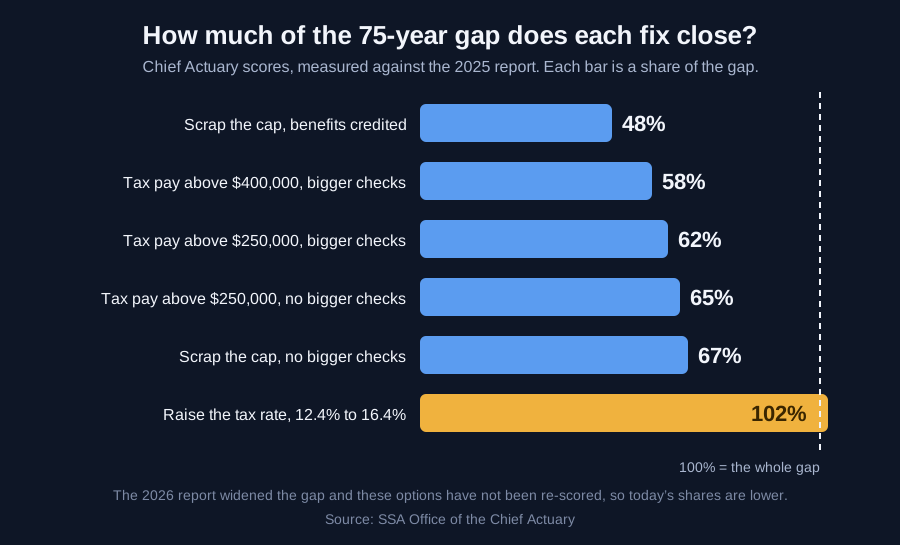
Bar chart of the share of the gap closed by each cap option: 48, 58, 62, 65 and 67 percent, and 102 percent for a rate rise
What to see: no cap change reaches the dashed 100% line. Only the tax-rate rise crosses it.Chart drawn from the article’s numbers. Source: SSA Office of the Chief Actuary, scored against the 2025 report.

Part 8 of 13

What about just putting it in the stock market?

This is the other thing you hear constantly, and the first half of it is true. The trust fund is required by law to hold government bonds. Over the last forty years the stock market returned far more than those bonds did. So if the money had been sitting in an index fund all along, wouldn't we be fine?

So take the question at its word: what if the surplus had gone into an index fund from the start, instead of into government bonds?

It would be bigger. There was a real pile to invest — the fund peaked at about $2.9 trillion in 2021 — and stocks beat those bonds over that stretch, so a fund invested that way would hold more today. Nobody can tell you exactly how much more without picking a starting year and a mix, which is how that argument usually gets fudged.
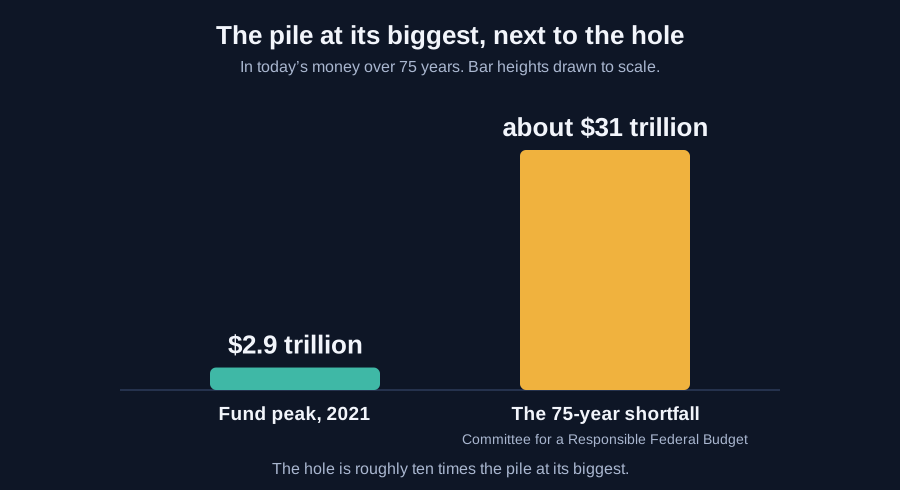
Bar chart of the 2.9 trillion dollar fund peak next to a 31 trillion dollar shortfall
What to see: even at its biggest, the pile was about a tenth of the hole. A better return on a tenth of the problem does not fix the problem.Chart drawn to scale from the article’s numbers. Shortfall: Committee for a Responsible Federal Budget.

It would not be solved. That is the part the argument skips. The pile was never the program's money — it was only the leftover from the years Social Security collected more than it owed. Everything else went straight out as checks the same month it came in. The hole to fill is about $31 trillion in today's money, roughly ten times the pile at its biggest. A better return on a tenth of the problem does not fix the problem.

And it would have been selling into the crash. A trust fund is not a retirement account that can wait for a recovery. It has to pay 70 million checks on schedule. In 2009 it would have been selling stocks at the bottom to do it.

There is also the question of what to do from here, and that is where it gets stark. The surplus is being spent down now. It reaches zero in late 2032. A 10% return on nothing is nothing.

Social Security's actuaries have actually priced this, and the result needs both halves to be honest. Put 40% of the fund's reserves into stocks, phased in over fifteen years, and assume a healthy 5.8% real return every year. It does help a little over the 75 years — worth 0.49% of payroll. By the 75th year it does nothing at all: 0% of the shortfall in that year. And the actuaries refuse to print a percentage for the long-range column, because the help depends entirely on how much money is in the fund to invest. Their own words: if the program ends up purely pay-as-you-go, with reserves just above zero, then investing in stocks "would have no effect on the actuarial balance." So stocks are not nothing. They are a little, early, and then nothing — because zero times any return is still zero.

There is also a lesson from the country that actually ran the experiment. Chile replaced its state pension in 1981 with private individual accounts: 10% of every worker's wage, invested in funds. The funds performed well — the oldest one has reported roughly 10% a year in real returns. And it still did not give people enough to retire on. For Chileans who retired between 2015 and 2023, the median pension their own account paid for was 26% of their old wage for men and 11% for women. In March 2025 Chile kept the accounts and bolted on an 8.5% employer contribution and a shared insurance pillar to hold up the bottom.

The reason is the part the returns argument leaves out. Your account only grows if money goes into it, every month, for forty years. Raising kids, caring for a parent, getting laid off, working off the books — each gap is a hole in the account that no rate of return fills. A defined benefit is not better at investing. It is better at not caring whether you had a bad decade.
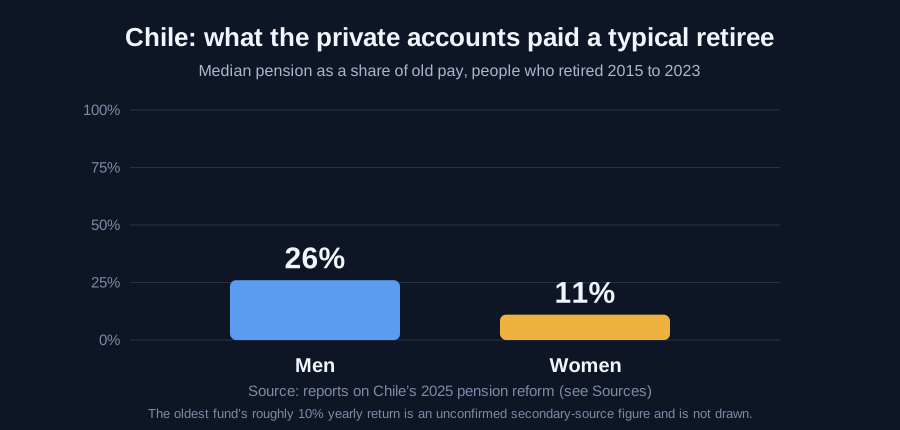
Bar chart of Chile’s median pension: 26 percent of old wage for men and 11 percent for women
What to see: after decades of private accounts, a typical Chilean retiree got 26% (men) or 11% (women) of old pay from their own account.Chart drawn from the article’s numbers.

Part 9 of 13

What a switch would actually take

Switching to private accounts runs into three problems.

One hand passing a blank slip of paper to an older, open hand
What to see: the money goes hand to hand, from a working person to a retired one, the same month. If it goes into your own account instead, this hand is empty.Illustration. The paper is blank on purpose.

Somebody still has to pay today's retirees. The moment your payroll tax goes into your own account instead, the money paying your parents' checks disappears. Not shrinks — disappears, the same month you start. Those checks are owed and they don't stop. That gap is what people mean by the transition cost, and it has to be borrowed. When President Bush proposed personal accounts in 2005, his own Office of Management and BudgetOMB stands for the Office of Management and Budget, the White House office that prepares the president’s budget and prices proposals. put the first ten years at $664 billion, or $754 billion once you count the interest on borrowing it. Estimates over longer windows and bigger carve-outs ran from about $1 trillion to more than $5 trillion. Nobody on either side disputed that the number was large; they disputed what it bought.

It is not only a retirement program. Social Security also pays workers who become disabled before they can retire, and it pays the families of workers who die young. A twenty-six-year-old with two children who is killed in a crash has not built up an account worth anything. The current system pays his family anyway. Any switch has to say what replaces that, and it is usually the part left out of the pitch.

It does not fix the hole by itself. This is the actuaries' own conclusion, not an opinion: individual-account provisions of this kind "generally do not, in themselves, improve the solvency of the Social Security trust funds." They change who carries the risk. Closing the gap still takes the same unpopular levers — more money in, or smaller checks out.


Part 10 of 13

How Congress fixed it last time

The last time Social Security faced a crisis like this was the early 1980s. The retirement fund was months from running dry — estimates had it missing checks as early as August 1983. Congress didn't act until the deadline was right in front of them.
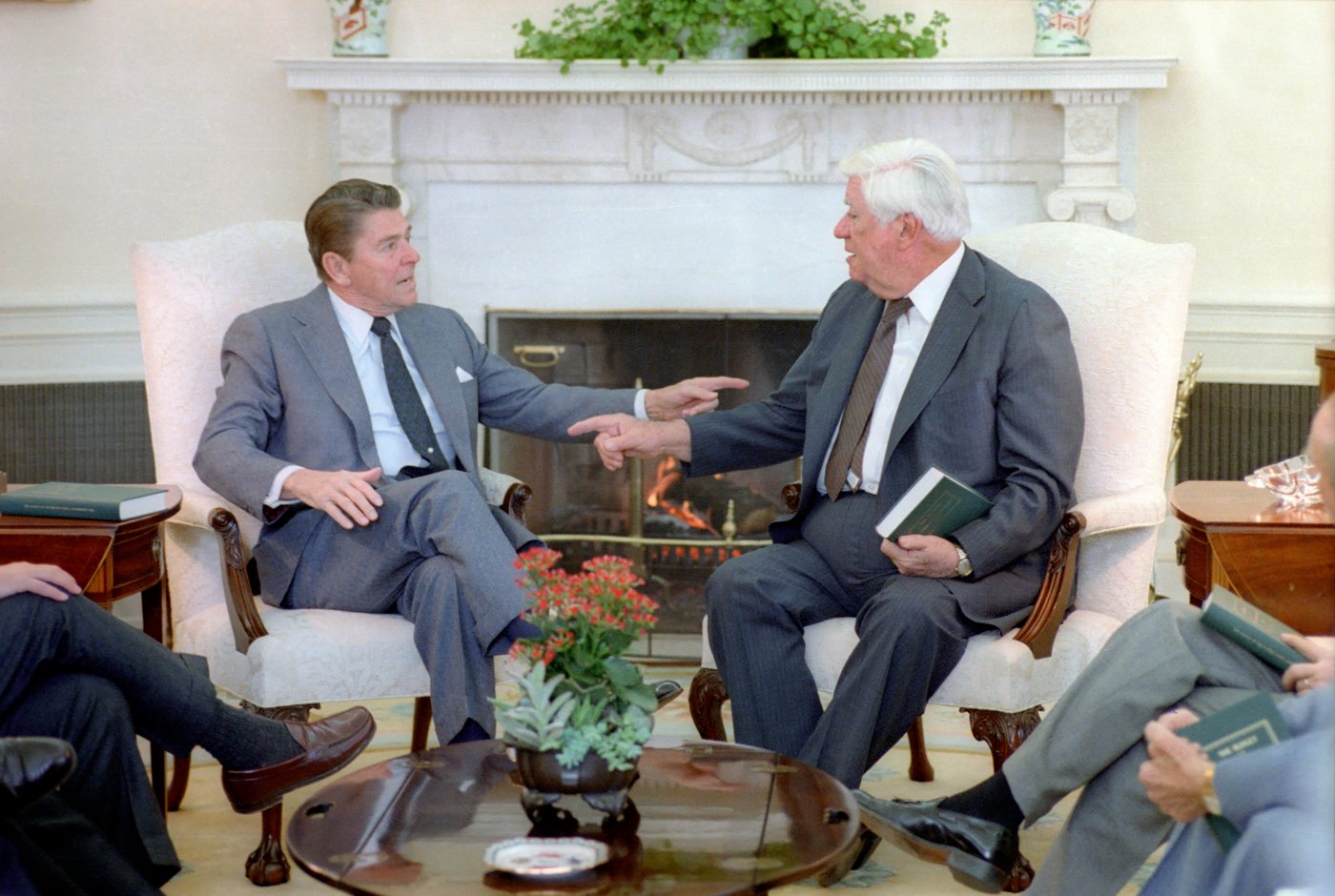
President Reagan and House Speaker Tip O’Neill talking in the Oval Office
What to see: the two sides of the 1983 deal, Reagan and Speaker Tip O’Neill, in the Oval Office on January 31, 1983.Photo: White House Photographic Office, public domain.

The fix came from the Greenspan Commission, a bipartisan body chaired by Alan Greenspan. The deal was ultimately a handshake between President Ronald Reagan and Democratic House Speaker Tip O'Neill. It raised the full retirement ageThe age when you can claim your whole earned check. Claim earlier and every check is smaller for life. Claim later and it is bigger. from 65 to 67, phased in so slowly that it only fully took effect in 2026 — more than four decades later. It taxed Social Security benefits for the first time, applying to up to 50% of benefits for higher-income recipients. (In 1993, that rose to 85% for the highest earners.) It expanded who paid into the system, bringing in federal employees and nonprofit workers. And it accelerated already-scheduled payroll tax increases.

Neither party got everything it wanted. Republicans accepted tax increases. Democrats accepted a benefit cut in the form of a higher retirement age. The political pain was shared.


Part 11 of 13

What is on the table now

Both the advisers and Senator Cassidy expect Congress to follow the same pattern this time — waiting until the deadline is close, likely 2032 or 2033, before acting. Cassidy says: "Most likely Congress will do nothing." He says borrowing is "easier… than to take a tough political decision."
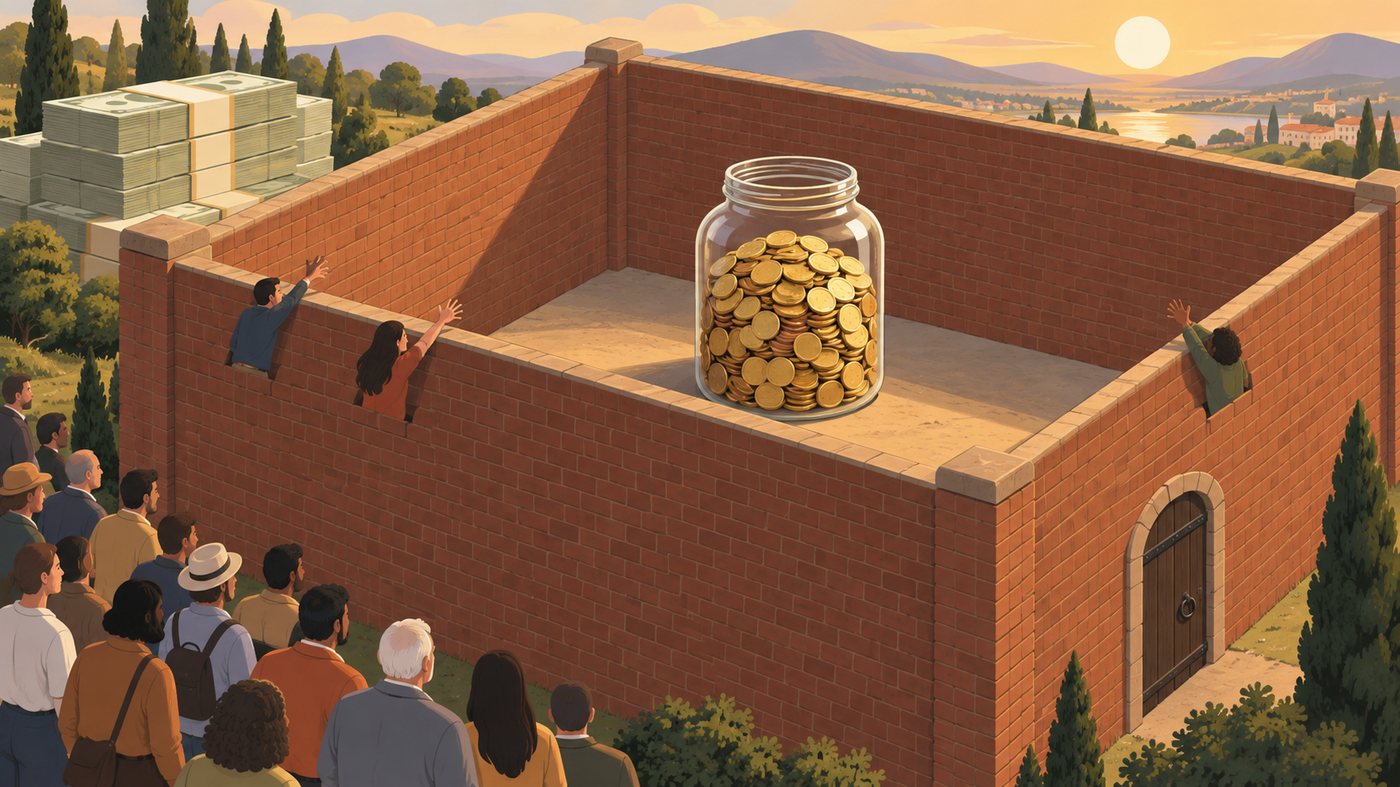
A jar of coins protected inside a tall brick wall while people and money wait outside
What to see: Social Security is walled off from borrowing on purpose. It can spend only what its own fund holds. Congress can take the wall down in a sentence.Illustration made for this page. No real people.

Those two things sound like they cancel out, and they don't, so here is the piece that usually gets left out. The reason an empty fund forces a cut is not that the money runs out of the country. It is that the law only lets Social Security spend what its own fund holds. Nothing else in the budget works that way — when the government wants a fighter jet or a farm subsidy and the money isn't there, it borrows. Social Security is walled off from that, on purpose, so it can never quietly become a line item somebody has to defend every year.

Congress can take that wall down in a sentence. It could vote to let Social Security draw on general revenue, or simply hand the fund enough Treasury money to keep paying full checks, and the automatic cut would never happen. That is what "doing nothing" would most likely turn into: not 70 million people taking a 22% cut, but one more thing paid for with borrowed money, on top of a debt that crossed $40 trillion in August 2026 and now costs about a trillion dollars a year just in interest. No serious person calls that a fix. It is the path of least resistance, and it is the one Cassidy is warning about when he says borrowing is easier. Worth knowing before somebody tells you the checks are guaranteed to be cut — what is guaranteed is that the wall gets tested.

When Congress does act, Scott Caufield predicts the fix will include higher payroll taxes and probably the elimination of the wage cap without a matching benefit increase for high earners. Social Security was designed as an earned benefit: you pay in on your wages, and your benefit is tied to what you paid. Removing the cap without adjusting the benefit formula turns it into something closer to a transfer. Caufield says the political climate seems more comfortable with that framing today than it used to be.

There are at least six bills in Congress addressing Social Security, according to financial planner Erik Goodge. They fall into three groups. The first are process bills, like the Promise Act, which don't change a single tax or benefit — they hand the drafting to an outside commission and force Congress to vote on whatever comes back. Political cover for a politically painful decision. The second group raises revenue from high earners and expands benefits, lifting or removing the payroll tax cap and, in some cases, extending the tax to investment income. The third group — ideas not yet introduced as legislation — includes raising the full retirement age again, or changing how yearly raises are worked out so each one comes in a little smaller.

Senator Cassidy says he is working with Senators Tim Kaine and Dick Durbin on a different kind of proposal: a $1.5 trillion investment fund, held apart from the trust fund, that would compound over 60 to 70 years. Notice what that is. It is the stock-market idea from earlier, done the only way it can actually work — borrow the pile first, then invest it, instead of hoping a fund that is emptying can earn its way out. By his "conservative estimates," it would eventually offset up to 65% of the program's shortfall, which he puts at $27 trillion in today's money. The Committee for a Responsible Federal Budget puts the 75-year shortfall at $31 trillion on the same present-valueWhat a future amount of money is worth in today’s dollars. It lets you add up money spread over 75 years using one yardstick. basis, so treat Cassidy's $27 trillion as his own accounting, not an agreed figure. The fund wouldn't touch the immediate gap — the money needs decades to grow — but it would make the remaining hole smaller.

Cassidy also warns of a worst case: if Congress simply covers the shortfall out of the general fund without fixing the underlying problem, the national debt balloons. He attributes to the Congressional Budget Office the view that the impact would be severe, and predicts long-term interest rates would rise, making mortgages unaffordable. That attribution is his, not something the CBO said here.


Part 12 of 13

What it means for your own plan

The most immediate question for anyone near retirement is whether to claim Social Security early to "lock in" a full check before a cut lands. Erik Goodge, a chartered financial analyst and certified financial planner, has run the numbers — and his answer is no.
Bars showing 100 percent promised, about 78 percent the Trustees automatic result, and an 80 percent planner stress test
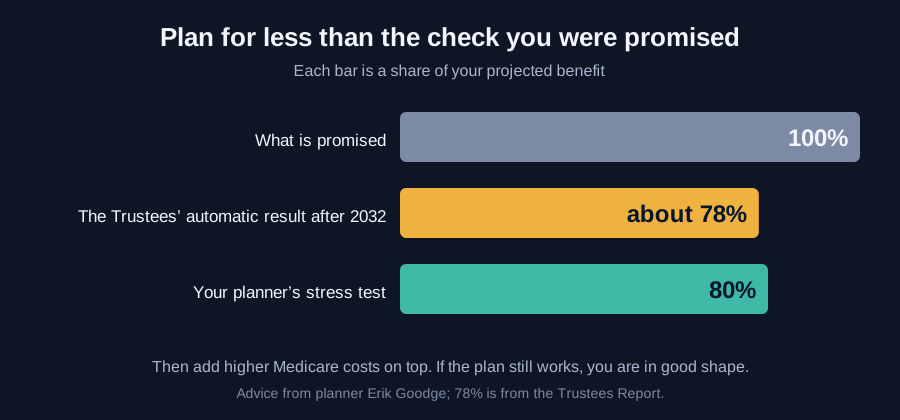
What to see: plan for a check smaller than the one you were promised. The stress test asks for 80%, a little kinder than the Trustees’ 78%.Chart drawn from the article’s numbers.

A 22% cut does change the break-even math. The break-even age is the point at which delaying your benefit has paid for itself — when the larger checks you get by waiting catch up to the checks you skipped. Goodge's analysis shows a cut pushes that age later, especially for people making single-year delay decisions close to 2033. For someone turning 70 in 2033 and deciding whether to delay from 69 to 70, the break-even age stretches to nearly 89.

But Goodge explicitly advises against claiming early to get ahead of the cut. Break-even age alone is a poor basis for the decision — not least because nobody knows how long they'll live. His recommendation: build a stress test into your retirement plan that assumes you get only 80% of your projected benefit, and assume higher Medicare costs on top. If the plan still works under those assumptions, you're in good shape. If it doesn't, that gap is something to deal with now, not in 2032.

Scott Caufield says much the same: don't ignore it, don't overreact to it. Build a plan that survives lower benefits, higher Medicare costs and future tax changes.


Part 13 of 13

What is still unsettled

Six things in this article are not settled:

  • The fund-by-fund split. The $2.56 trillion combined total is the Trustees'. The $2.34 trillion for the retirement fund and the $223 billion for the disability fund, and the 2025 flows behind them, are the advisers' reading of the report's tables.
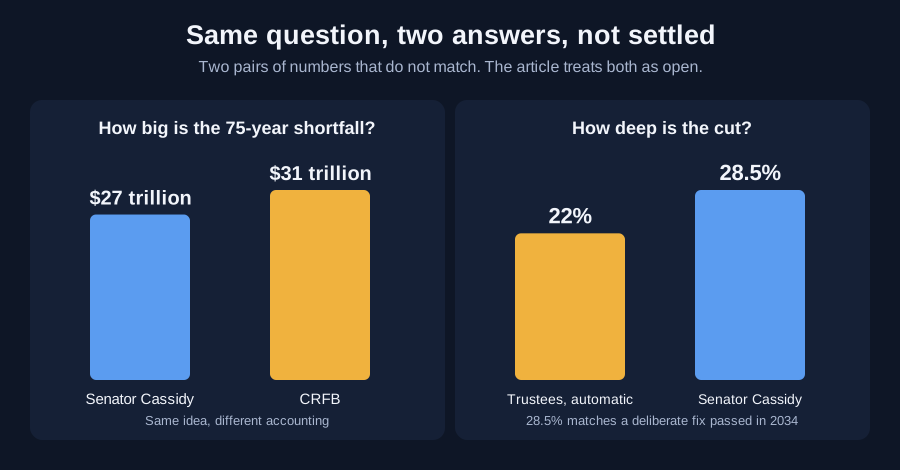
  • Cassidy's 28.5% cut. It is on the record from him, it does not match the Trustees' 22% automatic cut, and he did not show his work. It does match the Trustees' figure for a deliberate fix passed in 2034. Which one he meant is still his to say.
  • Cassidy's $27 trillion shortfall. The Committee for a Responsible Federal Budget says $31 trillion. Same idea, different accounting.
  • What the 2025 tax law costs the fund. The $30 billion a year and $168.6 billion through 2034 come from the Committee for a Responsible Federal Budget. The Trustees name the law as a reason the date moved but do not publish their own dollar figure for it.
  • Chile's fund returns. The roughly 10% a year real return for the oldest Chilean fund is a widely repeated figure from secondary write-ups, not a number I pulled from the Chilean regulator. The replacement rates and the March 2025 reform terms are firmer.
  • The wage-cap scores. Those percentages are the Chief Actuary's, measured against the 2025 report. The 2026 report widened the gap and the options have not been re-scored against it yet, so every one of those shares is now somewhat generous.

As long as workers pay payroll taxes, the checks keep going out. What nobody knows yet is how big they will be, and who pays to keep them where they are.
Two pairs of bars: 27 versus 31 trillion dollars for the shortfall and 22 versus 28.5 percent for the cut
What to see: two questions with two answers each. The article treats both pairs as unsettled.Chart drawn from the article’s numbers.

Sources

Every link below opens in a new tab. They are grouped by who published them. A link is listed only if it backs a claim in the article. Government pages load in a normal browser even though some block automated checkers.

Social Security Administration (SSA)

Committee for a Responsible Federal Budget (CRFB)

Independent analysts

Congress and the law

White House and Office of Management and Budget (2005)

Chile

News and explainer coverage of the 2026 report

Planners and a senator, on video

🎧 Listen to the teaching version — --:--
0:00 / --:--

Play the audio and the sentence being read lights up. Tap any sentence to jump there, or press Play this box on a box.

Teach me from scratch: the Social Security trust fund

This side teaches the article from zero. Each part starts with a gold box that explains the idea you need first. Then the lesson walks through it in small steps. Hard words get explained when they show up.


Part 1 of 13

What is the Social Security trust fund, and what happens when it runs out?

What this part is about

Two things get mixed up in almost every news story about Social Security. One is a machine that moves money. The other is a pile of money that got left over. This part teaches you to tell them apart, because the scary headline only makes sense if you mix them up.

Now the lesson, step by step ↓
Go deeper

Picture a lemonade stand run by a family. Every day, the kids sell lemonade and hand the money to Grandma. Some days they sell more than Grandma needs, so the extra goes in a jar. Now the jar is almost empty. Does the lemonade stand shut down? No. The kids still sell lemonade every day. Grandma still gets paid every day. She just gets only what the kids sold that day, with nothing extra from the jar.

Two children hand coins from a lemonade stand to their grandmother while a nearly empty jar sits to one side
What to see: the coins move from the stand to Grandma every day. The jar on the ground is only the leftover. An almost empty jar does not close the stand.Illustration made for this page. No real people.

Social Security has two parts.

Workers paying payroll taxes into a savings tank that pays benefits to retirees
What to see: money goes in from workers, a small tank holds the leftover, and money goes out to retirees. The tank is not the machine.Illustration. The chart cropped out of the original frame is not shown.

The first part is a machine. Every payday, a little money is taken out of every worker's check. The machine sends that money out, the same month, to people who are retired.

The second part is a savings pile, called the trust fund. For many years, the machine took in more money than it had to send out. The extra went into the pile.

Now the machine sends out more than it takes in. So each year, it uses some of the pile to make up the difference. The pile is shrinking.

The people who check the program's math every year are called the Trustees. They say the retirement part of the pile hits zero in the last three months of 2032.

Then what? The machine keeps running. Workers still pay in every payday. Retired people still get checks. But now the checks can only be as big as what workers pay in that month.

That covers about 78 cents of every dollar people were promised. So every retirement check would shrink by about 22 cents on the dollar. That is a 22% cut. It happens by itself, unless Congress changes the law first.

So Social Security does not disappear. The real fight is over the size of the checks, and who pays to keep them full.

The key thing to remember: The pile running out does not stop the machine. It means checks shrink to about 78% of what was promised, unless Congress acts.

A bar of one dollar split into 78 cents payable and 22 cents cut
What to see: the green part is what the coming-in payroll taxes can still pay after the retirement fund hits zero. The amber part is the automatic cut.Chart drawn from the article’s numbers. Source: 2026 Trustees Report.

Part 2 of 13

Where Social Security came from

What this part is about

This part is history, but it carries the most important idea in the whole article. From the very first check, the money for retired people has come from people working at the same time. The story of the first person ever paid, a woman from Vermont, proves it with her own numbers.

Now the lesson, step by step ↓
Go deeper

Ida May Fuller paid $24.75 into Social Security. Over her life she got back $22,888.92. That is about 925 times what she paid. No savings account on Earth turns $24.75 into that. So where did the money come from? From the workers who were paying in while she was retired. That is called pay-as-you-go. Money comes in from workers, and goes right back out to retired people.

Go back to the early 1930s. The country is in the Great Depression.

An elderly couple sitting at a bare kitchen table in a black and white scene
What to see: what “no pension” looked like. Before 1935 an older person lived on savings, family or charity.Illustration. Not a photograph of real people.

If you were too old to work, you had four choices: your savings, your family, charity, or a state pension. A pension is a payment you get every month after you stop working.

Most people had none of those that worked. The Social Security office's own history says only about 5% of older Americans got a pension in 1932. By 1934, more than half of older Americans did not have enough money to get by. Thirty states had pension laws, but only about 3% of older people actually got paid by one.

President Roosevelt seated at a desk signing the Social Security Act, officials standing behind him
What to see: the signing of the Social Security Act on August 14, 1935.Photo: FDR Presidential Library, via Wikimedia Commons.

So on August 14, 1935, President Franklin Roosevelt signed the Social Security Act. It did three main jobs:

  • It started a national retirement check.
  • It sent money to the states to help people who were already old and poor.
  • It put a tax on businesses to help people who lost their jobs.

Who paid for the retirement check? Not the government. Workers paid 1% of their pay, and their bosses paid a matching 1%. This started with pay earned after the last day of 1936. Larry DeWitt, a historian at the Social Security office, says it was split equally between bosses and workers, with no government money. The job-loss tax was different. Only businesses paid it, and only businesses with eight or more workers. The help for poor older people came from regular government tax money.

At first, the program left a lot of people out. Farm workers were out. People who cleaned or cooked in other people's homes were out. People who worked for themselves were out. It covered only a little over half of all workers. And only the first $3,000 a person earned each year got taxed.

Checks were first planned for 1942. A change in 1939 moved them up to 1940. It also added checks for a retired worker's wife or husband and children, and for the family of a worker who died.

The first monthly check went to Ida May Fuller on January 31, 1940. She was a retired legal secretary from Ludlow, Vermont. The check was for $22.54. She reached age 100, and collected the lifetime total from the box above.

Two more changes came later. In 1956, Congress added checks for workers aged 50 to 64 who got too sick or hurt to work. That began the disability fund. And in 1972, Congress made checks rise every year by themselves, starting in 1975, to keep up with prices. Before that, every raise needed a new vote. Fuller's check stayed at $22.54 for ten years, until a 1950 law raised it to $41.30.

DeWitt writes that Social Security has always kept some money set aside, but never enough to pay for everything ahead of time. That money set aside is the trust fund.

The key thing to remember: Social Security was never a savings account with your name on it. Today's workers pay today's retired people, and the trust fund is just the leftover.


Part 3 of 13

How the money actually moves

What this part is about

This part follows one dollar of your pay after it leaves your paycheck. It also shows that there are really two savings piles, not one, and only one of them is in trouble. That matters, because Congress can move money from the healthy pile to the sick one.

Now the lesson, step by step ↓
Go deeper

The trust fund is not a vault full of cash. Think of it as a drawer full of IOUs. When Social Security has extra money, the law says it must lend that money to the government. The government hands back a special kind of IOU called a bond, which pays a little extra, called interest. Later, when Social Security needs money, it cashes in those IOUs. The government pays them back.

Follow your dollar.

Working people on the left and retired people on the right with an arrow of money between them and a small tank underneath
What to see: today’s workers pay, and the same month today’s retirees get paid. The small tank underneath is the leftover reserve.Illustration.

Every payday, 6.2% of your pay goes to Social Security. Your boss adds another 6.2%. On your pay stub, it may say FICA or OASDI. Those are just names for this tax.

That money does not wait for you. It goes out right away, in checks to people who are retired now. When you retire, the workers of that time will pay your check.

When more comes in than goes out, the extra is lent to the government, and the trust fund gets IOUs back. When less comes in than goes out, Social Security cashes in some IOUs.

There are two piles, kept apart by law.

  • The big one pays retirement checks, plus checks to husbands, wives and children of retired workers, and to families of workers who died. Its name is Old Age and Survivors Insurance, or OASI.
  • The small one pays workers who get too sick or hurt to work before retirement age. Its name is Disability Insurance, or DI.

The small one is in good shape. The Trustees say it can pay every promised check for the whole 75 years they look ahead. The big one is the one running low.

At the end of 2025, both piles together held $2.56 trillion. That was $160 billion less than a year earlier. Those two numbers come straight from the Trustees' 2026 report.

How much sits in each pile is less sure. Erik Goodge, a financial planner, and other planners worked it out from the report's tables. They say about $2.34 trillion is in the retirement pile and about $223 billion in the disability pile. They also say the retirement pile lost about $200 billion in 2025, while the disability pile grew. Their numbers add up to the Trustees' total, so the split is very likely right. But it is their math, not the Trustees'.

Congress has joined the two piles before. If it does it again, the disability money helps pay retirement checks too. The Trustees say that pushes the empty date to 2034. That is why some advisers tell people to plan for 2034 instead of 2032.

The key thing to remember: Your tax pays someone else's check today. Only the retirement pile is running low, and joining the two piles buys about two years.

Bar chart of the retirement fund at 2.34 trillion dollars and the disability fund at 223 billion dollars
What to see: two funds, and the retirement one is about ten times bigger. The $2.56 trillion total is the Trustees’. The split is the advisers’ reading.Chart drawn from the article’s numbers.

Part 4 of 13

What the 2026 Trustees Report says

What this part is about

Every year the Trustees give the program a checkup. This year's report had a small change most people heard about, and a bigger change most people missed. This part also untangles two numbers that sound like they disagree, a 22% cut and a 28.5% cut, which answer two different questions.

Now the lesson, step by step ↓
Go deeper

A 22% cut and a 28.5% cut are about different things. For example, take a $2,000 check. A 22% cut leaves $1,560. That is what happens on its own, the day the pile is empty. A 28.5% cut leaves $1,430. That is not what happens on its own. It is how deep a cut Congress would have to choose to fix the whole problem for 75 years, if it waits until 2034 to do it. One is a crash. The other is a repair bill that grows the longer you wait.

Think of the Trustees' report as a yearly checkup.

The small news: the date the retirement pile runs out moved three months earlier. It is now the last three months of 2032. That is the part the news mostly reported.

Bar chart of the 75-year gap growing from 3.82 percent to 4.42 percent of taxable payroll
What to see: the hole grew between the 2025 and 2026 reports, from 3.82% to 4.42% of taxable payroll.Chart drawn from the article’s numbers. Source: Trustees Reports.

The bigger news: the total shortfall grew. The Trustees measure it as a share of all the pay the whole country earns. Last year, the shortfall was 3.82% of all that pay. This year it is 4.42%. For example, on $1,000 of pay, that is a jump from about $38 to about $44. Spread across a whole country's pay for 75 years, that is a big jump.

The Trustees gave three reasons.

  1. Fewer babies. They now expect women to have 1.75 children each over their lifetimes, down from 1.9. Fewer babies today means fewer workers paying in twenty years from now.
  2. Fewer immigrants. They lowered their count of people moving into the country, both past and future. Fewer workers again, only sooner.
  3. A tax law. The One Big Beautiful Bill of 2025 kept lower income tax rates from a 2017 law, made the standard deduction bigger, and added an extra break for people over 65. A deduction is an amount of income you don't pay tax on. Scott Caufield, a financial adviser, explains why this hurts Social Security. Some retired people pay income tax on their Social Security checks, and part of that tax goes back into the pile. Lower taxes mean less going back into the pile.

When the pile is empty, checks can only be paid from what workers pay in. The Trustees say that covers 78% of what was promised. That is the 22% cut.

Senator Bill Cassidy told reporter Erin Moriarity the cut could be "as much as 28.5%." He did not say where that came from. It does not match the 22%. But 28.5% is a real number in the Trustees' report. It is the size of cut Congress would have to choose, to fix the whole 75-year problem, if it waits until 2034. The senator did not say which one he meant. One happens to you. The other is a choice somebody makes.

Medicare, the health plan for people 65 and older, has a similar clock. It has parts:

  • Part A pays for hospital stays. Your payroll tax already paid for it. No monthly bill.
  • Part B pays for doctor visits. You pay a monthly price, called a premium, taken out of your Social Security check.
  • Part D pays for medicine. You pay a premium for that too.

Only Part A has a pile that can run out. The 2026 report says that happens in the second quarter of 2033, and it could then pay 89% of what it promised. Caufield expects that when Congress fixes Part A, it will likely change Parts B and D too. Those are the parts retired people pay for, so that means higher premiums or less coverage.

The key thing to remember: The date moved a little, but the hole got a lot bigger. The 22% cut happens on its own; the 28.5% is a bigger fix Congress would have to choose after waiting.


Part 5 of 13

What is actually draining it

What this part is about

A fund can shrink two ways. Money can be taken out, or money that should come in never shows up. This part shows that Social Security's biggest problem is the second kind. The biggest leak is a rule from 1983 about which pay gets taxed, and the pay of the highest earners slipped past it.

Now the lesson, step by step ↓
Go deeper

Imagine all the pay in the country is $100. In 1983, Congress set a line, called the cap. Pay under the line gets the Social Security tax. Pay over the line does not. The line was set so $90 of every $100 got taxed. Then the line was set to rise at the same speed as average pay. But the highest earners got raises much faster than everyone else. More and more of the $100 ended up over the line. By 2000, only about $82.50 was getting taxed. That missing $7.50 of every $100, every year, is money that never came in.

Three of these came up in the last part, as reasons the date moved. This part puts all four leaks side by side, including the biggest one.

A tank of money with four leaks labelled fewer babies, less immigration, the 2025 tax law and the cap
What to see: four separate leaks, each one a reason less money reaches Social Security. The cap is the biggest.Drawn from the article’s figures; the tax-law figure is CRFB’s.

Leak one: a tax cut. Since 1984, people with higher incomes pay income tax on part of their Social Security check. The tax on the first half of a check goes back into the Social Security pile. The tax on anything above that half goes to Medicare's hospital pile instead. That split is easy to get wrong. The 2025 law gave people over 65 an extra tax break and kept the 2017 tax rates going. So older people pay less tax, and less goes back into the pile. The Committee for a Responsible Federal Budget, a group that studies government money, says that costs the pile about $30 billion a year, about $168.6 billion through 2034. The Trustees name the law as one of the three reasons the date moved. Nothing was taken out. Money that was supposed to come in stopped coming.

Leak two: fewer babies. The expected number of children per woman fell from 1.9 to 1.75. A baby not born today is a worker not paying in twenty years from now.

Leak three: fewer immigrants. Same idea, but faster. Immigrants who work jobs that report their pay pay the Social Security tax. Fewer of them means less money in.

Leak four: the cap, and it is the biggest. The cap is the pay level where the Social Security tax stops. In 2026, it is $184,500. Any dollar you earn above that gets no Social Security tax, and it does not count toward your own check either.

In 1983, Congress set the cap so that 90% of all the pay in the country got taxed. It planned for the cap to rise as average pay rose. That plan only works if everyone's pay grows at about the same speed. It didn't. Pay at the very top grew faster. So a bigger and bigger slice of the country's pay sat above the cap, with no tax on it. The taxed share fell from 90% to about 82.5% by 2000, and it has stayed near there.

Stephen Goss is Social Security's chief actuary. An actuary uses math to figure out future costs. Goss told a group of senators that because of this, the tax has brought in more than 8% less than the 1983 plan expected. He said this shrinking taxed share explains most of why costs are higher, and the pile is running out sooner, than the 1983 plan said.

The key thing to remember: The biggest drain is not money taken out. It is top pay that grew over the cap, where it never got taxed.

Bar chart of the taxed share of wages falling from 90 percent in 1983 to about 82.5 percent in 2000
What to see: the 1983 plan aimed for 90% of wages taxed. By 2000 it was about 82.5%, and it stayed near there.Chart drawn from the article’s numbers. Source: Chief Actuary Stephen Goss.

Part 6 of 13

So did the government raid it?

What this part is about

Many people believe politicians stole the Social Security money. This part checks that belief in three steps. The answer turns on what the fund actually holds. It never held a pile of cash to steal. It holds IOUs, and those have always been paid back.

Now the lesson, step by step ↓
Go deeper

Say you lend your brother $100. He gives you a signed note promising to pay you back with a little extra. Then he spends the $100 on his car. Did he steal from you? No. He owes you, and you have the note. Now say he pays you back every time, on time. That is how the trust fund and the government work. The fund lends. The government spends the money and owes it back. The government has paid it back every time so far.

Take the raid story one step at a time.

A closed steel vault door stamped TRUST FUND
What to see: nobody broke into this. The vault is closed and intact.Illustration.

Step one: did anyone take the cash and spend it on something else? No. The Social Security office's history team says the trust fund has never been moved into the government's main pot of money. And the way the program gets its money has never changed. So the raid story is false.

Step two: then why does it feel like the money is gone? Because the fund never held cash. The law says every extra dollar must be lent to the government, in return for IOUs that pay interest. The government spends the cash that year on everything else it does. So yes, the government owes the fund money. That debt is real, and it has been paid every time. If lending to the government counts as a raid, then it was a raid. If a raid means someone emptied an account, it was not.

Step three: so what really went wrong? Money that never came in. That is the cap problem from the last part. The 1983 plan expected pay to grow evenly and families to have more children. Neither happened. No one stole anything. The plan just stopped collecting what it was built to collect.

Three tax changes often get blamed as raids. Each one's money goes to a different place:

  • 1984: Congress started taxing Social Security checks. That money goes into Social Security. In, not out.
  • 1993: Congress raised that tax. The extra money goes to Medicare's hospital pile. It never touched Social Security.
  • 2025: the tax cut. It shrinks the 1984 money coming in.

The key thing to remember: No one raided the fund. It lends to the government and gets paid back. The real damage is pay above the cap that was never taxed.

A stack of expected payroll tax cash on the left, an arrow of dots that stops short of the trust fund vault on the right
What to see: the arrow of money thins out and stops before it reaches the vault. That gap is money that never arrived, which is the real story.Illustration.

Part 7 of 13

Would raising the cap fix it?

What this part is about

The most popular fix is to tax the pay of rich people above the cap. This part checks that idea against the scorecard from Social Security's own math experts. First it measures how big the hole is. Then it shows how much of the hole each version of the idea would fill. None of them fills all of it.

Now the lesson, step by step ↓
Go deeper

Think of the problem as a hole in the ground, and every plan as a truck of dirt. "Fills 67%" means the truck fills two-thirds of the hole. One-third is still empty, and another truck has to come. Also, the hole gets deeper every year you wait. Fixing it in 2026 takes one size of truck. Waiting until 2034 takes a bigger one.

First, measure the hole.

A pay bar split at the 184,500 dollar cap: pay below is taxed, pay above is not
What to see: tax stops at the cap line. Pay above it is not taxed and does not count toward your check.Illustration of the rule. The dollar figure is the 2026 cap.

Add up everything Social Security is set to pay out over the next 75 years. Add up everything it is set to take in. The pay-out is bigger. The difference is the hole, which the article calls the gap.

The Trustees measure that one hole three ways:

Three panels: raise the tax rate from 12.40 to 16.65 percent, cut every check 25.2 percent, or cut new retirees 30.3 percent
What to see: one hole, three ways to fill it. Each panel alone would close the whole 75-year gap.Chart drawn from the article’s numbers. Source: Trustees Report.
  • $29.3 trillion, in today's dollars.
  • 4.42 cents out of every dollar of pay the country earns between now and 2100.
  • About 1.5% of everything the country makes.

The Trustees also say what would fill the whole hole, if done in 2026. Pick any one:

  • Raise the Social Security tax from 12.40% to 16.65%. Your 6.2% and your boss's 6.2% would each become about 8.3%.
  • Cut every check, for people retired now and later, by 25.2%.
  • Leave people already retired alone, and cut checks for everyone who retires from now on by 30.3%.
  • Or mix those together.

Wait until 2034, and the tax has to go to 17.30%, or the cut to 28.5% for everyone. About four and a quarter cents on every dollar of pay now becomes about five cents later.

Now the cap ideas. Social Security's Office of the Chief Actuary scores each one by how much of the hole it fills. These scores use the 2025 report, when the hole was 3.82% of all taxed pay:

  • Tax pay above $400,000, and give those people bigger checks for it. This is the idea in a bill called Social Security 2100, written by Congressman John Larson. It fills 58%.
  • Tax pay above $250,000, with bigger checks: 62%.
  • Tax pay above $250,000, with no bigger checks: 65%.
  • Get rid of the cap entirely, with no bigger checks: 67%. That is the most any cap idea fills.
  • Get rid of the cap entirely, and count that pay toward bigger checks: 48%.

So no cap idea fills the whole hole. Even taxing every dollar anyone earns, and giving nothing back for it, fills about two-thirds.

It is actually a little worse than that list. The hole got bigger in the 2026 report, 4.42% of pay, and the ideas have not been scored again. So each one fills less than the list says. And getting back to taxing 90% of all pay is hard. In 2024, when the cap was $168,600, Goss said it would have to be about $350,000. That is more than double.

One single move does fill the whole hole: raising the Social Security tax rate itself, from 12.4% to 16.4%, fills 102% of it. But that is not a tax on the rich. It is about two more cents out of every dollar, from every worker and every boss. That is why Congress has not done it, and why real plans mix several ideas together.

The key thing to remember: Taxing high pay fills part of the hole, at most two-thirds. Filling all of it takes a mix of ideas.

Bar chart of the share of the gap closed by each cap option: 48, 58, 62, 65 and 67 percent, and 102 percent for a rate rise
What to see: no cap change reaches the dashed 100% line. Only the tax-rate rise crosses it.Chart drawn from the article’s numbers. Source: SSA Office of the Chief Actuary, scored against the 2025 report.

Part 8 of 13

What about just putting it in the stock market?

What this part is about

The second most popular fix is to invest the trust fund in stocks, which usually grow faster than the bonds it holds now. This part says that idea is half right. Stocks would have grown the pile. But the pile was always small next to the hole, it is now shrinking to zero, and the one country that tried private stock accounts, Chile, still left many people short.

Now the lesson, step by step ↓
Go deeper

A great return on a small amount is still a small amount. The most the pile ever held was about $2.9 trillion. The hole, by the Committee for a Responsible Federal Budget's count, is about $31 trillion. That is about ten times bigger. Even if stocks had grown the pile a lot, it would still be far short. And by late 2032 the pile is at zero. Ten percent of zero is zero.

Start with the part that is true. By law, the trust fund can only hold government bonds. Over the last forty years, stocks grew much faster than those bonds. So what if the extra money had gone into an index fund instead? An index fund is a simple way to own a tiny piece of many companies at once.

The pile would be bigger. It was at its biggest in 2021, about $2.9 trillion, and stocks would have grown it more. No one can say exactly how much more without choosing a start year and a mix of stocks and bonds. That is where this argument usually gets fuzzy.

But the problem would not be solved, for three reasons.

Bar chart of the 2.9 trillion dollar fund peak next to a 31 trillion dollar shortfall
What to see: even at its biggest, the pile was about a tenth of the hole. A better return on a tenth of the problem does not fix the problem.Chart drawn to scale from the article’s numbers. Shortfall: Committee for a Responsible Federal Budget.

Reason one: the pile was never the main money. Most of what Social Security takes in goes straight out as checks the same month. The pile is only the leftover. And the hole is about ten times the biggest the pile ever got.

Reason two: the fund can't wait out a crash. Your own retirement account can sit still while stock prices recover. The trust fund can't. It has to pay 70 million checks on time, every month. In the 2008 crash, stock prices hit bottom in early 2009, and the fund would have had to sell at that bottom to pay them.

People walking on a busy street in Santiago, Chile, with snowy mountains behind
What to see: the country that ran the experiment. Chile swapped its state pension for private accounts in 1981.Illustration of the place. Not a news photo.

Reason three: the pile is heading to zero. It hits zero in late 2032. There is nothing left to grow.

Social Security's own math experts tested the idea. They put 40% of the pile into stocks, slowly, over fifteen years, and assumed stocks grow 5.8% a year after rising prices. It helps a little: 0.49% of payroll over 75 years, which is about half a cent on every dollar of pay. But by the 75th year, it helps 0%. In their words, if the pile ends up just above zero, putting it in stocks "would have no effect on the actuarial balance." Actuarial balance means whether the program has enough money.

Chile tried the bigger version. In 1981, it replaced its government pension with private accounts. Each worker put 10% of their pay into their own account, invested in funds. The funds did well. The oldest one has reported growth of about 10% a year after rising prices.

People still came up short. Look at the middle person who retired between 2015 and 2023. Their account paid a pension of 26% of their old pay for men, and 11% for women. For example, someone who earned $4,000 a month would get $1,040 as a man, or $440 as a woman. In March 2025, Chile kept the accounts but added a payment of 8.5% from bosses and a shared insurance plan for the people at the bottom.

Why so short? A private account only grows if money goes in every month, for forty years. Raising kids, caring for a parent, losing a job, working for cash: every break leaves a gap no stock return can fill. A defined benefit, a check with a set amount like Social Security, is not better at investing. It is better at not caring whether you had a bad ten years.

The key thing to remember: Stocks would have grown the pile, but the pile was small next to the hole and is heading to zero. Private accounts only work for people who pay in every month for decades.

Bar chart of Chile’s median pension: 26 percent of old wage for men and 11 percent for women
What to see: after decades of private accounts, a typical Chilean retiree got 26% (men) or 11% (women) of old pay from their own account.Chart drawn from the article’s numbers.

Part 9 of 13

What a switch would actually take

What this part is about

Some people want to end Social Security and give every worker a private account instead. This part lists three costs of that switch that the sales pitch tends to skip. The biggest is a double bill: for years, the country would have to pay into new accounts and still pay today's retired people.

Now the lesson, step by step ↓
Go deeper

Right now, your tax pays your grandma's check this month. Now move your tax into your own account. Your grandma's check is still owed, and nothing is paying it. So the country has to borrow to pay grandma while your money goes into your account. It pays for two groups at once, for years. That double bill is called the transition cost.

Switching to private accounts runs into three problems.

One hand passing a blank slip of paper to an older, open hand
What to see: the money goes hand to hand, from a working person to a retired one, the same month. If it goes into your own account instead, this hand is empty.Illustration. The paper is blank on purpose.

Cost one: someone still pays today's retired people. The moment your tax goes into your own account, the money for your parents' checks is gone. Not smaller. Gone. Those checks are still owed. So the country has to borrow the difference. In 2005, President George W. Bush proposed personal accounts. His own budget office said the first ten years would cost $664 billion, or $754 billion counting the interest on the borrowing. Longer or bigger versions ran from about $1 trillion to more than $5 trillion. Both sides agreed the cost was large. They argued about whether it was worth it.

Cost two: Social Security is more than retirement. It also pays workers who get too sick or hurt to work, and families of workers who die young. Think of a twenty-six-year-old with two kids who dies in a car crash. His account would be nearly empty. Today's system pays his family anyway. A switch has to say what takes the place of that. The pitch usually leaves it out.

Cost three: it doesn't fill the hole. Social Security's math experts say private accounts like this "generally do not, in themselves, improve the solvency of the Social Security trust funds." Solvency means having enough money to pay what you owe. Private accounts only change who takes the risk. The hole still needs more money in, or smaller checks out.

The key thing to remember: A switch means paying for two groups at once, replacing the protection for disabled workers and families, and still fixing the hole.


Part 10 of 13

How Congress fixed it last time

What this part is about

This has happened before, in 1983, and Congress fixed it. This part tells how. The trick was that both parties took some of the blame at the same time, so neither one could attack the other for it. Most people expect Congress to use the same trick again.

Now the lesson, step by step ↓
Go deeper

Two friends owe a bill neither wants to pay. If one pays it all, the other gets to brag. So they split it, and neither can brag. In 1983, Republicans agreed to higher taxes, which they hate. Democrats agreed to a later retirement age, which works like a cut, because people collect checks for fewer years. Each side paid some of the bill.

In the early 1980s, the retirement pile was months from empty. Some figures said checks could be missed as soon as August 1983. Congress waited until the deadline was right in front of it.

President Reagan and House Speaker Tip O’Neill talking in the Oval Office
What to see: the two sides of the 1983 deal, Reagan and Speaker Tip O’Neill, in the Oval Office on January 31, 1983.Photo: White House Photographic Office, public domain.

A group from both parties, led by Alan Greenspan, wrote the plan. Then President Ronald Reagan, a Republican, and Tip O'Neill, the Democratic Speaker of the House, sealed it with a handshake.

The deal did four things:

  • It raised the full retirement age from 65 to 67. The full retirement age is when you can get your whole check. The change came in so slowly that it only finished in 2026, more than forty years later.
  • It taxed Social Security checks for the first time, on up to half the check for people with higher incomes. In 1993, that went up to 85% for the highest earners.
  • It brought more people in, including government workers and people who work for charities.
  • It moved up tax raises that were already planned.

Republicans took tax raises. Democrats took a later retirement age. Both shared the pain.

The key thing to remember: In 1983, Congress waited until the deadline, then both parties shared the pain.


Part 11 of 13

What is on the table now

What this part is about

This part looks ahead. It starts with a rule most people don't know: Social Security is only allowed to spend money from its own pile. That rule is the only reason an empty pile means a cut. Congress wrote the rule, so Congress can change it, and that is the most likely thing Congress does. Then it walks through the plans already written, including one from Senator Cassidy.

Now the lesson, step by step ↓
Go deeper

Most government spending works like a family with a credit card. If money runs short, the government borrows and pays later. Social Security is different. It has its own jar, and the law says it can only spend what is in that jar. No credit card. That is why an empty jar means smaller checks. But one vote from Congress could hand Social Security the credit card too. Then checks stay full, and the bill gets added to the country's debt.

Senator Cassidy and financial advisers expect Congress to wait again, until 2032 or 2033. Cassidy said: "Most likely Congress will do nothing." He also said borrowing is "easier… than to take a tough political decision."

A jar of coins protected inside a tall brick wall while people and money wait outside
What to see: Social Security is walled off from borrowing on purpose. It can spend only what its own fund holds. Congress can take the wall down in a sentence.Illustration made for this page. No real people.

Those two sentences fit together once you know the rule. An empty pile forces a cut only because the law says Social Security can spend only what its own pile holds. Nothing else the government pays for works that way. When the government wants a fighter jet or money for farmers and comes up short, it borrows. Social Security is walled off from borrowing on purpose, so it never has to fight for money each year.

Congress can take that wall down with one vote. It could let Social Security use the government's regular money, or just hand the pile enough to keep paying full checks. Then the 22% cut never happens.

That is what "doing nothing" would most likely become. Not 70 million people getting smaller checks. Instead, one more thing paid for with borrowed money. The country's debt passed $40 trillion in August 2026, and the interest alone now costs about a trillion dollars a year. No serious person calls more borrowing a fix. It is just the easiest road, and it is the road Cassidy is warning about. So if someone says the cut is certain, the thing that is really certain is that the wall gets tested.

When Congress does act, Scott Caufield expects higher Social Security taxes, and probably no more cap, without bigger checks for high earners. That would change what the program is. It was built as an earned benefit: what you get back is tied to what you paid in. If high earners pay much more without getting more back, the program moves money from some people to others. Caufield says people today seem more open to that than before.

Erik Goodge counts at least six bills in Congress. They come in three kinds:

  • Bills that hand off the job. Like the Promise Act. They change no tax and no check. They give the job to an outside group and make Congress vote on its plan. That protects lawmakers from blame.
  • Bills that tax high earners and raise checks. They raise or remove the cap. Some also tax money people make from investments.
  • Ideas that aren't bills yet. Raising the full retirement age again, or changing the yearly raise so each one is a little smaller.

Senator Cassidy is working with Senators Tim Kaine and Dick Durbin on something different. The government would put $1.5 trillion into an investment fund, kept apart from the trust fund, and let it grow for 60 to 70 years. That is the stock market idea done the only way it can work: get the money first, then invest it, instead of hoping a shrinking pile can grow. Cassidy says by his "conservative estimates" it could someday cover up to 65% of the shortfall, which he puts at $27 trillion. The Committee for a Responsible Federal Budget puts it at $31 trillion, counted the same way, so the $27 trillion is Cassidy's own math. His fund would not help in 2032, since it needs decades to grow. It would make the hole smaller later.

Cassidy also warns about a worst case: Congress just pays the shortfall from the government's main pot and never fixes the real problem. He says the debt would balloon, and he says the Congressional Budget Office thinks the damage would be severe. He predicts long-term interest rates would rise, making home loans too costly. That claim about the budget office is his. The budget office did not say it here.

The key thing to remember: The automatic cut happens only because of a rule Congress wrote, and Congress can change it by borrowing. Most plans on the table fill only part of the hole.


Part 12 of 13

What it means for your own plan

What this part is about

If you are near retirement, you might think: start my checks early, before the cut. This part shows why a financial planner says no. The key idea is the break-even age, the age when waiting finally pays off. A cut pushes that age later, but it still does not make starting early the smart move.

Now the lesson, step by step ↓
Go deeper

Waiting to start your checks makes each check bigger, but you skip checks while you wait. For example, say you skip a year of $1,000 checks, so you miss $12,000. Waiting makes each later check $80 bigger. At $80 a month, it takes 150 months, about twelve and a half years, to earn back the $12,000. After that, waiting was the better deal. The catch: no one knows how many years they have.

Erik Goodge is a certified financial planner. He looked at whether people should start their checks early, to get full checks before a cut. His answer is no.

Bars showing 100 percent promised, about 78 percent the Trustees automatic result, and an 80 percent planner stress test
What to see: plan for a check smaller than the one you were promised. The stress test asks for 80%, a little kinder than the Trustees’ 78%.Chart drawn from the article’s numbers.

A cut does change the math. It pushes the break-even age later, the age when the bigger checks from waiting catch up to the checks you skipped. It matters most for people deciding whether to wait one more year near 2033. Take someone who turns 70 in 2033 and is deciding whether to wait from 69 to 70. Their break-even age stretches to nearly 89.

But Goodge still says not to start early just to beat the cut. The break-even age alone is a poor way to decide, because nobody knows how long they will be alive.

He says to do this instead:

  • Test your retirement plan as if you get only 80% of the check you expect.
  • Add in higher Medicare costs.
  • If the plan still works, you are fine.
  • If it doesn't, fix that gap now, not in 2032.

Scott Caufield says much the same: don't ignore it, and don't panic. Build a plan that still works with smaller checks, higher Medicare costs, and tax changes.

The key thing to remember: Don't start your checks early just to beat the cut. Test your plan at 80% of your expected check, plus higher Medicare costs.


Part 13 of 13

What is still unsettled

What this part is about

Not every number in this article is equally solid. This part sorts six of them by where they came from, so you know how much weight each one can hold. A number printed by the Trustees is the official count. A number someone worked out from it, or said in an interview, is less sure.

Now the lesson, step by step ↓
Go deeper

Think of three people telling you the temperature. One checks the thermometer. One looks at the thermometer's chart and does some math. One just says "feels like 80." All three might be right. But you trust the first one most, and the last one least. Numbers work the same way. Always ask who is holding the thermometer.

Six numbers are not settled yet:

  • The split between the two piles. The $2.56 trillion total is the Trustees'. The $2.34 trillion and $223 billion split comes from advisers doing math on the report's tables.
  • Cassidy's 28.5% cut. He said it publicly without saying where it came from. It does not match the Trustees' 22% automatic cut. It does match their number for a fix chosen in 2034. Only he can say which one he meant.
  • Cassidy's $27 trillion shortfall. The Committee for a Responsible Federal Budget says $31 trillion. Same idea, different math.
  • What the 2025 tax law costs the pile. The $30 billion a year and $168.6 billion through 2034 come from the Committee for a Responsible Federal Budget. The Trustees name the law, but give no dollar amount of their own.
  • How well Chile's funds did. The roughly 10% a year for Chile's oldest fund is a widely repeated number from news write-ups, not from Chile's own pension office. The pension shares and the March 2025 changes are more solid.
  • The cap scores. They come from the chief actuary, using the 2025 report. The hole got bigger in 2026, and the ideas have not been scored again, so each one fills less than listed.

As long as workers pay payroll taxes, the checks keep going out. What no one knows yet is how big they will be, and who pays to keep them where they are.

The key thing to remember: The checks keep coming. How big they are, and who pays to keep them full, is still up to Congress.

Two pairs of bars: 27 versus 31 trillion dollars for the shortfall and 22 versus 28.5 percent for the cut
What to see: two questions with two answers each. The article treats both pairs as unsettled.Chart drawn from the article’s numbers.

Sources

Every link below opens in a new tab. They are grouped by who published them. A link is listed only if it backs a claim in the article. Government pages load in a normal browser even though some block automated checkers.

Social Security Administration (SSA)

Committee for a Responsible Federal Budget (CRFB)

Independent analysts

Congress and the law

White House and Office of Management and Budget (2005)

Chile

News and explainer coverage of the 2026 report

Planners and a senator, on video

← All explainers