Undastandable · As of October 2026

What is Project Jupiter? Why Oracle's biggest AI bet is waiting on a gas pipe

Watch the explainer

Prefer to watch? This narrated film walks through the whole story in about 17 minutes.

Play the audio and the sentence being read lights up and follows along. Tap a sentence to jump there.

Current as of October 7, 2026. This story is moving. Oracle's stock, its bond prices and the permits in New Mexico can change week to week, so some numbers here may have changed since it was written.

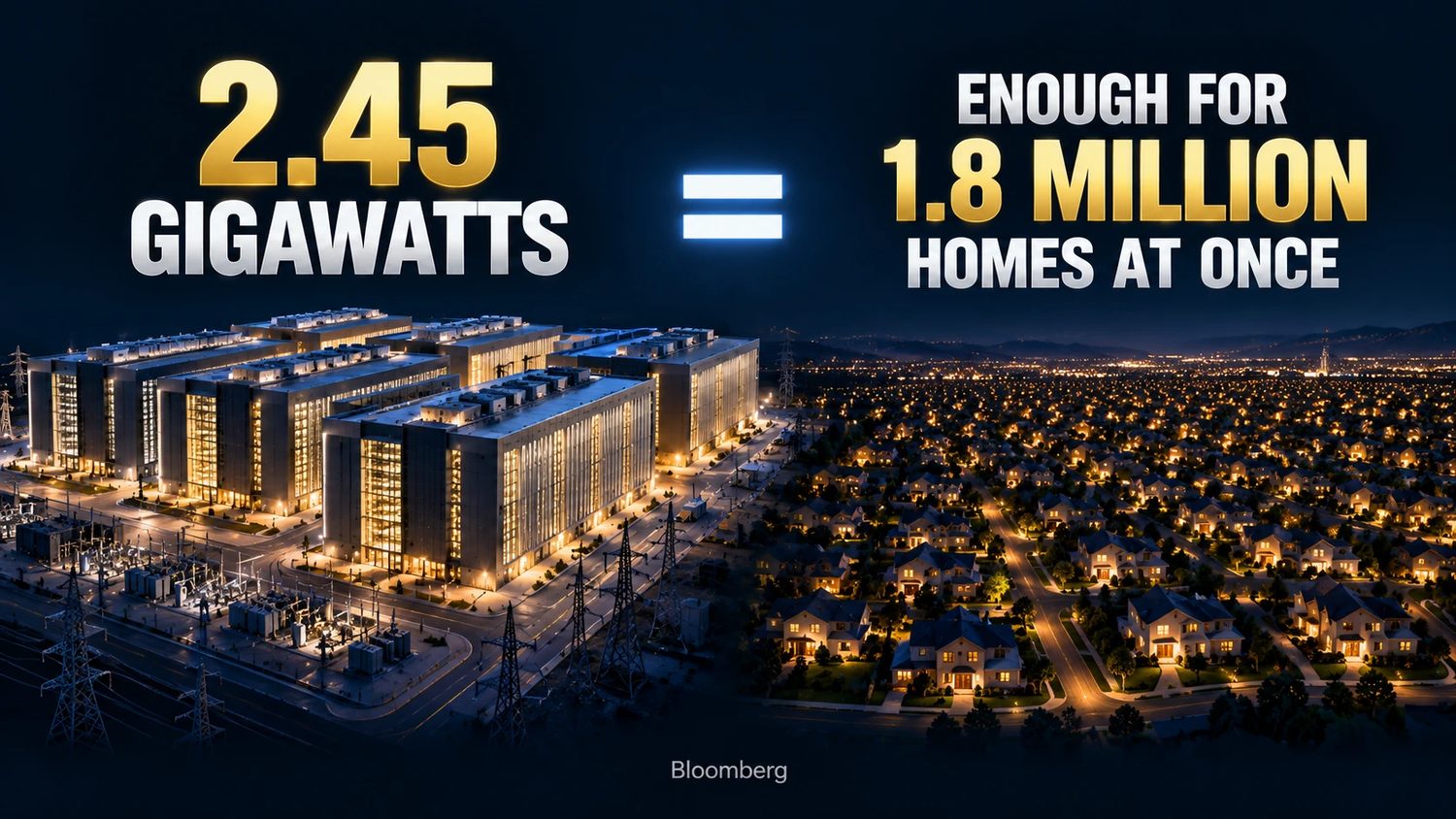
If you drive west out of El Paso and cross into New Mexico, you pass a construction site where about 3,500 workers are putting up four giant buildings on 1,400 acres of desert. When they are done, the buildings are supposed to pull 2.45 gigawatts of power. That is enough electricity, Bloomberg reported, to run roughly 1.8 million homes at once. The place is called Project Jupiter. It is one of the biggest pieces of Stargate, the artificial intelligence buildout President Trump announced at the White House with Larry Ellison, Sam Altman and Masayoshi Son.
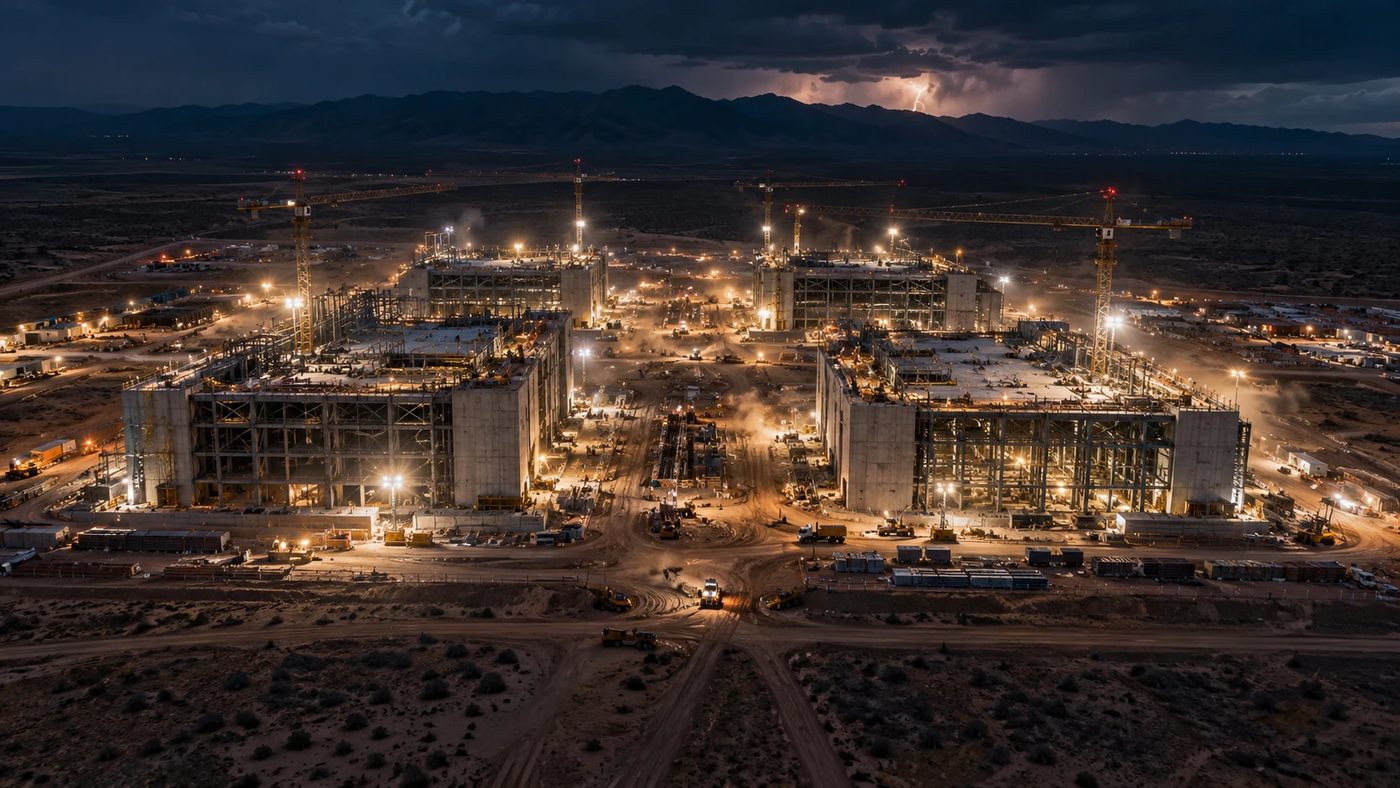
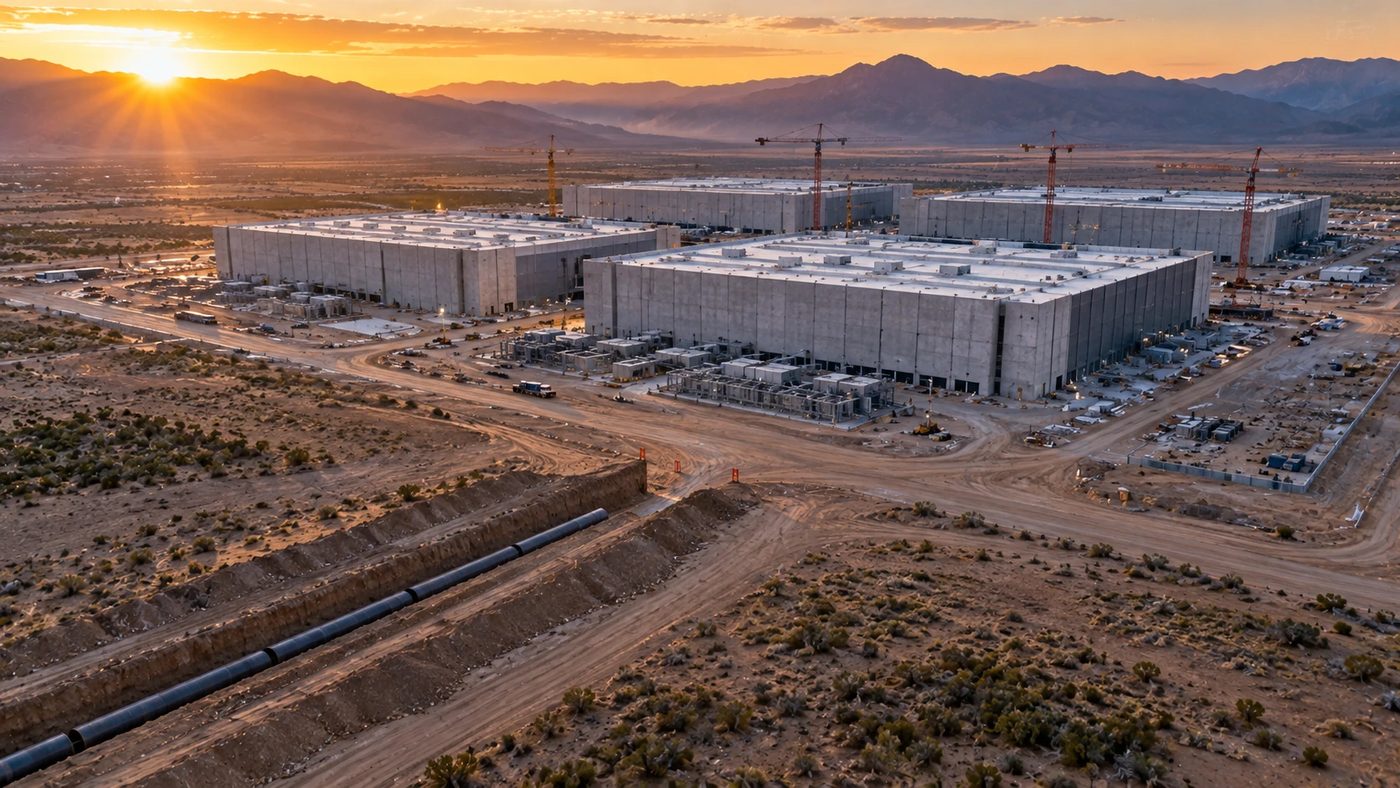
Aerial night view of a huge data center construction site in the desert with cranes and floodlights.
An illustration of the Project Jupiter site: four giant buildings going up on 1,400 acres of New Mexico desert.AI-generated illustration

On September 24, Oracle, the company signed up to rent the whole campus, sent the builder a letter. It was a force majeure notice. That is a formal warning that something outside your control may stop you from keeping your side of a deal, so you may not have to pay on time.

Oracle says the letter means nothing. "Project Jupiter remains on our planned schedule," spokesman Michael Egbert said. The lenders who paid for the buildings were already acting like it means something. Six days before the letter, the Financial Times reported, banks were quoting the $18 billion construction loan at about 90 cents on the dollar.

The letter matters. It is the first time a company at the center of the AI boom has put in writing, to its own partners, that its biggest promise might not arrive on time. And the reason is not a chip shortage or a failed AI model. It is a 17-mile gas pipe that a state office would not let cross its land.

The Half-Truth Detector — run it yourself

This is the prompt behind our own fact-checking tool. Paste it into any AI with web search on, add a claim or an article, and it returns two tables: every load-bearing claim with its full context and a verdict, then a second table of the actual sources with links. It grades what is factual, what is misleading, and what has no support — including on us.

What's in the rest of this article

  • Who does what in the desert — Oracle, OpenAI, the builder and the banks, and who owes whom.
  • The pipe the state said no to — why a power plant needs a gas line, and why New Mexico refused it twice.
  • What the letter actually asks for — the three-year rent delay, and the catch Oracle does not mention.
  • Oracle's money problem — the borrowing, the $288 billion in leases you will not find in the debt total, and what bond buyers are charging now.
  • One customer, half the orders — how much of Oracle's future rides on OpenAI.
  • Larry Ellison's shares — the pledged stock, the $7.5 billion sale plan, and the margin-call chain that could follow a falling price.
  • The stack of promises — every layer, from the banks to OpenAI's investors.
  • Oracle's case — the record quarter and what Oracle and its partners say back.
  • What this means for you — your index fund, your retirement account and your state.
  • What to watch next — the dates that will decide whether the buildings turn on.

Who does what in the desert

A tall apartment tower at dusk with every window lit and one moving truck at the front door.
Think of Jupiter as one giant apartment building built for a single tenant.AI-generated illustration
Twenty bank buildings feeding a tall stack of cash labeled 18 billion dollar loan, with a much smaller stack labeled 3 billion Blue Owl.
About 20 banks lined up an $18 billion construction loan. Blue Owl put in about $3 billion of its own.AI-generated diagram

Think of Project Jupiter like a giant apartment building that is being built for one tenant, and that tenant already has one customer lined up to fill every room.

The builder and owner is STACK Infrastructure, a data center company owned by funds managed by the investment firm Blue Owl Capital. A local developer, BorderPlex Digital Assets, is a partner. STACK owns the buildings, not Oracle.

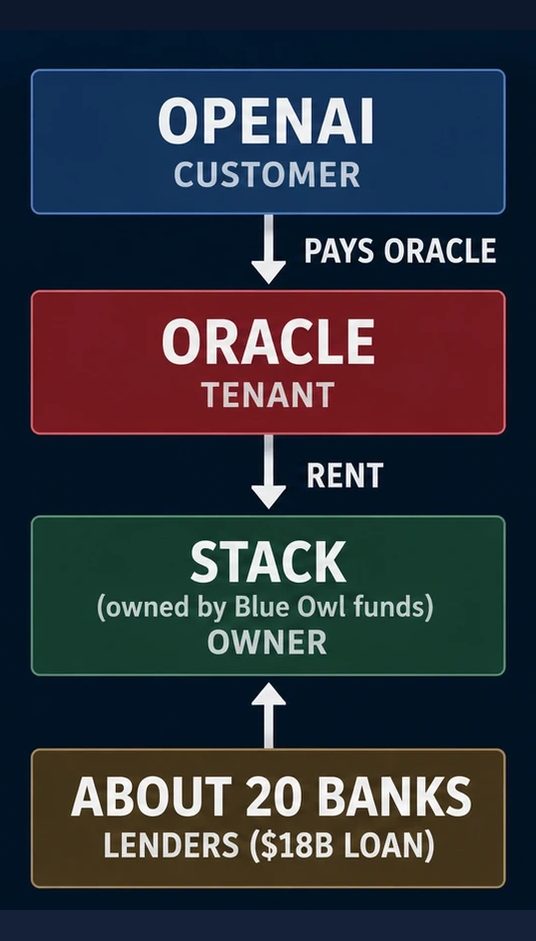
Oracle is the tenant. It signs a long lease, fills the buildings with computer chips, and runs them. Then it rents that computing power to OpenAI, the company behind ChatGPT. Oracle sits in the middle. It owes rent to the builder on one side, and it waits for OpenAI's payments on the other. That is a fine place to stand as long as the building opens.

The money to build it came from about 20 banks, which lined up an $18 billion construction loan, according to Bloomberg and Reuters. Blue Owl put in about $3 billion of its own. Reuters reported that Blue Owl earns about 9% on that money while the buildings go up, and about 11% once they are finished.

Doña Ana County gave the project a big tax break to land it. In September 2025, county commissioners voted 4 to 1 to approve $165 billion in industrial revenue bonds, the amount the companies expect to invest. The deal takes the property off the regular tax rolls for up to 30 years. In exchange, the companies pay the county a flat $12 million a year, El Paso Matters reported. The same deal commits the developers to switch on a first phase between October and December 2026 and finish the whole campus by the third quarter of 2028.

Stargate itself was announced on January 21, 2025, as $500 billion of AI building over four years. Jupiter came later, as one of five U.S. sites in a $400 billion deal OpenAI signed with Oracle and SoftBank, according to Bloomberg.

The pipe the state said no to
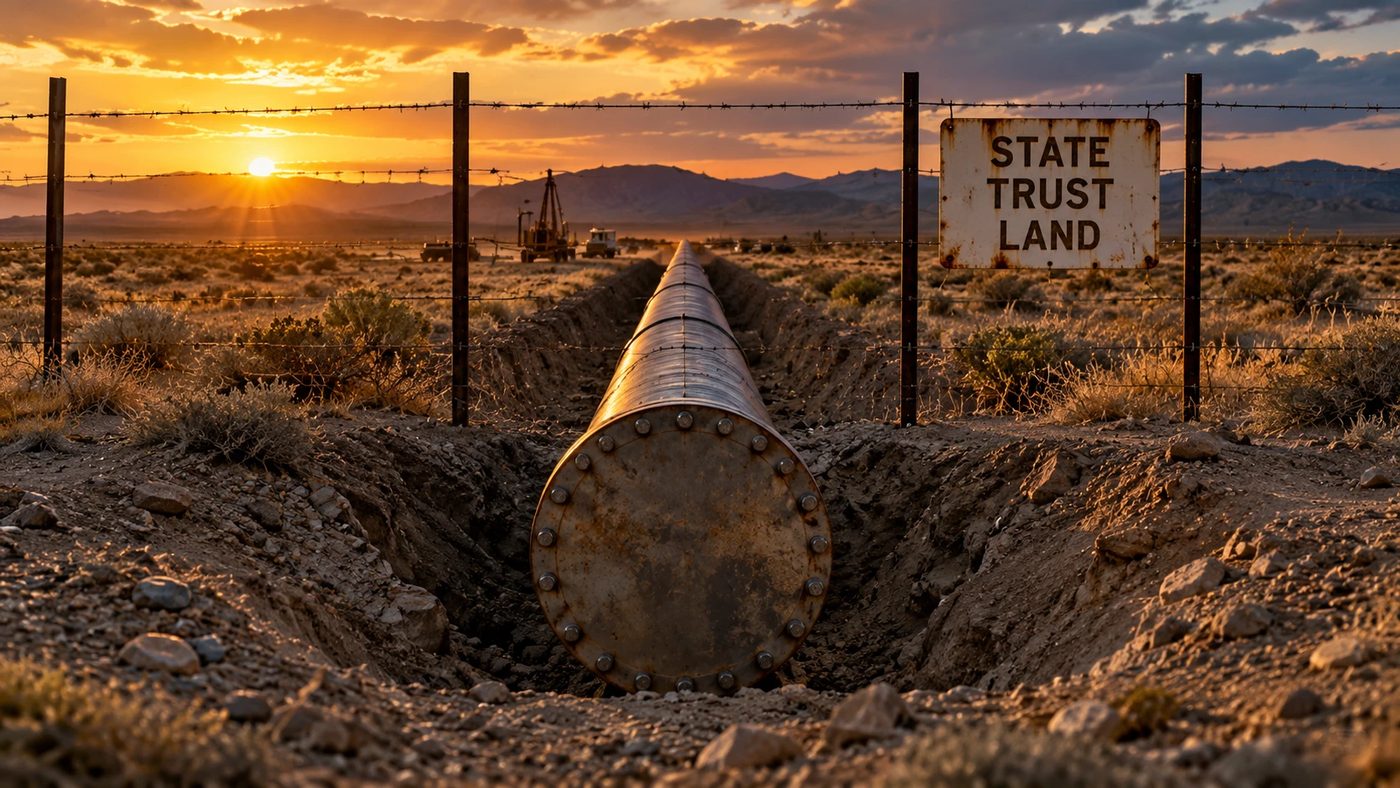
A wide steel gas pipe in a desert trench ending at a barbed-wire fence with a sign reading state trust land.
A gas pipe in its trench stops at a fence marked state trust land.AI-generated illustration
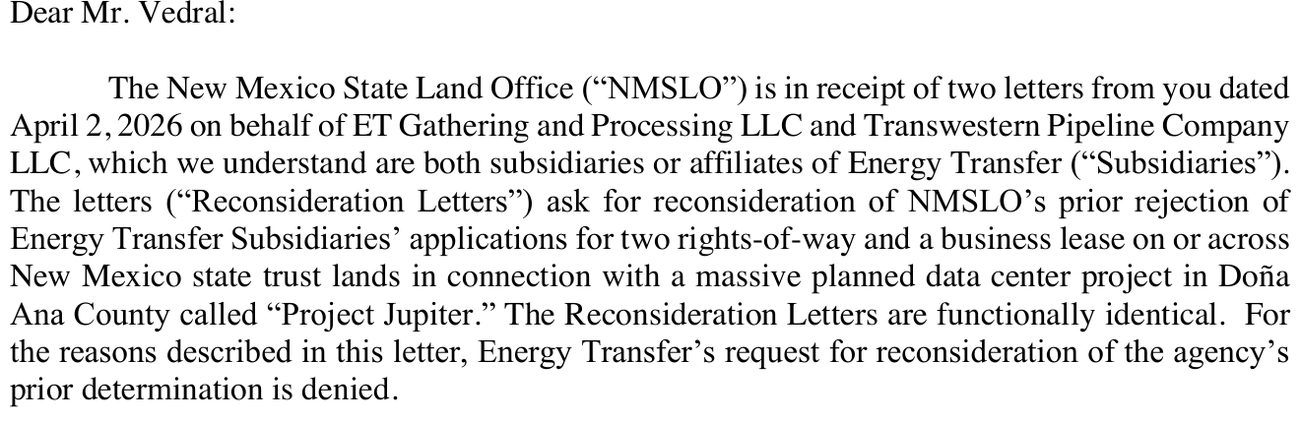
The opening paragraph of the New Mexico State Land Office letter to Energy Transfer.
The State Land Office letter of July 14, 2026: Energy Transfer's request for reconsideration “is denied.”Source: New Mexico State Land Office, public record, July 14, 2026

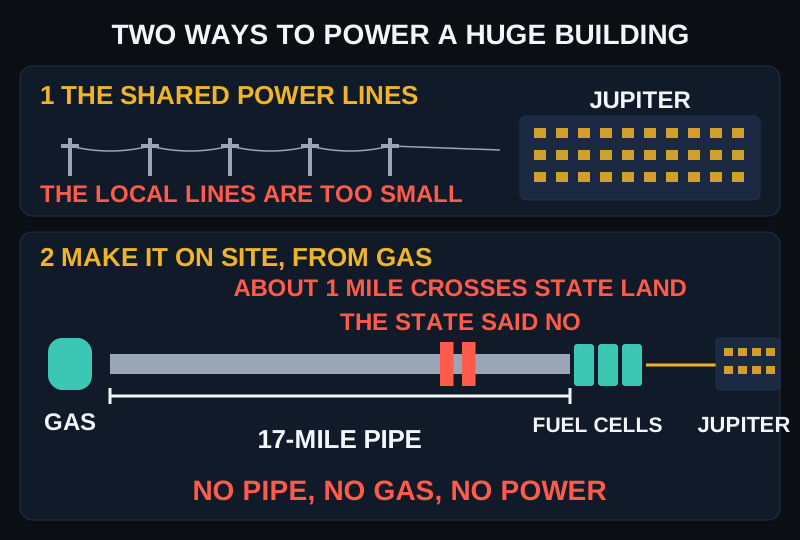
A campus that uses as much power as a mid-sized city cannot just plug into the local grid. The lines are not there. So the plan was always to make the power on site.

The first plan was gas turbines, like small jet engines that burn natural gas to spin generators. In April 2026, Oracle and BorderPlex switched to fuel cells from Bloom Energy. Fuel cells make electricity from gas through a chemical reaction instead of burning it. They cut the campus's expected greenhouse gas output from about 14 million tons a year to about 10 million, according to Searchlight New Mexico's timeline. That is about 28% less. It is still a huge amount, and the fuel cells still need gas.

The gas was supposed to arrive through a new 24-inch line called the Green Chile Lateral, about 17 miles long, built by an Energy Transfer company. Most of its route crosses private and federal land. About a mile of it, in two stretches, crosses state trust land, which is land New Mexico holds to raise money for its public schools. That short stretch needs a right-of-way permit from the New Mexico State Land Office.

The State Land Office said no. On March 20, 2026, it told Energy Transfer's companies their applications were canceled. On July 14 it turned down a request to reconsider, in a letter posted on its website. The office said the school trust would earn almost nothing from it: a one-time payment of about $32,000 and about $43,000 a year. Land Commissioner Stephanie Garcia Richard told the trade outlet NGI that "advancing the massive use of gas for a project of this scale is simply not in the best interest of the trust."

The result: the pipeline's start date moved from about August 15, 2026, to February 1, 2027, in Energy Transfer's federal filing, Source NM reported. Some reports say the company is now trying to route around the state land. That has not been confirmed.

The pipe is not the only open permit. The air-quality permit for the fuel cells is still waiting at the New Mexico Environment Department, with a decision due by November 23. The state Supreme Court paused that case in August, then let it go forward again on September 17. The hearing officer stepped aside, and a new one, retired federal judge James Browning, was named in early October.

Then there is politics. Water and emissions have made the project a fight ahead of the November 3 election. Deb Haaland, the Democratic nominee for governor, has said she would sign an order pausing new large data centers if she wins, Source NM reported. She did not say whether that would reach Jupiter.

So one of the most important AI building projects in the country is waiting on a pipe, a permit and an election.

What the letter actually asks for
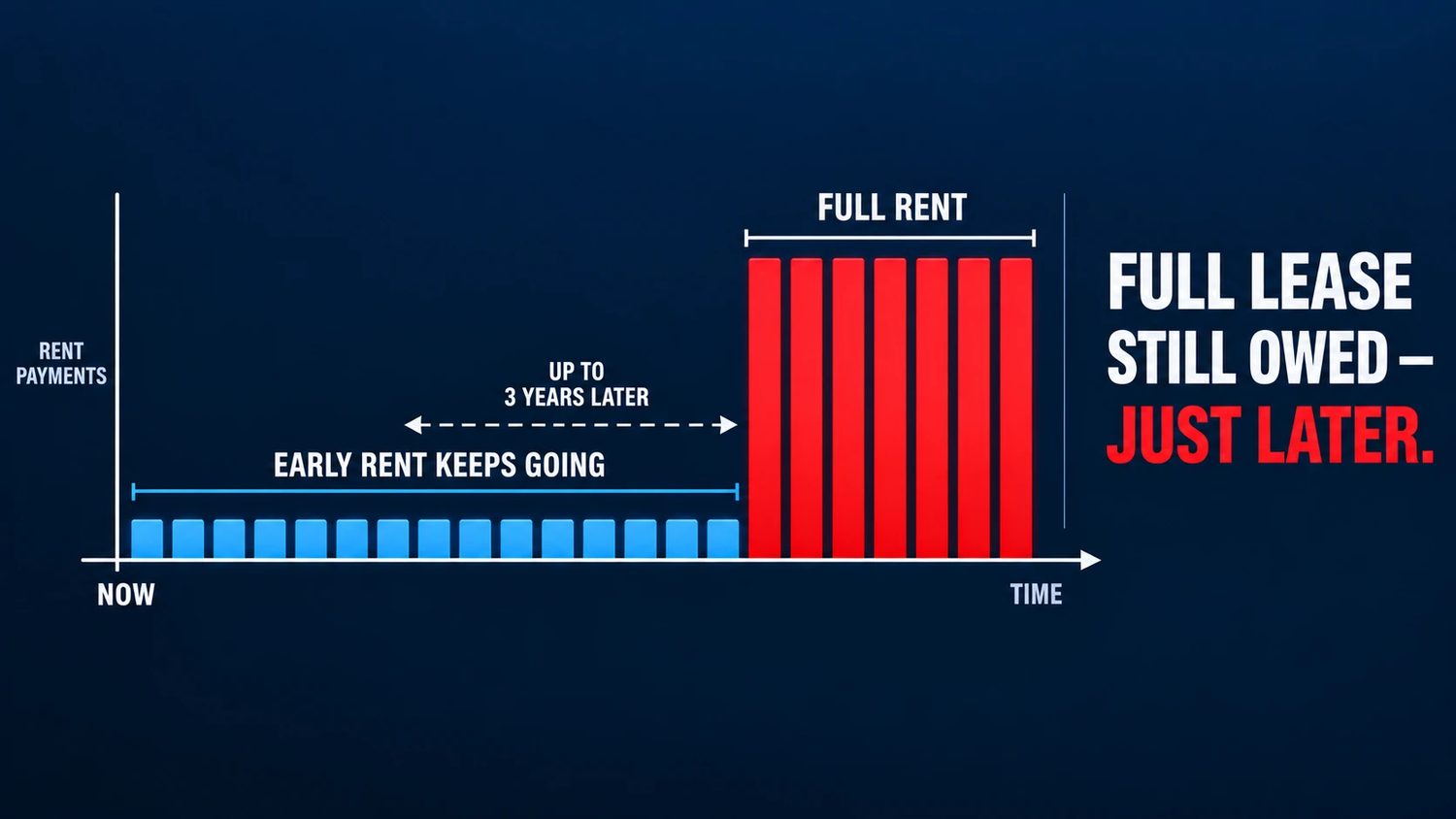
A bar chart: small early rent payments continue, then a tall block of full rent arrives up to three years later, with the words full lease still owed, just later.
What the letter can buy: the cheaper early rent keeps going while full rent slides back by up to three years. The full lease is still owed, just later.AI-generated diagram
The first words of a sentence in Oracle's April 27, 2026 news release: Oracle will continue to bear all energy costs for Project Jupiter.
Oracle's own April 2026 announcement: “Oracle will continue to bear all energy costs for Project Jupiter.”Source: Oracle news release, April 27, 2026

Force majeure is a clause in most big contracts. It covers events no one can control, like wars, floods and natural disasters. If one happens, the clause can excuse a company from deadlines or payments for a while.

Oracle did not walk away. It did not cancel the lease. It is still the main tenant. What the letter does is reserve a right. If the two sides agree a force majeure event tied to power has happened, Oracle could win a delay of up to three years before its full rent starts, Bloomberg reported, citing a person familiar with the matter. Until then, Oracle would stay on a cheaper rent stage that comes before the full lease payments, Reuters reported. Bloomberg added that it is not certain the move would free Oracle, and that Oracle would still owe the full rent for the whole lease once payments begin.

Oracle's official line is that the letter is routine. "Force-majeure notices are commonplace in developments of this scale," Egbert said. "They do not, by themselves, establish a project delay." Blue Owl said the notice "does not change the financial commitments to this multi-year project."

Here is the part Oracle does not lead with. Under its contract, Oracle carries full responsibility for securing power at the site, Reuters reported. Oracle's own April 2026 announcement said Oracle "will continue to bear all energy costs for Project Jupiter." So Oracle is claiming an act of God over the one thing the contract already made its job. Julien Simon, an AI industry writer, made that point in a piece he titled "An Act of God With Letterhead."

Think about your own lease. You do not send your landlord a letter about a flood you think will never come. A company sends one because it wants the right in its pocket before it needs it. Two weeks earlier, on September 10, Oracle co-CEO Clay Magouyrk told investors the data center was "definitely on track." Fourteen days later, the letter went out.

Oracle's money problem
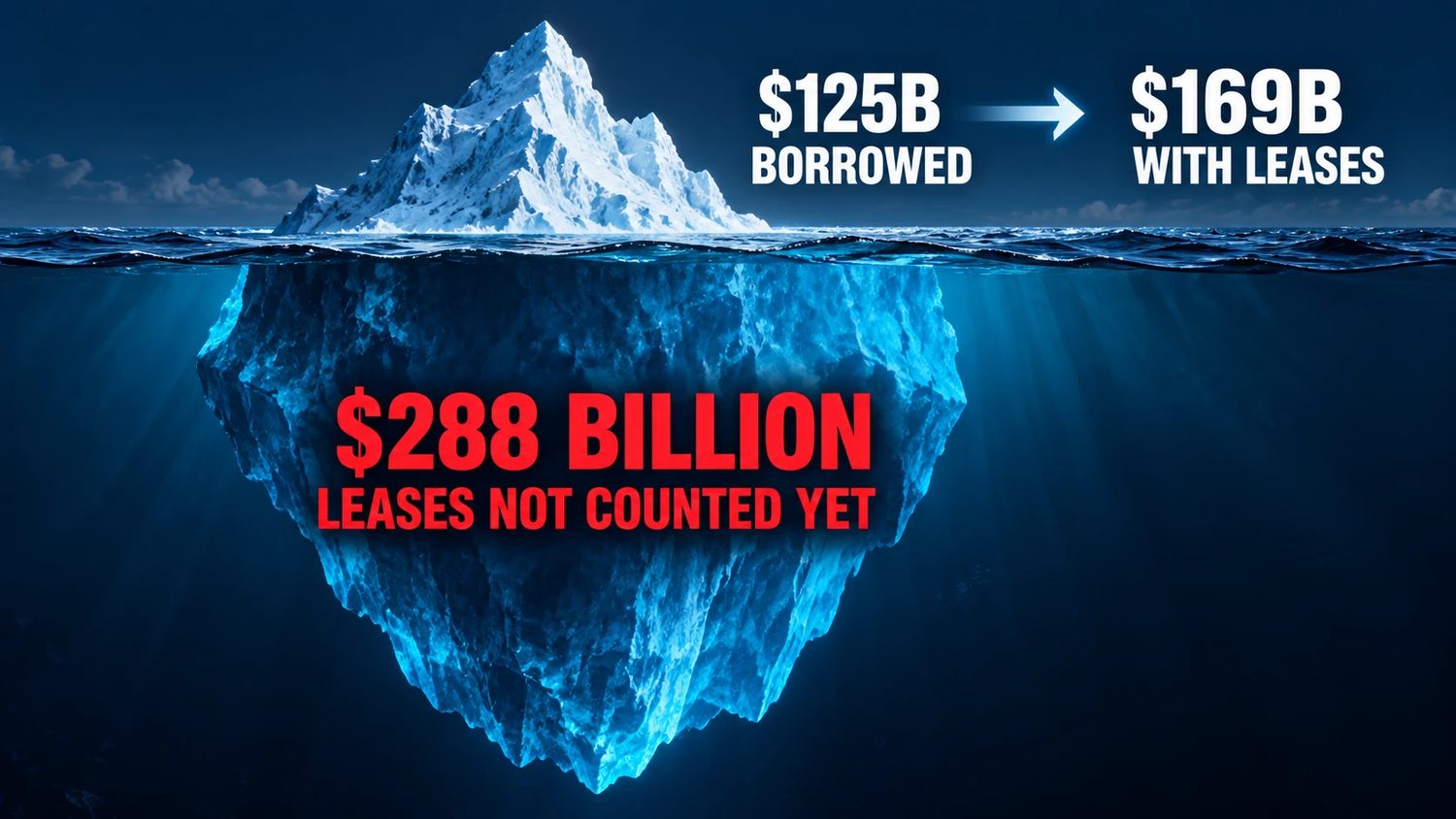
An iceberg: above the water 125 billion dollars borrowed, 169 billion with leases; below the waterline 288 billion dollars of leases not counted yet.
Oracle owed about $125 billion in notes and loans; with leases already on its books, about $169 billion. Under the waterline sit $288 billion of leases that have not started.AI-generated diagram
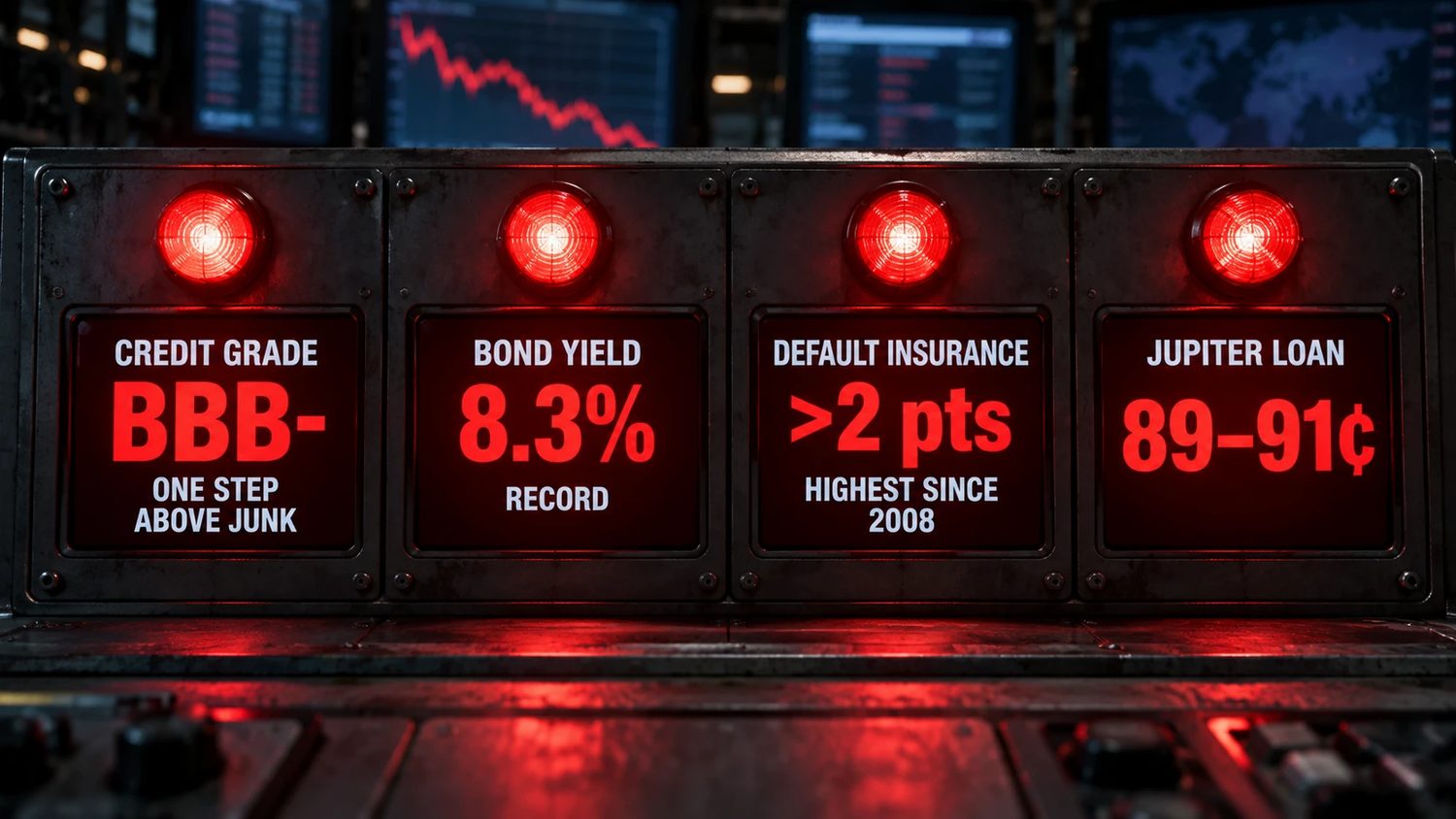
A dashboard of four red lights: credit grade BBB-minus, bond yield 8.3 percent, default insurance above 2 points, Jupiter loan 89 to 91 cents.
Four warning lights: a BBB-minus credit grade, a record 8.3% bond yield, default insurance above 2 points, and the Jupiter loan quoted at 89 to 91 cents.AI-generated diagram

If you have ever bought a house before you sold the old one, you know the squeeze. To fill buildings like Jupiter, Oracle has to buy the chips and sign the leases years before OpenAI's money shows up. It cannot pay for that out of its pocket.

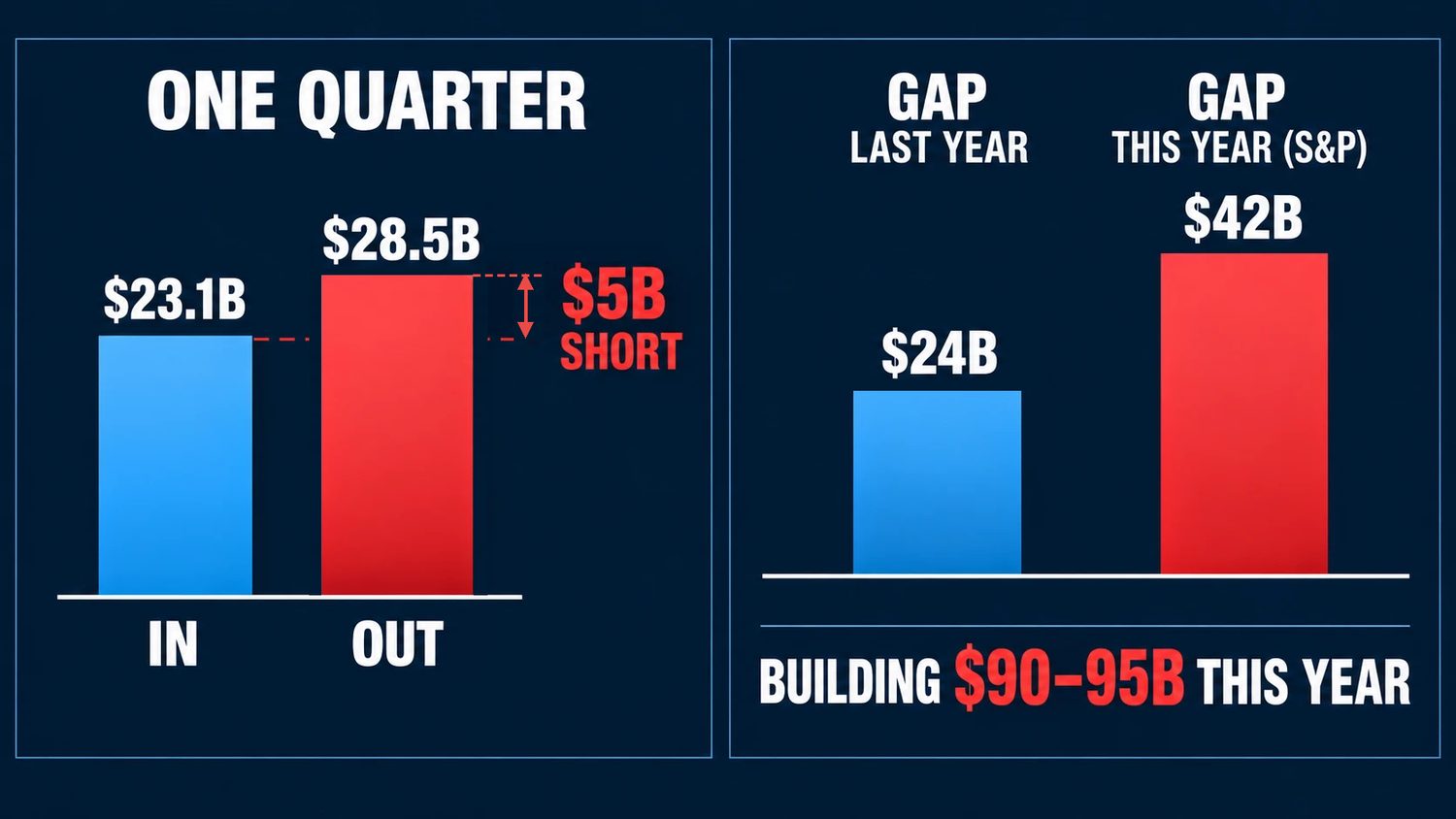
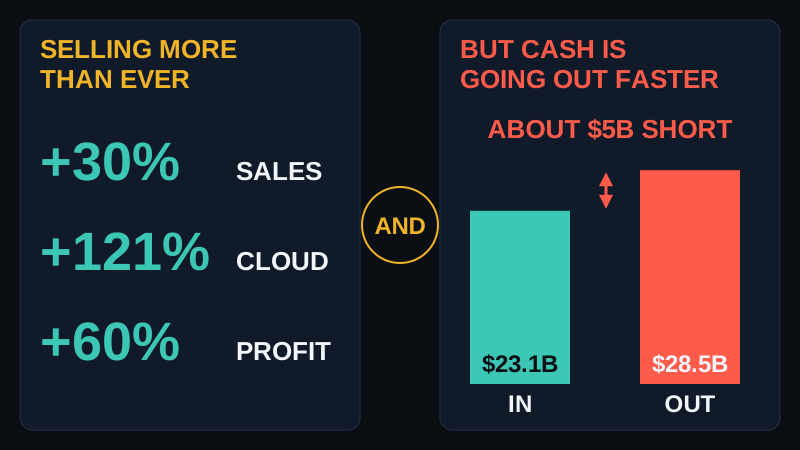
In the three months that ended August 31, Oracle took in $23.1 billion in cash from running its business and spent $28.5 billion building and buying equipment. That left it about $5 billion short in a single quarter. For its last full fiscal year, the gap was about $24 billion. S&P, one of the big credit rating companies, expects a gap of about $42 billion this year as Oracle spends $90 billion to $95 billion on building.

Oracle fills the gap with other people's money. It sold $19.9 billion of new stock this year, starting one day after Larry Ellison set up a plan to sell his own shares, Filing Insights found. Nothing shows the two moves were linked. If you own Oracle stock, every new share it sells makes your slice a little smaller. And it borrows. At the end of August, Oracle owed about $125 billion in notes and loans, its quarterly filing shows. Count the leases already on its books and the total is about $169 billion.

The bigger number sits in a footnote. Oracle has signed another $288 billion of leases, "substantially all related to data center arrangements," that have not started yet, its August quarterly report says. Accounting rules leave a lease off the balance sheet until it begins. These leases start between now and 2029 and run 15 to 19 years. That is more than double everything Oracle has borrowed. The number everyone quotes is the small one.

Bond buyers have noticed. In July, S&P cut Oracle's credit rating to BBB-minus, one step above junk. Junk is the label for bonds with a real risk of not being paid back. Moody's, another rating company, has Oracle on a negative outlook. Some of Oracle's long-term bonds hit a record yield of about 8.3% around September 24, according to market data relayed from Bloomberg. A yield is the interest rate a buyer demands to hold the bond, so a higher one means lenders want more pay for more risk.

The price of insurance against Oracle missing its debt payments, called a credit default swap, went above 2 percentage points a year in September. That is a level last reached during the 2008 financial crisis, Fortune reported.

The Jupiter loan tells the same story. On September 18, the Financial Times reported that banks including Santander and Jefferies were quoting the $18 billion in loans at 89 to 91 cents on the dollar. The banks had planned to sell pieces of the loan to other investors and could not, so they were left holding more of it. If you held a piece of that loan, you could only sell it for about 90 cents of every dollar you were owed. A loan that trades at 90 cents means the market thinks there is a real chance it will not be paid back in full. That was six days before the letter. The letter did not start the worry. It confirmed it.

The letter is not a default. Bloomberg reported that it "does not constitute an event of default" on the loan, and the loan is still being paid. A 90-cent quote is a price, not a loss. But prices are where trouble shows up first.

One customer, half the orders
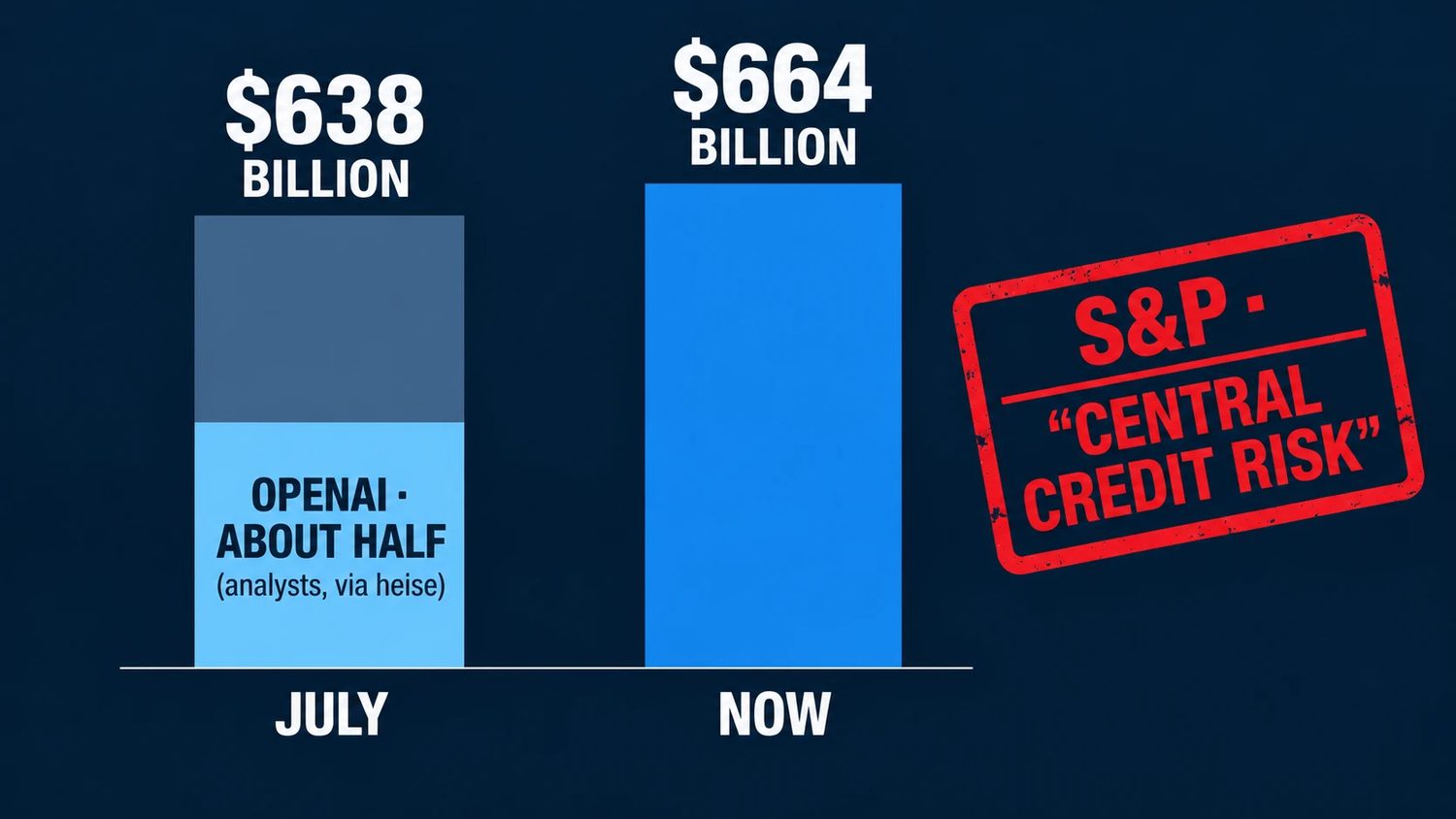
Two bars: 638 billion dollars in July with about half colored for OpenAI and a stamp reading central credit risk, and 664 billion dollars now.
The backlog: $638 billion in July, about half of it owed by OpenAI, and $664 billion now.AI-generated diagram
Two tired men in suits sitting back to back on an empty parking lot at dusk, each holding the other up.
Oracle borrows to build for a customer that pays with investors' money. Each one leans on the other.AI-generated illustration

In September 2025, Oracle and OpenAI signed a cloud deal reported at $300 billion over five years, starting in 2027, according to the Wall Street Journal. That one contract changed Oracle's order book overnight.

Oracle now says it has $664 billion of business signed and not yet delivered. When S&P cut Oracle's rating in July, the backlog was $638 billion, and analysts estimated about half of it was owed by OpenAI, heise reported. S&P called OpenAI a "central credit risk" for Oracle. Our AI bubble article walks through that part of the chain.

If you are counting on Oracle's backlog, you are mostly counting on OpenAI. A large share of Oracle's future is one company's promise to pay. And OpenAI pays largely with money it raises. In 2025 it also announced huge deals and agreements with Nvidia, AMD, Broadcom and CoreWeave. To cover them, it depends on new funding rounds, SoftBank's backing, its deal with Microsoft, and maybe a stock market listing someday.

Put the two together. Oracle borrows money to build for a customer that pays its bills with money raised from investors. Each side's numbers look good as long as the other side keeps going.

Larry Ellison's shares
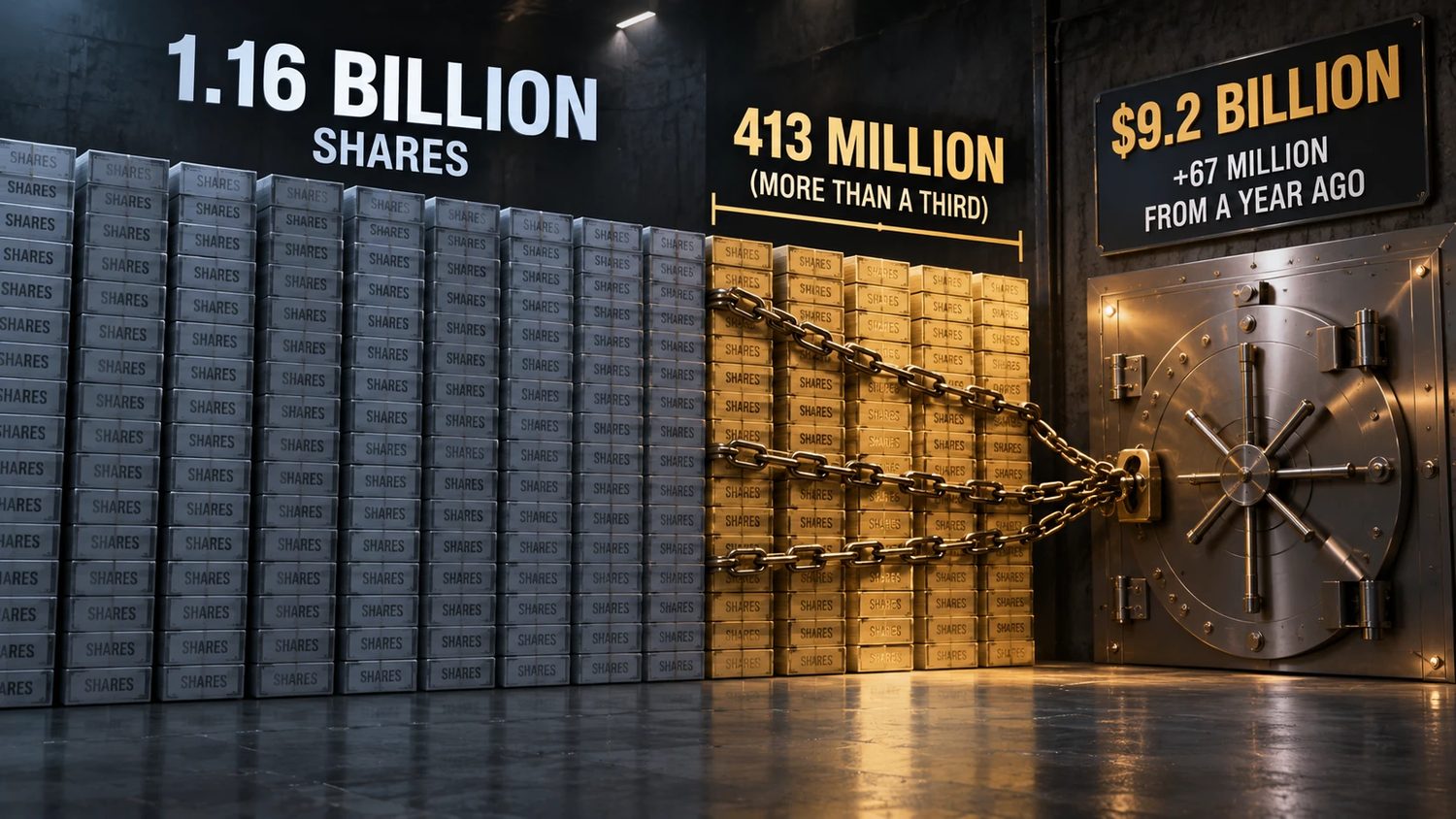
A wall of 1.16 billion shares, with 413 million turned to gold and chained to a bank vault door.
Larry Ellison has pledged 413 million of his roughly 1.16 billion Oracle shares as collateral, about $9.2 billion at the September 25 close.AI-generated diagram
A bullet from Oracle's proxy statement reading anti-pledging policy applicable to all employees and directors except Mr. Ellison, with those words circled in red.
Oracle's 2026 proxy statement: the anti-pledging policy covers all employees and directors “except Mr. Ellison.”Source: Oracle definitive proxy statement filed with the SEC, September 25, 2026

Larry Ellison co-founded Oracle and is its chairman. He owns about 38% of the company, about 1.16 billion shares, according to the proxy statement Oracle filed in late September.

He has pledged 413 million of those shares as collateral for personal loans. That is more than a third of his stake. It is 67 million more shares than a year earlier, worth about $9.2 billion at the September 25 closing price. The board says the loans fund his "outside personal business ventures." CNBC has reported that Ellison helped finance the Skydance and Paramount merger, run by his son David Ellison, and is backing a bid for Warner Bros. Discovery.

Oracle has a rule against this. Its policy bans employees and directors from pledging company stock as collateral, with one exception: Larry Ellison. The proxy summary says it in so many words: "Anti-pledging policy applicable to all employees and directors except Mr. Ellison."

Why should you care about one man's loans? A loan backed by stock is sized by what the stock is worth. If the price falls far enough, the shares no longer cover the loan. Then the lender can ask for more cash or more shares. That is called a margin call. If the borrower cannot meet it, the lender can sell the pledged shares.

The chain could run like this. Oracle's stock falls. A lender asks Ellison for more collateral. If he cannot or will not meet it, hundreds of millions of shares could hit the market. Selling that many pushes the price down further. That weakens the collateral that is left, which can bring the next call. Oracle's stock was about $145 in early October, about 55% below its high of $322.54 last fall, so this is not a far-off picture.

The board's answer: none of the shares sit in a margin account, and it "believes that Mr. Ellison has the financial capacity to repay his personal term loans without resorting to the pledged shares." He is one of the richest people on earth, so that may be true. It is still a bet on one man's other businesses holding up, sitting under the stock of a company that is borrowing record amounts.

Then there was the sale plan. On June 22, Ellison set up a plan to sell up to 50 million Oracle shares, worth about $7.5 billion, before October 24. These pre-set plans, called 10b5-1 plans, let executives schedule sales ahead of time. CNBC noted that, by FactSet's records, Ellison had not sold more than 25,000 shares at once this century.

Shareholders found out on Friday evening, September 11, when the plan showed up in Oracle's quarterly filing. The next day, a Saturday, Oracle announced Ellison had canceled it. "No Oracle stock was sold under the plan," the company said, and he "has no other plans to sell." By then the stock was more than 18% below where it closed the last trading day before he set up the plan, Reuters reported. Reuters tied that drop to Oracle's spending and cash worries, not to the plan.

No shares were sold. But a plan is a signal. The man who knows Oracle best, the man asking investors to back one of the most aggressive AI buildouts in American business, quietly put himself in position to sell $7.5 billion of it. Twelve days after the cancellation, the force majeure letter went out.

The stack of promises
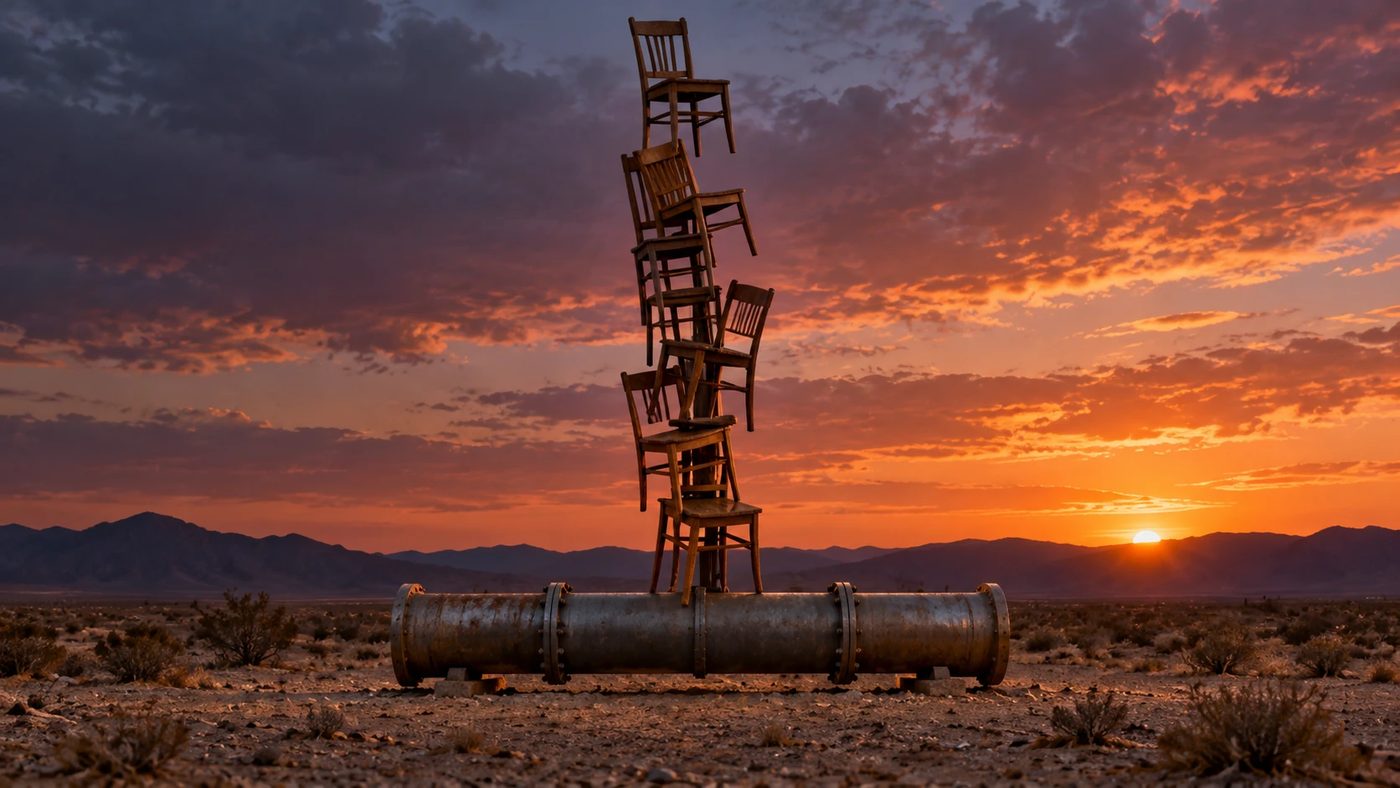
A tall tower of stacked wooden chairs balanced on a single steel pipe lying in the desert at sunset.
Every layer rests on the one below it, like chairs stacked on a pipe.AI-generated illustration
Five dominoes falling in a row labeled power late, rent delayed, loan stressed, junk rating, stock falls, with the words none has happened, all are open doors.
One way it could unravel: power late, rent delayed, loan stressed, a junk rating, a falling stock. None of these has happened. Each is an open door.AI-generated diagram

From the bottom up:

  1. The banks get paid if the builder collects rent.
  2. The builder collects rent if Oracle pays.
  3. Oracle pays if OpenAI pays for the computing power.
  4. OpenAI pays if its investors keep writing checks.
  5. And Oracle's full rent does not start until the campus switches on.

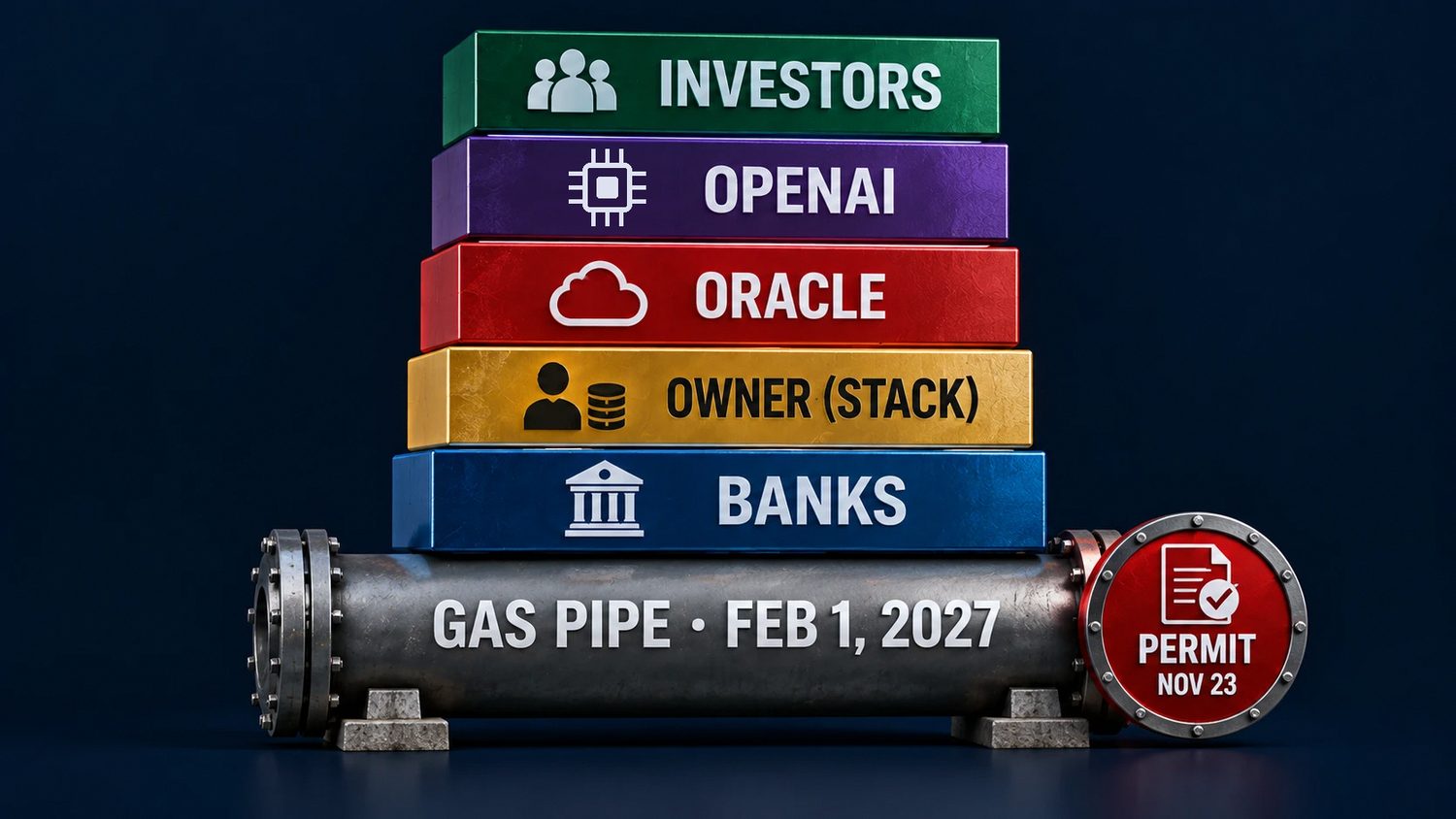
If you pull out any one layer, the ones under it feel it. Each layer leans on the layer above it, like a stack of chairs where every chair is resting on the one on top. It holds as long as nobody moves. Today, the whole stack is resting on something much plainer than chips or AI models. It is resting on a gas pipe in the desert that is now due February 1, and a permit due by November 23.

Nothing here says Ellison did anything illegal. The point is how much of this rests on a few people's choices. Billions in debt, buildings and stock value can move on what one man decides to do with his shares.

Most earlier warnings about the AI buildout came from short sellers, analysts and commentators, people outside the deals. This one came from inside. A company in the middle of the chain told its partners, in writing, that one piece might not arrive on time.

That is how this could unravel, step by step. It is a chain of possibilities, not a forecast. If the power is late, Oracle's rent delay could kick in. If rent is delayed, the builder's payout is delayed and the loan stays stressed. If Oracle's costs keep running ahead of its cash, the rating agencies could cut it to junk. A downgrade to junk would push about $120 billion of Oracle bonds out of the investment-grade indexes that many funds follow, according to market reports, which would force those funds to sell. Forced selling makes borrowing more expensive for Oracle, right when it needs to borrow most. And a falling stock brings the pledged-share chain back into play.

None of those steps has happened. Every one of them is a real door that is now open.

Oracle's case
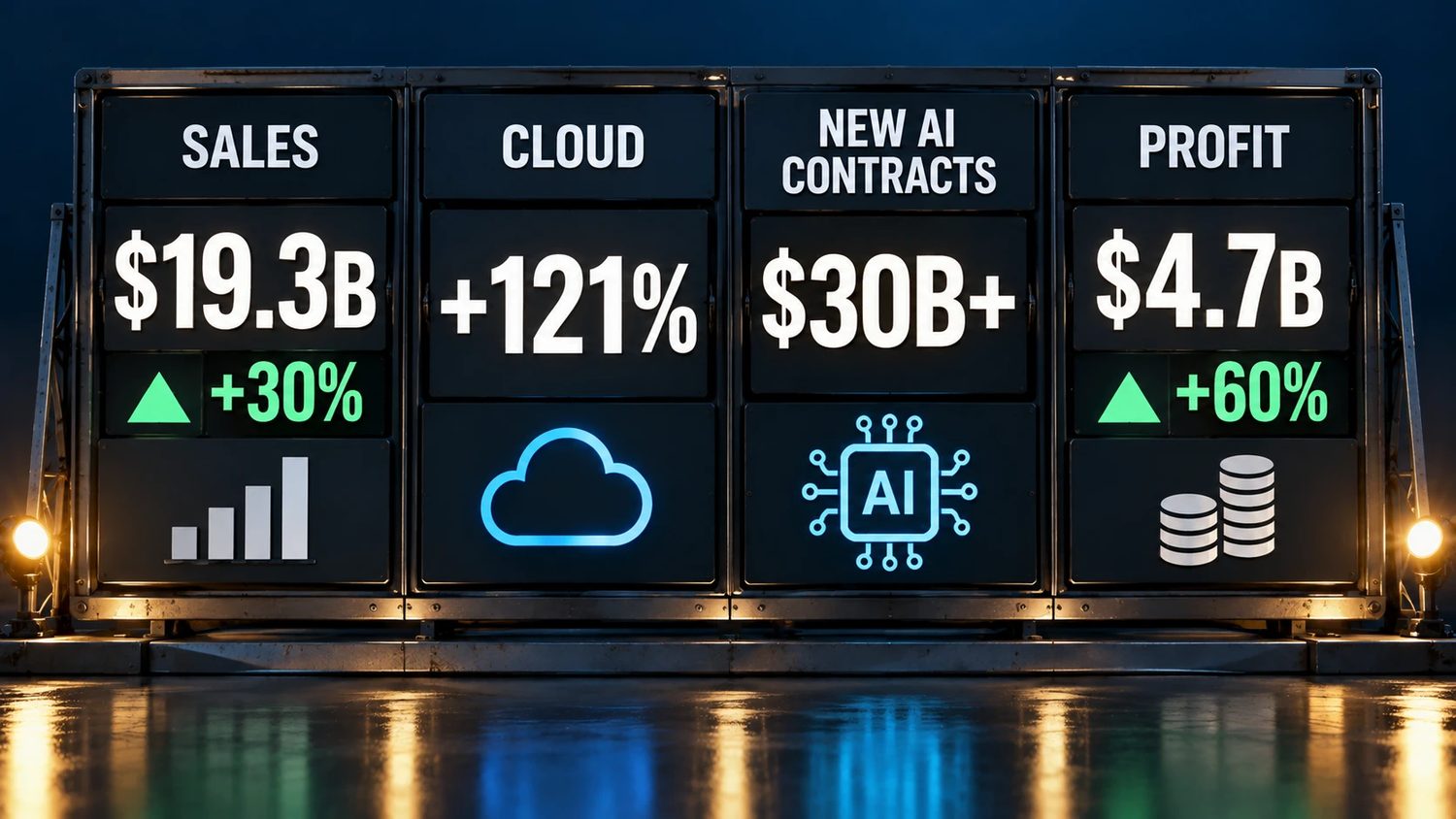
A scoreboard: sales 19.3 billion dollars up 30 percent, cloud up 121 percent, new AI contracts over 30 billion dollars, profit 4.7 billion dollars up 60 percent.
Oracle's quarter: sales of $19.3 billion, up 30%; cloud up 121%; more than $30 billion in new AI contracts; profit of $4.7 billion, up 60%.AI-generated diagram
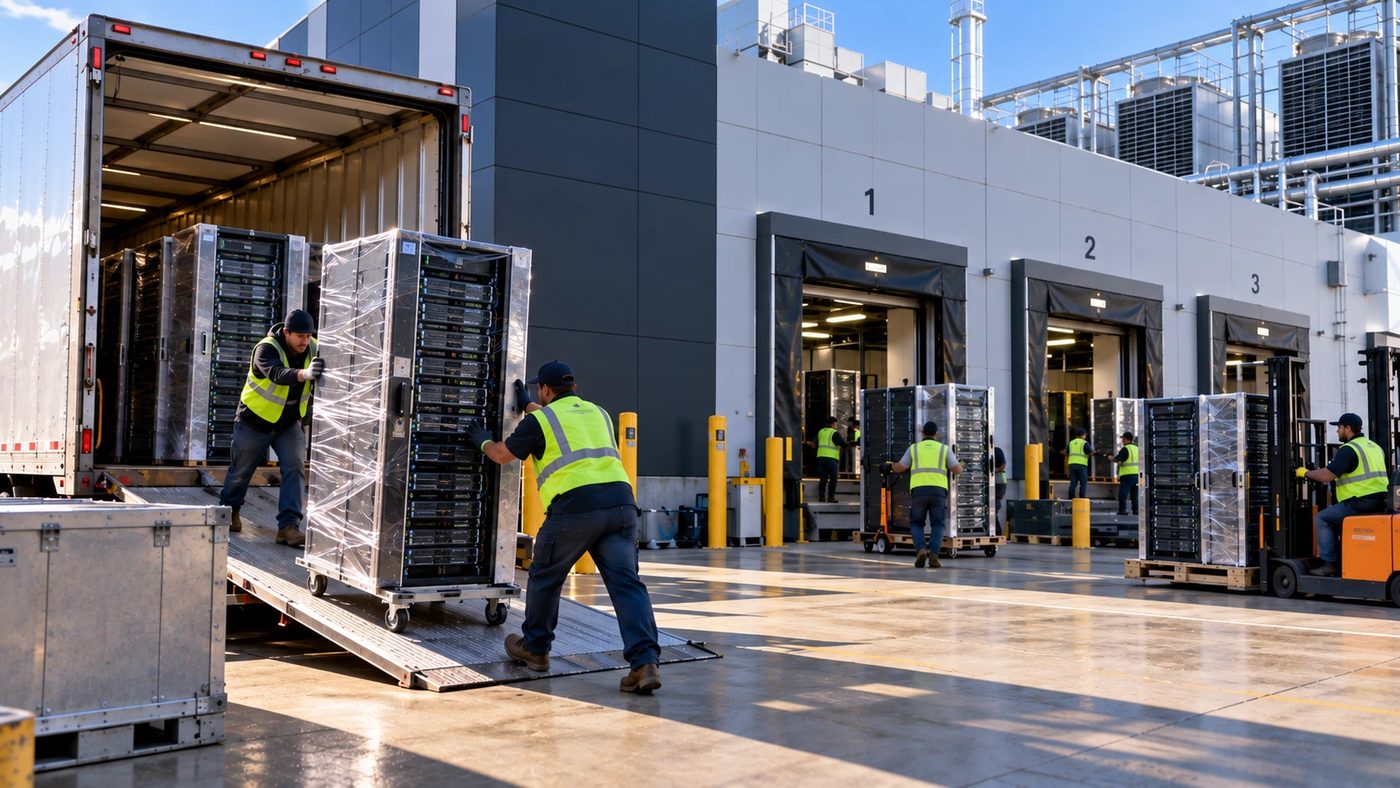
Workers rolling new server racks off a truck at a busy data center loading dock in morning light.
Oracle says customer demand “continues to grow faster than supply.”AI-generated illustration

Oracle has real numbers on its side, and you should weigh them.

Two weeks before the letter, Oracle reported its quarter. Revenue was $19.3 billion, up 30%. Its cloud infrastructure business grew 121%. It signed more than $30 billion of new AI contracts, raised its forecast, and said it delivered 850 megawatts of new capacity. Customer demand, Oracle said, "continues to grow faster than supply." Net income was $4.7 billion, up 60%.

Magouyrk argued on the call that a plan needing "100% achievement of every one of their deliverables" is "a bad plan," which is why a company builds in slack. Blue Owl said the partners are "fully aligned." Bloom said on X that it remains committed and on schedule. After a flood reached the site on September 30, Oracle and STACK said "no critical infrastructure was damaged."

Some analysts agree with Oracle. William Blair kept its buy rating and saw little effect on this year's revenue, Reuters reported. A Motley Fool writer argued on September 30 that Oracle's 8% bond yields are "an Oracle problem, not an AI problem," because Microsoft, Alphabet, Amazon and Meta can pay for their buildings out of their own cash. Even Filing Insights, which is skeptical, called Jupiter a case of "supply struggling to come online on schedule, not demand collapsing."

That is a fair point. You and millions of other people want what Oracle is building. But it also makes the case. If demand is real and Oracle still has to lean this hard on borrowed money, lenders, and one customer, then the risk is not whether AI is useful. The risk is whether the money holds out until the buildings turn on.

What this means for you

A hand dropping a gold coin stamped Oracle into a glass jar labeled 401(k) on a kitchen counter.
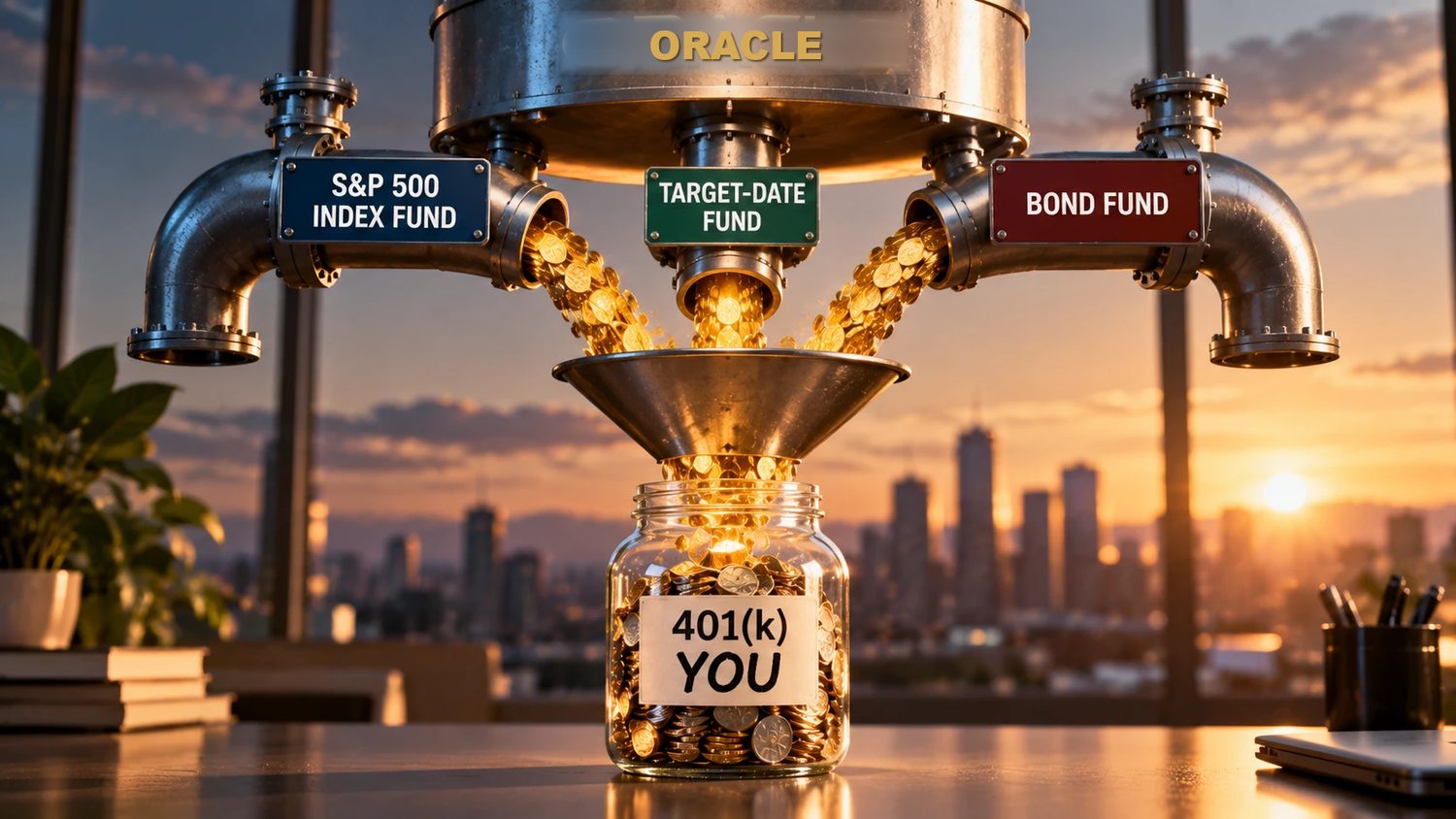
Oracle can sit inside the funds in your 401(k) even if you never picked it.AI-generated illustration
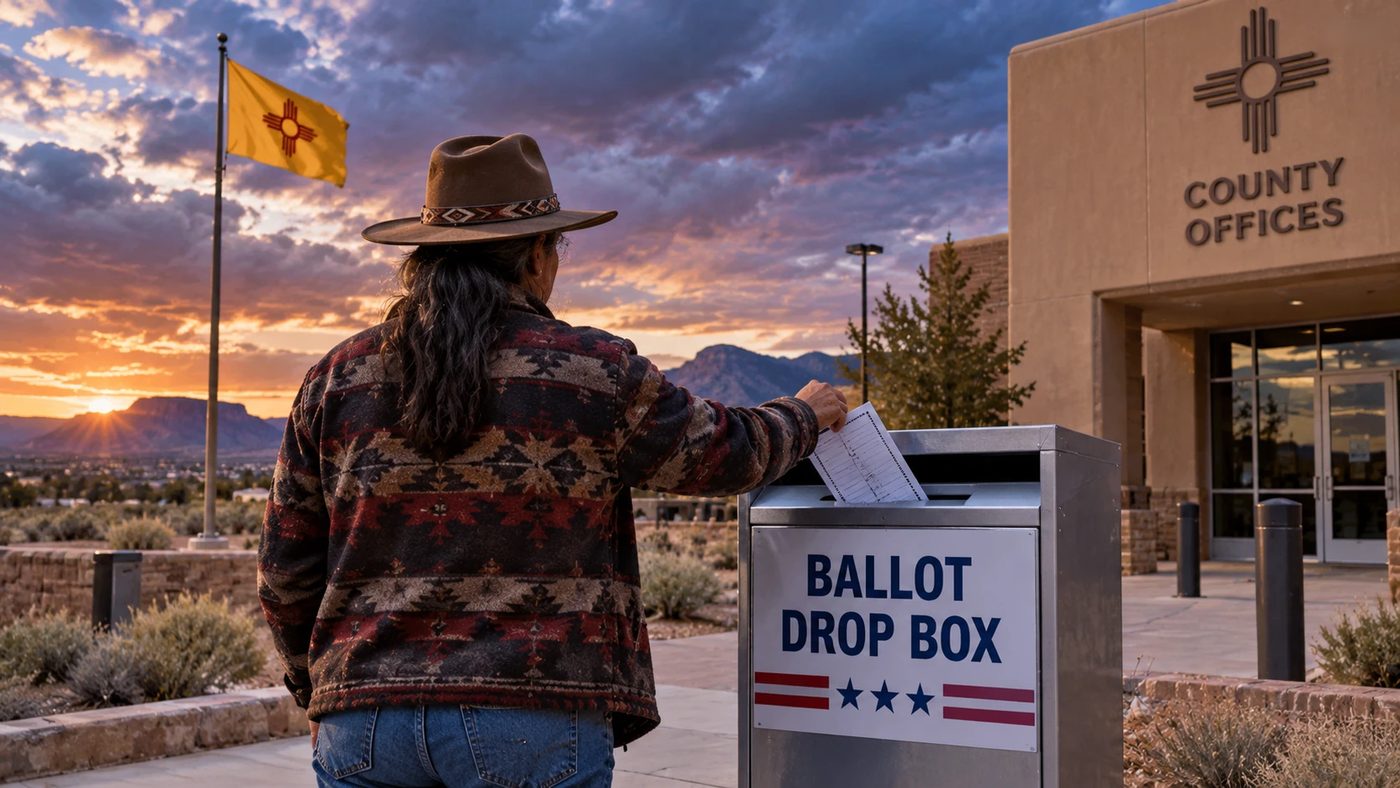
A voter seen from behind dropping a ballot into a ballot drop box outside a county office.
In New Mexico, Jupiter is a live question in the November 3 election.AI-generated illustration

You may not own Oracle stock on purpose. You probably own it anyway. Oracle is in the S&P 500, so S&P 500 index funds hold it, and many target-date retirement funds hold it through their stock funds. Its bonds sit in many bond funds that buy investment-grade debt. If Oracle were cut to junk, the funds that must sell would include the kind in a lot of 401(k) plans.

Banks and private credit firms, the lenders outside the regular banking system, are carrying the Jupiter loan. If projects like this stumble, those losses travel. They show up in the funds and pensions that bought into private credit for higher returns.

If you live in New Mexico, this is on your ballot. The tax break, the water, the air permit and a possible pause on new data centers are all live questions in the November 3 election. The deal pays about $12 million a year, most of it to the county and some to schools, and that payment depends on the project going forward.

And if you just use AI tools, the cost of building them is not only paid in dollars. Much of it is paid with borrowed money that has to be paid back, by companies like Oracle whose stock is in your savings.

What to watch next
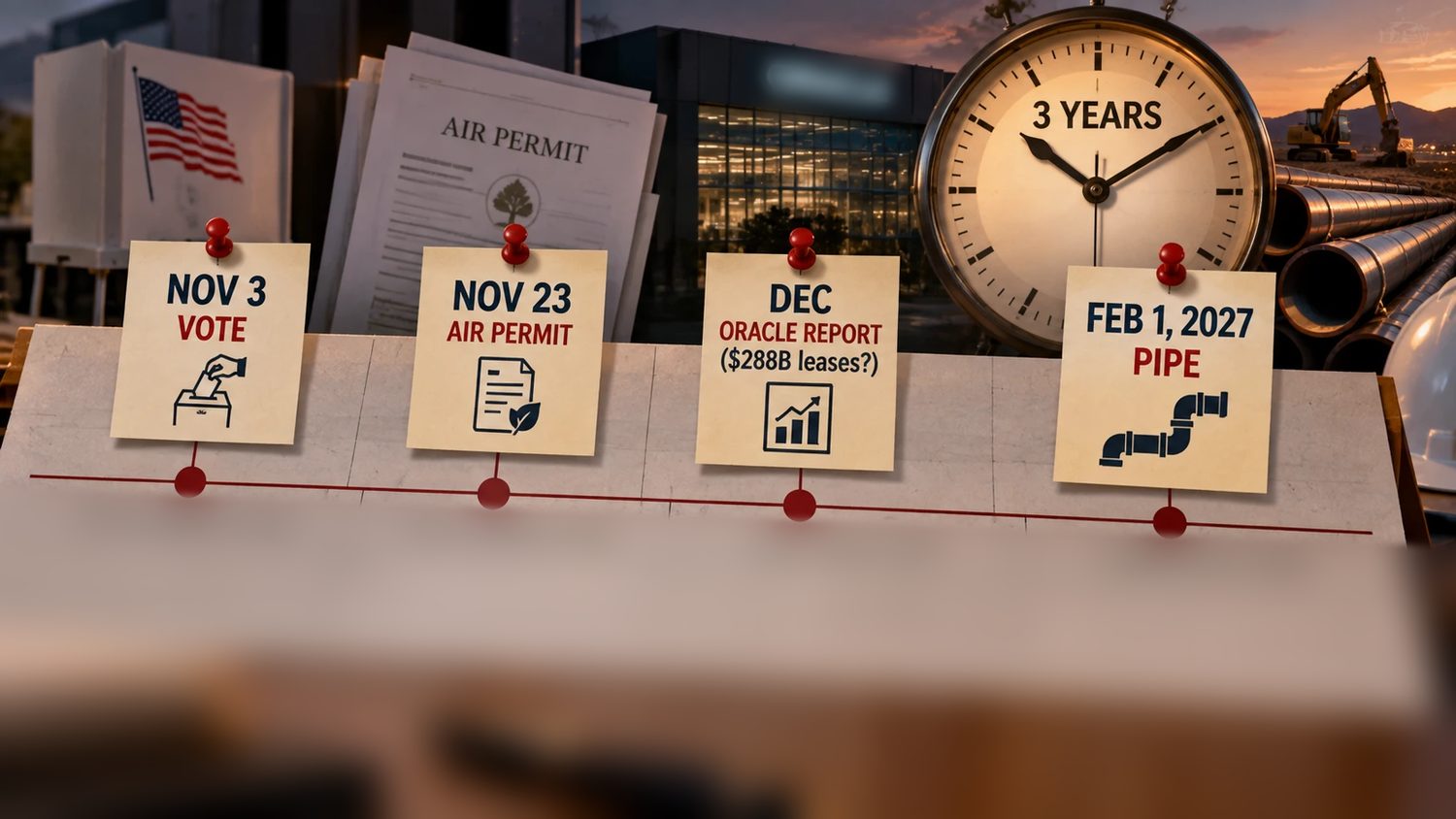
A desk calendar with four pins: Nov 3 vote, Nov 23 air permit, December Oracle report, Feb 1 2027 pipe, and a clock reading 3 years.
The dates to watch: November 3 vote, November 23 air permit, December Oracle report, February 1, 2027 pipe.AI-generated diagram
The Jupiter site from the air at dawn, cranes still, and a pipe trench ending before it reaches the buildings.
The site at dawn, with a pipe trench that stops short of the buildings.AI-generated illustration

Mark these dates if you want to know how this ends.

  • November 3: New Mexico's governor election. A pause on new large data centers is on the table.
  • November 23: Deadline for the state's decision on the fuel cell air permit.
  • Early December: Deadline for other agencies' decisions on the pipeline's federal permits, according to Julien Simon's reading of the filings.
  • Around December: Oracle's next quarterly report is expected. Watch the cash gap, the borrowing, and whether the $288 billion of unstarted leases grows.
  • Oracle's next filings: any new sale plan or change in Ellison's pledged shares will show up there.
  • February 1, 2027: The pipeline's new start date. If that slips, the three-year clock in Oracle's letter starts to matter.

Oracle may be right that the letter is just paperwork. But paperwork is how companies get ready for what they think could happen. And for now, one of the biggest AI projects in the country is waiting on a pipe.

Sources

Pictures and diagrams support the article. Every number here is in the article text and in the sources above.
🎧 Listen — teach me from scratch

Teach me from scratch: Oracle and Project Jupiter

Current as of October 7, 2026. This story is moving. Oracle's stock, its bond prices and the permits in New Mexico can change week to week, so some numbers here may have changed since it was written.

This side teaches the same story as the article, from zero. You will see the same facts and the same numbers again here, but broken into smaller steps and explained before they are used. Each part starts with a gold box that explains the idea you need first. Then the lesson walks through it in small steps. Hard words get explained when they show up.

Part 1 of 11

What is Project Jupiter? Why Oracle's biggest AI bet is waiting on a gas pipe

💡 What this part is about

Two ideas run through this whole story. First, AI runs inside giant buildings full of computer chips, and those buildings need a huge, steady flow of electricity. No power means no AI, and no rent money. Second, a company that signs a contract can send a formal warning that something outside its control might make it late. Oracle, the company renting this building, just sent that kind of warning. Lenders read it the way you would read a friend saying, "I might not pay you back on time."

Four giant buildings lit at night beside a city of lit houses, with the words 2.45 gigawatts equals 1.8 million homes at once.
The four Jupiter buildings are supposed to pull 2.45 gigawatts of power, roughly what 1.8 million homes use at once, Bloomberg reported.AI-generated diagram
🔍 Go deeper

For example, say your friend borrows money from you to open a pizza shop. The shop is half built. Then your friend sends you a note: "If the oven is late, I may not be able to pay you on time." Nothing has gone wrong yet. But you would start to worry about getting paid back, and you would want to know why the oven might be late.

Picture driving west out of El Paso, Texas, into New Mexico. You would pass a huge construction site. About 3,500 workers are putting up four giant buildings there. The buildings sit on 1,400 acres of desert. An acre is about three-quarters the size of a football field, so that is more than 1,000 football fields of land.

When the buildings are finished, they are supposed to use 2.45 gigawatts of electricity. A gigawatt is a huge unit of power. Bloomberg reported that 2.45 gigawatts is roughly enough electricity to run 1.8 million homes at the same time. That is how much power four buildings full of computers can need.

This place is called Project Jupiter. It is one of the biggest pieces of a much bigger plan called Stargate. Stargate is a plan to build artificial intelligence computers across the country. President Trump announced Stargate at the White House together with three men: Larry Ellison, Sam Altman and Masayoshi Son.

AI tools like ChatGPT run on huge rooms full of computer chips. Those rooms are called data centers. A data center needs two things above everything else: computer chips, and a steady supply of electricity.

The company that is going to rent and run Jupiter is Oracle. Oracle is a big tech company. It is betting heavily on renting out computer power for AI.

On September 24, 2026, Oracle sent a letter to the company that owns and is building Jupiter. This was not a casual note. It was a force majeure notice. Force majeure is a legal term for an event outside your control, so serious that it can excuse you from keeping a promise in a contract on time. Sending that letter was Oracle telling its own partner, in writing, that the power at Jupiter might not be ready on schedule, and that Oracle might not pay full rent on time because of it.

Oracle says the letter means nothing. Oracle spokesman Michael Egbert said, "Project Jupiter remains on our planned schedule." But the people who lent money to build Jupiter were already acting nervous before the letter even went out. The Financial Times reported that six days before the letter, banks were quoting the $18 billion construction loan for Jupiter at about 90 cents on the dollar. That means if you had a right to be paid one dollar from that loan, the market thought it was only worth buying for about 90 cents. A loan trading below its full value is a sign that buyers see real risk of not being paid back in full.

Why does this letter matter so much? It is the first time any company at the center of the AI building boom has put a worry like this in writing to its own partners. And the reason is not a shortage of computer chips, and it is not a failed AI model. The reason is far more ordinary: a 17-mile gas pipe that a New Mexico state office would not let cross a small strip of its land.

The key thing to remember: Jupiter is a giant AI building that cannot run without power, and Oracle warned in writing that the power might be late.


Part 2 of 11

Who does what in the desert

💡 What this part is about

A big building project is a chain of money. An owner borrows to build. A renter pays rent to the owner. The renter makes its money by selling space to its own customers. Each one can pay the next only after it gets paid. At Jupiter, the owner is STACK, the renter is Oracle, Oracle's big customer is OpenAI, and the lenders are about 20 banks. Keep those four straight and the rest of the story is easy to follow.

A chain of four blocks: OpenAI the customer pays Oracle the tenant, Oracle pays rent to STACK the owner, and about 20 banks lent the money.
Who owes whom: OpenAI pays Oracle, Oracle pays rent to STACK, and about 20 banks lent STACK the money to build.AI-generated diagram
🔍 Go deeper

For example, picture a storage building. One person owns it. A moving company rents the whole thing. The moving company then rents space inside to one big customer. The owner borrowed money from a bank to build it. The bank gets paid only if the owner gets rent. The owner gets rent only if the moving company pays. And the moving company pays mostly because its big customer pays it.

Think of Project Jupiter like one giant apartment building. It is being built for a single tenant. That tenant already has one customer lined up to fill every room before the building even opens.

The owner and builder is a company called STACK Infrastructure. STACK is a data center company owned by funds managed by an investment firm named Blue Owl Capital. A local developer, BorderPlex Digital Assets, is also a partner in the project. It is important to hold onto this: STACK owns the buildings. Oracle does not.

Oracle is the tenant. A tenant is the one who rents, not the one who owns. Oracle signed a long lease, meaning a long-term contract to rent the buildings, and Oracle is the one who will fill them with computer chips and run them.

Then Oracle turns around and rents that computer power to OpenAI, the company behind ChatGPT. So Oracle sits in the middle of the deal. On one side, Oracle owes rent to STACK, the owner. On the other side, Oracle is waiting on OpenAI to pay it. That is a fine place to stand, as long as the building actually opens on time and OpenAI keeps paying.

Now follow the money that built it. About 20 banks lined up together to lend $18 billion. This is called a construction loan, which is a loan used to pay for building something before it exists. Bloomberg and Reuters both reported that figure. Blue Owl itself put in about $3 billion of its own money. Reuters reported that while the buildings are still being built, Blue Owl earns about 9% a year on the money it put in. Once the buildings are finished and running, that rate rises to about 11% a year.

The local government helped too. Doña Ana County, where the site sits, voted 4 to 1 among its commissioners in September 2025 to approve a big tax break. The tool the county used is called industrial revenue bonds. They are a way New Mexico counties give big projects a tax break. The county approved $165 billion of them, which is the amount the companies expect to invest in the project. This tax break takes the property off the normal property-tax rolls for up to 30 years. In exchange, El Paso Matters reported, the companies agreed to pay the county a flat $12 million a year instead of regular property taxes.

That same deal set two deadlines. The companies promised to switch on the first phase of the campus sometime between October and December of 2026. And they promised to finish the entire campus by the third quarter of 2028.

Step back and see where Jupiter fits into the bigger picture. Stargate itself, the larger AI building plan, was announced on January 21, 2025. It was described as $500 billion of AI building spread over four years. Jupiter came later. Bloomberg reported that Jupiter is one of five U.S. sites inside a separate $400 billion deal that OpenAI signed with Oracle and SoftBank.

The key thing to remember: Oracle is not the owner; it is the renter in the middle, owing rent on one side and waiting to be paid by OpenAI on the other.


Part 3 of 11

The pipe the state said no to

💡 What this part is about

A building can get electricity two ways. It can plug into the power lines everyone shares, or it can make its own. Jupiter is too big for the local lines, so it has to make its own power, from natural gas. Gas travels in pipes. If one piece of pipe cannot be built, the gas cannot arrive, and the power cannot be made. New Mexico's land office, run by Stephanie Garcia Richard, refused to let one short piece of pipe cross land that earns money for schools.

Thin wooden power poles along a desert road with the giant half-built data center buildings behind them.
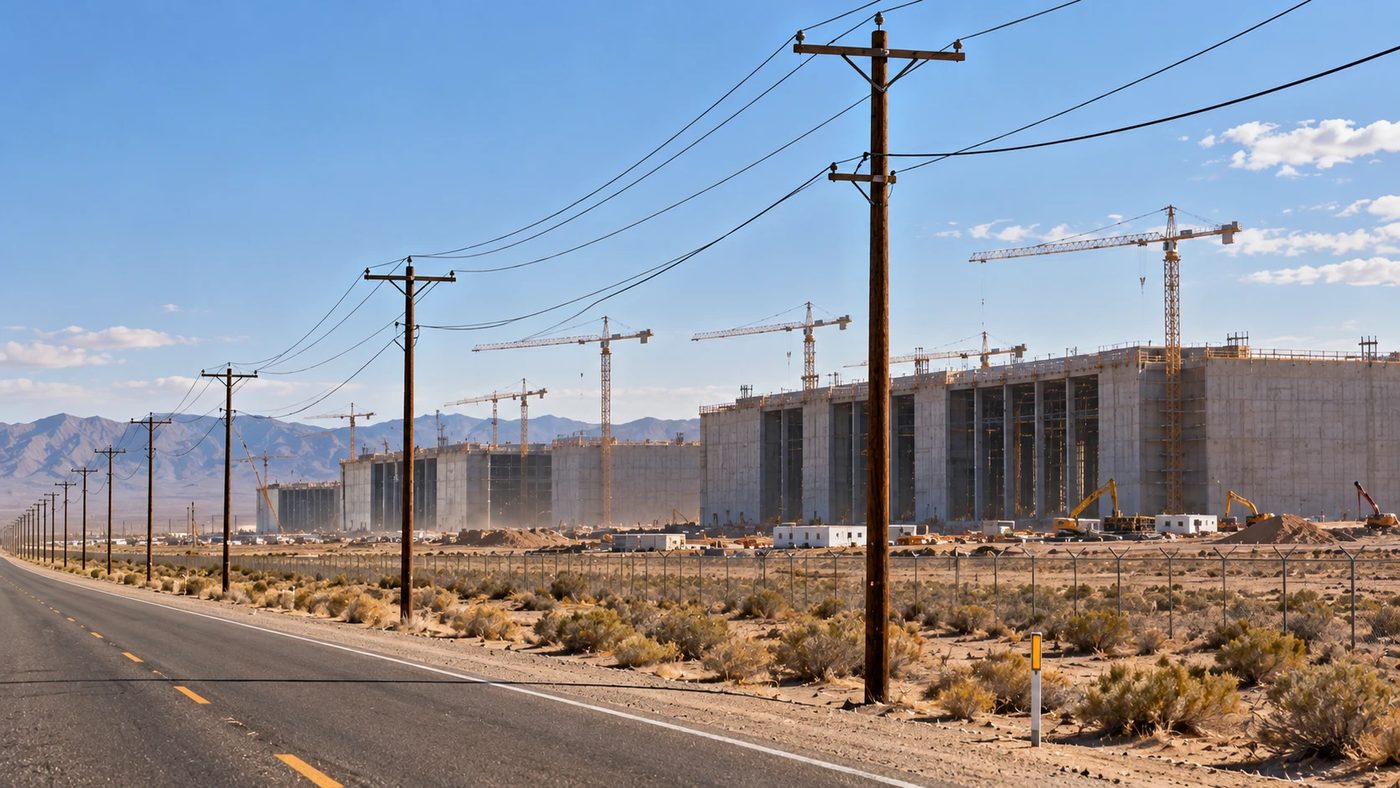
The local power lines are thin next to a campus that uses as much power as a mid-sized city.AI-generated illustration
Two ways to power a huge building: the shared power lines, which are not there, or power made on site from gas, which depends on a 17-mile pipe with about one mile of state land the state refused to open.
Two ways to get power. Jupiter plans to make its own from gas, and the gas pipe has about one blocked mile out of 17.Diagram drawn in code from the numbers in this article
🔍 Go deeper

For example, imagine you are building a house far out in the country. There are no power lines, so you plan to run a generator. The generator needs fuel, so you plan a fuel line from the road. Your neighbor owns a tiny strip of land the line has to cross. Your neighbor says no. Your whole house now waits on that one strip.

A campus that uses as much electricity as a mid-sized city cannot simply plug into the local power lines. The power lines near Jupiter are not big enough to carry that much electricity. So from the start, the plan was to make the power right there, on site.

The first plan was gas turbines. A turbine is a machine like a small jet engine. It burns natural gas to spin a part that makes electricity.

In April 2026, Oracle and BorderPlex switched that plan to fuel cells made by a company called Bloom Energy. A fuel cell still runs on gas, but it does not burn the gas. Instead, it uses a chemical reaction to turn gas into electricity. Searchlight New Mexico reported that this switch cut the campus's expected greenhouse gas output from about 14 million tons a year down to about 10 million tons a year. That is a cut of about 28%. Ten million tons a year is still an enormous amount of pollution, and fuel cells still need a steady supply of gas to run.

That gas was supposed to arrive through a brand-new pipeline called the Green Chile Lateral. It is a 24-inch-wide pipe, about 17 miles long, being built by a company connected to Energy Transfer. Most of its route crosses private land and federal land, which is not a problem. The trouble is about one mile of it, split into two separate stretches, which crosses state trust land. State trust land is land that New Mexico holds specifically to raise money for the state's public schools. To cross even a small stretch of that land, a company needs a right-of-way permit, which is official permission to build across someone else's land, from the New Mexico State Land Office.

The State Land Office said no, twice. On March 20, 2026, it told Energy Transfer's companies that their permit applications were canceled. The company asked the office to reconsider. On July 14, the office said no again, in a letter posted on its own website. The office's reasoning was about money for schools: crossing the land would earn the school trust only a one-time payment of about $32,000. On top of that one-time payment, the deal would only bring in about $43,000 a year. New Mexico's Land Commissioner, Stephanie Garcia Richard, told the trade publication NGI that "advancing the massive use of gas for a project of this scale is simply not in the best interest of the trust."

That refusal had a real effect on the schedule. Source NM reported that, in Energy Transfer's own federal filing, the pipeline's start date moved from about August 15, 2026, all the way to February 1, 2027. Some reports say the company is now trying to find a way around the state land instead of crossing it, but that has not been confirmed.

The pipe is not the only permit still open. The fuel cells also need an air-quality permit, which is a government approval that the pollution they release is within legal limits. That permit is still waiting at the New Mexico Environment Department, with a decision due by November 23. The case had its own detour: the state Supreme Court paused it in August, then let it move forward again on September 17. The officer in charge of the hearing stepped aside, and a new one, retired federal judge James Browning, was named in early October.

On top of all that, there is politics. Water use and air pollution have turned this project into a fight ahead of New Mexico's November 3 election. Source NM reported that Deb Haaland, the Democratic candidate for governor, has said that if she wins she would sign an order pausing new large data centers. She has not said whether that pause would reach Jupiter specifically.

Put it together: one of the biggest AI building projects in the entire country is sitting and waiting on a pipe, a permit, and the outcome of an election.

The key thing to remember: Without the gas pipe and the air permit, Jupiter has no power, and without power the buildings cannot earn anything.


Part 4 of 11

What the letter actually asks for

💡 What this part is about

Most big contracts have an escape hatch for disasters nobody could stop, like a flood or a war. If one hits, a company can be late without being punished. The fair question is always the same: was this really outside your control? Oracle's spokesman, Michael Egbert, says the letter is normal paperwork. The writer Julien Simon says Oracle is using the escape hatch for a problem the contract already made Oracle's own job.

A desert highway split by an earthquake crack with orange cones and a road-closed barrier.
Force majeure covers events nobody can control, such as wars, floods and natural disasters.AI-generated illustration
A calendar page Sept 10 definitely on track, a clock reading 14 days, and a calendar page Sept 24 the letter.
September 10: Oracle's co-CEO says “definitely on track.” Fourteen days later, on September 24, the letter goes out.AI-generated diagram
🔍 Go deeper

For example, say you agree to paint a fence by Saturday for $100. On Friday a big storm hits. Your contract says storms excuse you, so you can paint it next weekend instead. That is fair. But what if your contract also said you were in charge of bringing the paint, and you were late because you forgot to order it? Calling that a storm would be a stretch.

Force majeure is a French phrase. It means "greater force." Lawyers put a force majeure clause into most big contracts. It covers events that nobody could control, like wars, floods or natural disasters. If one of those events happens, the clause can excuse a company from a deadline, or from a payment, for a while.

Oracle did not walk away from the deal. It did not cancel its lease. It is still the main tenant at Jupiter. What the letter actually does is reserve a right. That means it locks in an option Oracle can use later, if it needs to.

That right could be worth a lot, because of how the rent works. Right now, before the buildings are finished, Oracle pays a lower, early-stage rent. Once the buildings are running, Oracle's full rent is supposed to start.

Now add the letter. Bloomberg reported, citing a person familiar with the matter, that Oracle could push back the start of its full rent by up to three years. That only happens if both Oracle and the owner agree a power-related force majeure event really happened. Until that is settled, Reuters reported, Oracle keeps paying the cheaper, early rent.

Bloomberg added one catch. Even if Oracle wins that delay, it is not sure to free Oracle from anything. Oracle would still owe full rent for the whole lease once payments begin. It would just start owing it later.

Oracle's own public line is that the letter is routine paperwork. Egbert said, "Force-majeure notices are commonplace in developments of this scale. They do not, by themselves, establish a project delay." Blue Owl, the owner's investor, said the notice "does not change the financial commitments to this multi-year project."

There is one part Oracle does not lead with when it talks about the letter. Reuters reported that under Oracle's own contract, Oracle carries full responsibility for securing power at the site. That is Oracle's job, written into the deal. And Oracle's own announcement from April 2026 said Oracle "will continue to bear all energy costs for Project Jupiter." So Oracle is pointing at a power problem as an event outside its control, on the one job the contract already made Oracle's responsibility. Julien Simon, a writer who covers the AI industry, made exactly that point in a piece titled "An Act of God With Letterhead."

Think about your own apartment lease. You do not send your landlord a letter warning about a flood you think will never happen. A company sends a letter like that because it wants a right sitting in its pocket, ready, before it actually needs it. The timing here is tight. On September 10, Oracle co-CEO Clay Magouyrk told investors the data center was "definitely on track." Just fourteen days later, on September 24, the force majeure letter went out.

The key thing to remember: The letter does not cancel anything; it keeps a door open for Oracle to pay full rent years later, over a problem that was Oracle's job to solve.


Part 5 of 11

Oracle's money problem

💡 What this part is about

A company runs short of cash when it spends more than it brings in. It fills the gap by borrowing, or by selling new pieces of itself, called shares. Lenders show their worry in a few ways. They give the company a worse grade. They charge it more interest. And they pay less when they buy its loans from each other. This part shows all of those happening to Oracle, plus a giant promise to pay rent that most people miss because it sits in the fine print.

Two bars for one quarter, 23.1 billion dollars in and 28.5 billion out, and two bars for last year and this year.
One quarter: $23.1 billion in, $28.5 billion out, about $5 billion short. Last year the gap was about $24 billion.AI-generated diagram
A pie on a plate being cut into many thin slices with a knife.
When a company sells new shares, the same company is cut into more and thinner slices.AI-generated illustration
🔍 Go deeper

For example, say you earn $1,000 a month and spend $1,200. You cover the gap with a credit card. You have also signed a lease on a second apartment that starts next year, and that rent does not show up on your card yet. When the bank looks at you, your card balance looks smallish. But the lease is a bill you already promised to pay.

Building AI data centers costs an enormous amount of money up front, long before any customer pays a cent. If you buy a house before you manage to sell your old one, you know this squeeze already. Oracle has to buy the computer chips and sign the building leases years before OpenAI's rent money actually arrives.

Start with the real numbers. In the three months that ended August 31, 2026, Oracle took in $23.1 billion in cash from running its normal business. In that same three months, it spent $28.5 billion building and buying equipment. Subtract those two: Oracle was about $5 billion short, in a single quarter alone. Zoom out to Oracle's whole last fiscal year, and the gap was about $24 billion. A fiscal year is a company's own 12-month money year, which does not have to start in January. Now look forward: S&P, one of the big companies that grades how safe debt is, expects the gap to widen to about $42 billion this year, because Oracle plans to spend $90 billion to $95 billion on building in that time.

Oracle fills a gap that size with other people's money, in two ways.

First, it sells new shares of its own stock. This year it sold $19.9 billion worth of new shares. Filing Insights, a research newsletter, found that Oracle started that stock sale one day after Larry Ellison set up his own separate plan to sell his personal shares. Nothing proves the two moves were connected, but the timing is close. If you already own Oracle stock, each new share Oracle sells makes your own slice of the company a little smaller, because there are now more slices to divide the same company into.

Second, it borrows. By the end of August 2026, Oracle's own quarterly filing says it owed about $125 billion in notes and loans. Notes are IOUs that investors can buy and sell. Add in the leases that are already sitting on its books, and the total climbs to about $169 billion.

But the much bigger number is tucked into a footnote, not the headline debt figure. Oracle's August quarterly report says the company has signed another $288 billion of leases, described as "substantially all related to data center arrangements," that have not even started yet. That number stays hidden for a simple reason. A company keeps an official list of what it owns and what it owes, called the balance sheet. Accounting rules do not put a lease on that list as debt until the lease actually begins. These particular leases are set to start sometime between now and 2029, and once they start, they will run for 15 to 19 years each. Compare the two numbers: $288 billion of leases not yet counted is more than double the roughly $125 billion Oracle has already borrowed. The number most people quote when they talk about Oracle's debt is the smaller one.

Lenders have noticed the strain, and it shows up in four separate warning signs.

  1. Credit rating. In July, S&P cut Oracle's credit rating to BBB-minus. That grade sits just one single step above "junk." Junk is the label for bonds that carry a real risk of not being paid back in full. Moody's, a different rating company, now has Oracle on a negative outlook, meaning it is watching for a possible cut too.
  2. Bond interest rates. A bond is essentially a loan that investors can buy and sell. Around September 24, some of Oracle's long-term bonds hit a record yield of about 8.3%, in market data that Bloomberg relayed. A yield is the interest rate a buyer demands in exchange for holding the bond. A higher yield means lenders are demanding more pay in exchange for taking on more risk.
  3. Default insurance. Investors can buy insurance, called a credit default swap, that pays out if a company fails to pay its debts. In September, the price of that insurance on Oracle's debt rose above 2 percentage points a year. That means insuring every $100 of Oracle's debt cost more than $2 a year. Fortune reported that insurance has not been that expensive on Oracle since the 2008 financial crisis.
  4. Loan price. The Jupiter construction loan tells the same story. On September 18, the Financial Times reported that banks including Santander and Jefferies were quoting the $18 billion in Jupiter loans at only 89 to 91 cents on the dollar.

The price fell because the banks got stuck. They had planned to sell pieces of the loan to other investors. Not enough buyers showed up. So the banks ended up holding more of the loan than they wanted.

If you held a piece of that loan, you could sell it for only about 90 cents for every dollar you were owed. Buyers pay less when they think they might not get all their money back.

The timing matters too. That 90-cent price showed up six days before Oracle's letter. So lenders were worried first. The letter only confirmed what they already suspected.

It is also important to be fair about what this is not. Bloomberg reported that the letter "does not constitute an event of default" on the loan, meaning it is not a default, and the loan is still being paid on schedule. A 90-cent quote is a price investors are willing to pay, not proof of an actual loss. But prices like that are usually where real trouble shows up first, before anything officially breaks.

The key thing to remember: Lenders were already nervous about Oracle before the letter, and the biggest bill, the $288 billion of unstarted leases, does not even show up in the debt number most people quote.


Part 6 of 11

One customer, half the orders

💡 What this part is about

A backlog is work a company has been promised but has not done yet. It sounds like money in the bank, but it is only as good as the customers who promised to pay. When one customer makes up a big share of it, the whole pile depends on that one customer. For Oracle, that customer is OpenAI, the company behind ChatGPT. And OpenAI pays mostly with money from its investors, not from profits.

Investors in suits at a long boardroom table sliding stacks of cash toward the center, one hand stopped mid-slide.
Oracle's biggest customer, OpenAI, pays largely with money it raises from investors.AI-generated illustration
🔍 Go deeper

For example, a bakery has orders for 100 cakes. Fifty of them come from one restaurant. That restaurant pays for its cakes with money from investors, not just from selling meals. If those investors ever slow down, the restaurant may cancel, and the bakery loses half its orders at once.

In September 2025, Oracle and OpenAI signed a cloud computing deal. The Wall Street Journal reported it at $300 billion, spread over five years, starting in 2027. One single contract like that changed the shape of Oracle's whole future business overnight.

When a company signs a deal to do work in the future, the total money it expects from signed-but-not-yet-done work is called its backlog. Oracle now says its backlog is $664 billion. Back in July, when S&P cut Oracle's credit rating, the backlog stood at $638 billion, and heise reported that analysts estimated about half of that backlog was owed by OpenAI alone. S&P itself called OpenAI a "central credit risk" for Oracle, meaning OpenAI's own ability to pay is one of the biggest dangers hanging over Oracle's finances.

That one customer matters this much for a simple reason. If you are counting on Oracle's backlog, you are really mostly counting on OpenAI. And OpenAI pays its bills largely with money it raises from investors, not from profits yet. In 2025, OpenAI also announced huge deals with Nvidia, AMD, Broadcom and CoreWeave. To pay all of those bills, OpenAI depends on new funding rounds, backing from SoftBank, its deal with Microsoft, and maybe a stock market listing someday.

Put the two companies together and you can see the shape of the risk. Oracle borrows money to build computers for a customer. That customer, OpenAI, pays its bills mostly with money raised from its own investors. Each side's numbers look fine only as long as the other side keeps going.

The key thing to remember: A big part of Oracle's future depends on one customer, and that customer depends on investors.


Part 7 of 11

Larry Ellison's shares

💡 What this part is about

You can borrow money by handing over something valuable as backup. If you do not pay, the lender keeps the backup. Using stock as that backup is called pledging. The danger is that stock prices move. If the price falls, the backup is worth less, and the lender can demand more or sell it. Larry Ellison, who started Oracle and owns a huge share of it, has pledged a big pile of his Oracle stock. He also set up a plan to sell some, then canceled it.

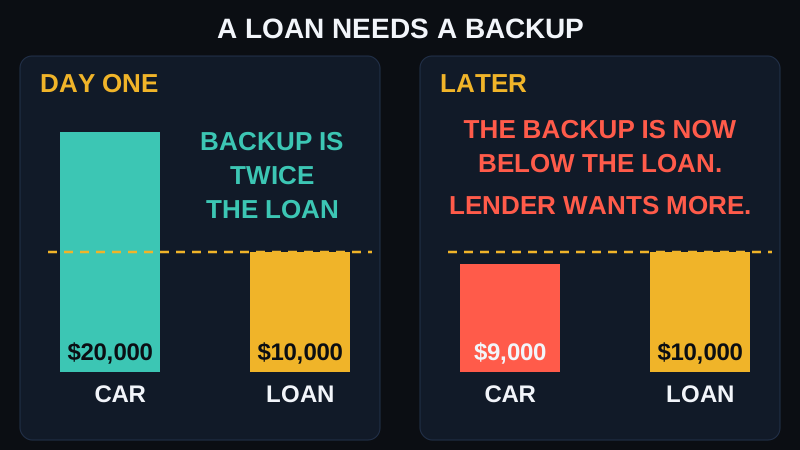
A loan with a backup. A 20,000 dollar car backs a 10,000 dollar loan. Later the car is worth 9,000 dollars, which is below the loan, so the lender can ask for more.
A loan with a backup. If the backup falls below the loan, the lender can ask for more. Ellison's backup is Oracle stock.Diagram drawn in code from the numbers in this article
A loop of four steps: stock falls, lender calls, shares sold, stock falls more, each one feeding the next.
The margin-call chain: the stock falls, the lender calls, shares are sold, the stock falls more.AI-generated diagram
🔍 Go deeper

For example, say you own a car worth $20,000 and borrow $10,000 using the car as backup. If the car's value drops to $9,000, the lender gets nervous. They ask you to pay some back or give them more backup. If you cannot, they can take the car and sell it. With Ellison, the car is a giant pile of shares, and selling them makes every other share worth less.

Larry Ellison co-founded Oracle, and he is its chairman today. According to Oracle's proxy statement, a document companies file with regulators, filed in late September 2026, Ellison owns about 38% of the entire company. In actual shares, that is about 1.16 billion shares.

The risky part is what he did with them. Ellison has pledged 413 million of those shares as collateral for personal loans. Pledging means using the stock as backup, so if he cannot repay the loan, the lender can take the shares instead. That 413 million is more than a third of his entire stake in Oracle. It is also 67 million more shares than he had pledged a year earlier. At Oracle's closing stock price on September 25, those pledged shares were worth about $9.2 billion. Oracle's board says the loans fund Ellison's "outside personal business ventures." CNBC has reported that Ellison has helped finance the Skydance and Paramount merger, which is run by his son David Ellison, and that he is backing a bid for Warner Bros. Discovery.

This matters extra because of a rule Oracle itself has. Oracle's own policy bans every employee and every director from pledging company stock as collateral, with exactly one exception. Oracle's proxy summary spells that exception out directly: the policy is "applicable to all employees and directors except Mr. Ellison."

Why should anyone else care about one man's personal loans? Because a loan backed by stock is only as safe as the stock's price. If Oracle's stock price falls far enough, the pledged shares stop covering the loan. At that point, the lender can demand more cash or more shares to make up the difference. That demand is called a margin call. If the borrower cannot meet it, the lender is allowed to sell the pledged shares itself.

Walk through how that chain could play out, step by step. First, Oracle's stock price falls. Second, a lender asks Ellison for more collateral. Third, if Ellison cannot or will not provide it, hundreds of millions of his shares could be sold onto the market all at once. Fourth, selling that many shares at once pushes the stock price down even further. Fifth, that drop weakens whatever collateral is left, which can trigger yet another margin call. This is not a far-off, hypothetical picture: Oracle's stock was trading around $145 in early October, which is about 55% below its high of $322.54 set the previous fall.

Oracle's board has an answer to this worry. It says none of Ellison's pledged shares sit in a margin account, and it says it "believes that Mr. Ellison has the financial capacity to repay his personal term loans without resorting to the pledged shares." Given that Ellison is one of the richest people on Earth, that may well be true. Even so, it is still a bet that rests on one man's other businesses holding up, sitting underneath the stock of a company that is already borrowing record amounts of money.

Then there was a separate sale plan, on top of the pledged shares. On June 22, Ellison set up a plan to sell up to 50 million Oracle shares, worth about $7.5 billion, with a deadline before October 24. Plans like this, called 10b5-1 plans, let company executives schedule stock sales ahead of time, on a fixed calendar. CNBC noted something unusual about this one: according to FactSet's records, Ellison had not sold more than 25,000 shares at once at any point this century, before this plan.

Shareholders only learned about the plan on Friday evening, September 11, when it showed up buried in one of Oracle's regular quarterly filings. The very next day, a Saturday, Oracle announced that Ellison had already canceled it. The company said, "No Oracle stock was sold under the plan," and that Ellison "has no other plans to sell." By the time of that cancellation, Reuters reported, Oracle's stock price was already more than 18% below where it had closed on the last trading day before the plan was first set up. Reuters tied that drop to worries about Oracle's spending and cash, not to the sale plan itself.

So in the end, no shares were actually sold. But a plan like that is still a signal, even when it is canceled. The person who knows Oracle best, the same man asking investors to back one of the most aggressive AI building projects in American business, had quietly put himself in position to sell $7.5 billion worth of his own stock. Twelve days after he canceled that plan, the force majeure letter went out.

The key thing to remember: Ellison's pledged shares tie his personal loans to Oracle's stock price, so a falling price could force sales that push it lower still.


Part 8 of 11

The stack of promises

💡 What this part is about

When a lot of people are each waiting on someone else to pay them, that is a chain. A chain is only as strong as its weakest link. If one person pays late, everyone behind them gets paid late too. This part lines up every group in the Jupiter story, from the banks to OpenAI's investors, and shows which link is weakest right now: the power that is not switched on yet.

Five colored layers stacked on a gas pipe labeled February 1, 2027 with a permit stamp for November 23.
The stack of promises, bottom to top: banks, owner, Oracle, OpenAI, investors. It all rests on a gas pipe due February 1 and a permit due November 23.AI-generated diagram
🔍 Go deeper

For example, five kids each borrow a dollar from the kid next to them, promising to pay back after the last kid gets an allowance. If the last kid's allowance comes on time, everyone gets paid. If it is late, every kid in the line is late too.

Lay the whole chain out from the bottom up, because each layer only holds up if the layer above it pays.

  1. The banks get paid only if the builder, STACK, collects rent.
  2. The builder collects rent only if Oracle pays.
  3. Oracle pays only if OpenAI pays Oracle for computing power.
  4. OpenAI pays only if its own investors keep writing it checks.
  5. And none of this really gets going until Oracle's full rent starts, which does not happen until the campus actually switches on.

If you pull out any single layer, every layer underneath it feels the loss. Picture it like a stack of chairs, where each chair is resting on the chair above it instead of the ground. It holds together as long as nobody moves. Right now, the entire stack is resting on something far plainer than computer chips or AI models: a gas pipe in the desert that is now due February 1, 2027, and an air permit due by November 23.

To be fair, nothing here says Ellison did anything illegal. The point is simply how much of this giant structure rests on a small number of people's choices. Billions of dollars in debt, buildings, and stock value can all move based on what one man decides to do with his own shares.

It is also worth noticing where this warning came from. Most earlier warnings about the AI building boom came from short sellers, who are investors that make money when a stock goes down, and from analysts and commentators. All of them were standing outside the actual deals. This warning is different. It came from inside: a company in the middle of the chain told its own partners, in writing, that one piece might not arrive on time.

The chain could unravel one step at a time. This is a list of things that could happen, not a prediction that they will. If the power is late, Oracle's rent-delay right could kick in. If rent gets delayed, the owner's payout gets delayed too, and the construction loan stays under stress. If Oracle's costs keep running ahead of the cash it brings in, rating agencies could cut Oracle's grade all the way to junk. A downgrade to junk would push about $120 billion of Oracle's bonds out of the investment-grade indexes, according to market reports. Those indexes are lists of safe-rated bonds that many investment funds are required to stick to. Those funds would then be forced to sell those bonds. Forced selling like that makes it more expensive for Oracle to borrow, exactly when Oracle needs to borrow the most. And a falling Oracle stock price brings Ellison's pledged-share chain back into play, too.

None of those steps has actually happened yet. But every single one of them is now a real, open door.

The key thing to remember: Every group in the chain is waiting on the one above it, and the weakest link right now is the power that is not switched on yet.


Part 9 of 11

Oracle's case

💡 What this part is about

Being fair means hearing the other side at its best. A business can be selling more than ever and still be short on cash, because the bills come before the sales money does. Oracle has strong sales and strong demand, and its leaders, like co-CEO Clay Magouyrk, say the worry is overblown. Some outside experts agree. This part lays out their best points, then shows why good sales do not answer the money question.

Both are true. Oracle is selling more than ever: sales up 30 percent, cloud up 121 percent, profit up 60 percent. And in one quarter 23.1 billion dollars came in while 28.5 billion went out, about 5 billion short.
Both are true: Oracle's sales are up, and its cash still goes out faster than it comes in.Diagram drawn in code from the numbers in this article
🔍 Go deeper

For example, a lemonade stand has a line around the block. Business is great. But the owner bought ten new stands with borrowed money, and they are not open yet. Both things are true at once. Lots of customers want lemonade. And the owner still has to pay back the loans before the new stands make money.

Oracle has real, strong numbers on its side, and they deserve a fair look. Two weeks before the force majeure letter, Oracle reported its latest quarter of results. Revenue, meaning total sales, was $19.3 billion, up 30% from a year earlier. Its cloud infrastructure business, the part that rents out computer power, grew 121% in that same year. Oracle signed more than $30 billion of new AI contracts in the quarter, raised its own forecast for the future, and said it had delivered 850 megawatts of new computing capacity. A megawatt is one-thousandth of a gigawatt, so that is about a third of the power Jupiter alone is supposed to use. Oracle said customer demand "continues to grow faster than supply." Net income, the profit left after every expense, was $4.7 billion, up 60% from the year before.

Oracle's leaders and partners back up that confident picture. Co-CEO Clay Magouyrk argued on the earnings call that any plan requiring "100% achievement of every one of their deliverables" is "a bad plan," which is exactly why a company builds in some slack ahead of time. Blue Owl said all the partners involved are "fully aligned." Bloom Energy, the fuel cell maker, said on social media that it remains committed and on schedule. After a flood reached the construction site on September 30, both Oracle and STACK said that no critical infrastructure had been damaged.

Outside analysts back up parts of that story too. William Blair, an investment firm, kept its buy rating on Oracle stock and told Reuters it saw little effect on this year's revenue. A Motley Fool writer argued on September 30 that Oracle's 8% bond yields are "an Oracle problem, not an AI problem," reasoning that bigger companies like Microsoft, Alphabet, Amazon and Meta can simply pay for their own data centers out of their own cash, instead of borrowing. Even Filing Insights, the newsletter that first connected Oracle's stock sale timing to Ellison's plan and is generally skeptical, called the Jupiter delay a case of "supply struggling to come online on schedule, not demand collapsing."

That last point is fair, and worth sitting with. Plenty of people, maybe including you, want exactly what Oracle is building. But that strength actually sharpens the real question instead of erasing it. If demand for AI computing power is genuinely this strong, and Oracle still has to lean this heavily on borrowed money, nervous lenders, and one dominant customer, then the risk is not whether AI itself is useful. The risk is whether Oracle's money holds out long enough for the buildings to actually turn on.

The key thing to remember: Strong demand does not erase the risk; it just means the real question is whether the money lasts until the buildings turn on.


Part 10 of 11

What this means for you

💡 What this part is about

Most people own tiny pieces of hundreds of companies without ever picking one. That happens through retirement accounts and funds that buy a little of everything. So when a big company like Oracle gets in trouble, a small part of the hit spreads to millions of savers. This part shows the paths from Oracle to your money, and why New Mexico voters get a say on November 3.

Three pipes labeled S&P 500 index fund, target-date fund and bond fund pour Oracle coins into a jar labeled 401(k) you.
Three ways Oracle can reach a 401(k): an S&P 500 index fund, a target-date fund and a bond fund.AI-generated diagram
🔍 Go deeper

For example, you put $100 a month into a retirement fund that buys a little of the 500 biggest U.S. companies. You never picked Oracle. But Oracle is one of those 500, so a small slice of your $100 is Oracle stock. If Oracle drops, your fund drops a tiny bit too.

You may believe you have never bought a single share of Oracle stock on purpose. You probably own some anyway. Oracle is one of the companies in the S&P 500, a list of 500 of the biggest U.S. companies, so any S&P 500 index fund automatically holds a slice of Oracle. Many target-date retirement funds, the kind that adjust automatically as you age, also hold Oracle through the stock funds inside them. Oracle's bonds sit inside plenty of bond funds that specialize in buying investment-grade debt, meaning debt rated safe enough for conservative investors. If Oracle's rating were cut down to junk, the funds that are required to only hold safe-rated debt would have to sell, and a lot of those funds live inside ordinary 401(k) retirement plans.

There is another path too. Banks and private credit firms, which are lenders that operate outside the regular banking system, are the ones carrying the Jupiter construction loan. If a project like this one stumbles, those losses do not just disappear. They travel into the very funds and pensions that invested in private credit specifically to chase higher returns.

If you happen to live in New Mexico, this story is literally on your ballot. The property tax break, the water use, the air pollution permit, and a possible pause on new data centers are all live, contested questions in the November 3 election. Remember that the tax deal pays about $12 million a year, most of it to the county and some to schools, and that payment only keeps flowing if the project actually moves forward.

And even if none of that applies to you directly, if you simply use AI tools at all, know that the cost of building them is not only paid in dollars today. A large share of it is paid with borrowed money that still has to be paid back later, by companies like Oracle, whose stock is very likely already sitting somewhere inside your own savings.

The key thing to remember: Even if you never bought Oracle, your retirement savings probably hold a piece of it.


Part 11 of 11

What to watch next

💡 What this part is about

A plan with lots of deadlines works like a row of dominoes. If an early one falls late, every one after it moves too. Jupiter's power depends on a few dates that are already set: an election, a permit decision, a company report, and the day the gas pipe is due. This part tells you what each date decides, so you can judge for yourself whether the plan is still on track.

A desk calendar with four pins: Nov 3 vote, Nov 23 air permit, December Oracle report, Feb 1 2027 pipe, and a clock reading 3 years.
The dates to watch: November 3 vote, November 23 air permit, December Oracle report, February 1, 2027 pipe.AI-generated diagram
🔍 Go deeper

For example, say you are baking a cake for a party at 6. The flour has to arrive by 2, the cake has to bake by 4, and the frosting has to cool by 5. If the flour shows up at 3, nothing after it can be on time. The flour date matters most, because everything else waits on it. For Jupiter, the gas pipe is the flour.

Mark these dates on a calendar if you want to follow how this story actually ends.

  • November 3: This is the date New Mexico picks its next governor. A pause on new large data centers is on the table, depending on who wins.
  • November 23: This is the state's deadline to decide on the fuel cell air-quality permit.
  • Early December: This is the deadline for other agencies to decide on the pipeline's federal permits, based on Julien Simon's reading of the official filings.
  • Around December: Oracle is expected to report its next quarterly results. Watch three things specifically: how big the cash gap is, how much new debt Oracle has taken on, and whether the $288 billion pile of unstarted leases has grown even larger.
  • Any time, in Oracle's regular filings: watch for any new stock sale plan from Ellison, or any further change in how many shares he has pledged.
  • February 1, 2027: This is the pipeline's current planned start date. If that date slips again, the three-year clock written into Oracle's force majeure letter starts to actually matter.

Oracle may turn out to be right that the letter was just routine paperwork. But paperwork like this is exactly how companies get ready for something they think could happen. For now, one of the biggest AI projects in the entire country is sitting and waiting on a pipe.

The key thing to remember: Watch the permits and the pipe; they decide whether Jupiter turns on, and that decides whether the stack of promises holds.


Sources

Pictures and diagrams support the lesson. Every number here is in the lesson text and in the sources above.
0:00